‘It’s the best of both worlds’: Adrian Quesada’s latest album revisits psychedelic ballads

Quesada talks “Boleros Psicodélicos II,” an Oscar nomination and embracing solo work under his own name.

By David BrownJune 23, 2025 9:00 am, ,

Adrian Quesada used to be considered a kind of underground hero of the music scene in Austin, once upon a time – one of the city’s most prolific musicians, to be sure.

But these days he’s enjoying the national spotlight, and his latest album has been generating buzz and excitement for months in anticipation of its release. 

Quesada joined the Standard to talk about the sequel to his 2022 psychedelic opus “Boleros Psicodélicos,” out June 27.

This transcript has been edited lightly for clarity: 

Texas Standard: “Boleros Psicodélicos II” – for those unfamiliar with the concept, how do you go about explaining it to people who haven’t spun the album? 

Adrian Quesada: You know, it’s a loose, loose kind of genre term, but I’ve learned it’s kind of easier sometimes to try to come up with a way to explain it to people. But it’s below the Latin American ballads. 

And psicodélicos obviously means psychedelic. So it’s kinda a sort of loose explanation for what’s happening on the album. It’s all generally inspired by this, you known, movement from the late ‘60s, early ‘70s where bands from Latin America were playing these traditional boleros in a more psychedelic fashion. 

It was music that greatly influenced everything I’ve done in the last 20 years. You know, I’ve always wanted to kind of pay homage to it. I did on volume one, which I recorded during the pandemic. 

And this time around, it’s more like, it’s less of a tribute or homage as it is just me, you know, continuing to write music that’s inspired by that but trying to see where I can take it. 

» MORE: Adrian Quesada conjures new grooves from bygone Latin beats on ‘Boleros Psicodélicos’

I think when a lot of listeners hear that phrase, psychedelic music, that means one thing. But this is a completely different and rather unique deep track genre, I would say, right? 

Probably one of the most well-known across the world is this group from Chile that eventually moved to Mexico called Los Angeles Negros. It means the Black Angels, no relation to Austin’s Black Angels. 

They were playing these songs, but they were playing with an electric guitar, with a combo organ, a lot of reverb, a lot of, you know, echo and all these like trademarks from what was psychedelic music at the time, but playing these beautiful songs. 
And I love the sounds of it: I love texture, the vibe, the aesthetic, but what I love about this intersection of these two things is that you have these songs that if you strip it away, they’re actually incredibly written ballads. So it’s like best of both worlds to me: They’re actual, like, amazing songs with all the aesthetic and the heavy vibe that I love from psychedelic music.

I actually didn’t discover this music until – it might have been a little over 20 years ago, maybe 22, 23 years ago. I was actually right here. I used to live right here near the campus where we’re taping this at KUT, University of Texas.

And I was driving one day listening to one of the AM Spanish radio stations, and they played a song by a group called Los Pasteles Verdes. I had never heard anything like that. I heard a song called “Esclavo Y Amo.” I literally pulled over off the side of the road.

I had just gotten a cell phone and waited on the radio station until they gave the phone number so that I could call them and ask what that was, and it just blew my mind. I drove around town all day the next day trying to find it.

A lot of that music has now been reissued and is easier to find on Spotify, but back then was not easy to find. I remember going to Waterloo, didn’t find it there. I went to a mom-and-pop store on South Congress here in Austin that sold all Spanish-language music and found a greatest hits CD of Los Pasteles Verdes. And that just changed my world and my musical direction.

» GET MORE NEWS FROM AROUND THE STATE: Sign up for Texas Standard’s weekly newsletters

You know, I heard you were coming to the studio, and I had a flashback. I guess it must have been around 2008 or something, and I was doing a lot of music journalism. And you had released with Grupo Fantasma, which was one of your earlier bands, “Sonidos Gold” – very heavily Latin; you had a lot of really sort of big band-almost sound.

Even then, it was clear that you were going to be a leader in this scene. And given how much you do – you know, forming new bands, collaborating, recently best original song, the Academy Awards nominee for “Like a Bird” – where do you draw inspiration from? Does it tend to be from the older, the funkier, the soul-leaning stuff? Does it go beyond music?

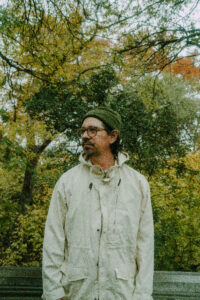
Credit: Jackie Lee Young

You know, sometimes it doesn’t always come from music. I remember during the pandemic I just kept thinking, like, I want to find another hobby, something that is not music.

But what would ultimately happen is I would be on a bike ride or walking in nature or something, and something in nature would inspire me to be like, “Oh, man, now I need to get back to the studio and do something.” So it’s like no matter what I try to do to distract myself, I get inspiration that makes me want to go make some music

I mentioned “Like a Bird” from the movie “Sing Sing.” It was nominated for outstanding original song at the Black Reel Awards, best original song at the Houston Film Critics Society Awards, and of course, for an Oscar.

I would have to give a lot of credit to Abraham Alexander. We met director Greg Kwedar a couple years ago. They were wrapping up “Sing Sing.” I had lunch with him, and he told me that they had a score done by Bryce Dessner, an incredible score. But no songs in the film.

So he was like, we need a song for the last scene, and it’s gonna be the only song in the film.

There was a lot of things that were super serendipitous. For example – well, this is just one of the many things that was insane how much this was meant to be – we weren’t able to see the whole movie when we did that song.

We had a short kind of trailer of it, and then we had the last scene, because we didn’t have a lot of time. So we had that scene and I just watched it over and over and started mapping out a rhythm and tapping out a feel until I started to write a little instrumental underneath it.

» MORE: Why Colman Domingo says ‘Sing Sing’ is not a ‘prison movie’

Abraham wrote the lyrics and the concept of “Like a Bird” and obviously that imagery. We had a screening right before the Oscars in Dallas where we sat there and watched it with the audience. Obviously we’ve seen it now a bunch of times since. But somebody in the audience pointed out how much birds figure in the imagery of the film. And they were like, was that what inspired the lyric? And well, the crazy thing was that this Q&A, we were like, we actually had not seen the film before we wrote that.

And that’s just one example of like, how there was just so much that came together beautifully that sometimes you just can’t force that.

Well, congratulations on all the critical acclaim that that song has received. You know, all the projects that you’ve been associated with – you go back to Ocote Soul Sounds, which got a lot of attention back, gosh, 20 years ago, I guess? And then, of course, Grupo Fantasma. I remember seeing you guys on stage at ACL Fest, I believe it was.

We played the very first ACL fest, and then we played another one later.

That’s crazy. It’s hard to believe. And then, of course, you’ve gone on with Black Pumas and others and this incredible solo career.

 Why do you do these things in pockets like that? Why isn’t this one umbrella – maybe it is – of Adrian Quesada, but instead it seems like you have several different branches of Adrian Quesada. You know what I’m talking about?

Yeah, I mean, I can’t take sole credit for any of the bands that I’ve been in by any means. But putting my name on the projects has honestly been – it’s kind of a vulnerable feeling. I’ve never liked that kind of attention.

And people for years used to ask me, “why don’t you just put your name on it?” And I think it got to a point where I’ve been in so many bands – even bands I didn’t start, that I just happened to be involved with – that people would see my name with a band and think I started a band just for the shock value of starting another band.

So I think I exhausted my bands. Record label and management and people were like, you know, it’s just a lot easier to find stuff when it’s under your name. So it was just a few years ago that for the first time I put my name on something, and it’s a strange feeling, but I’m getting used to it.

I want to ask you about that, just to dig a little deeper. I mean, it sounds like what you’re saying is you didn’t feel completely comfortable or, I don’t know, a certain degree of insecurity. What’s that about?

Yeah, it’s not my style, I’ve always been a little more behind the scenes and not necessarily an extroverted, like, look-at-me type person. But I love to create art. I love for people to listen to it. So I got to a point where I was like, okay, that’s the easiest way for people to find it and for people listen to it.

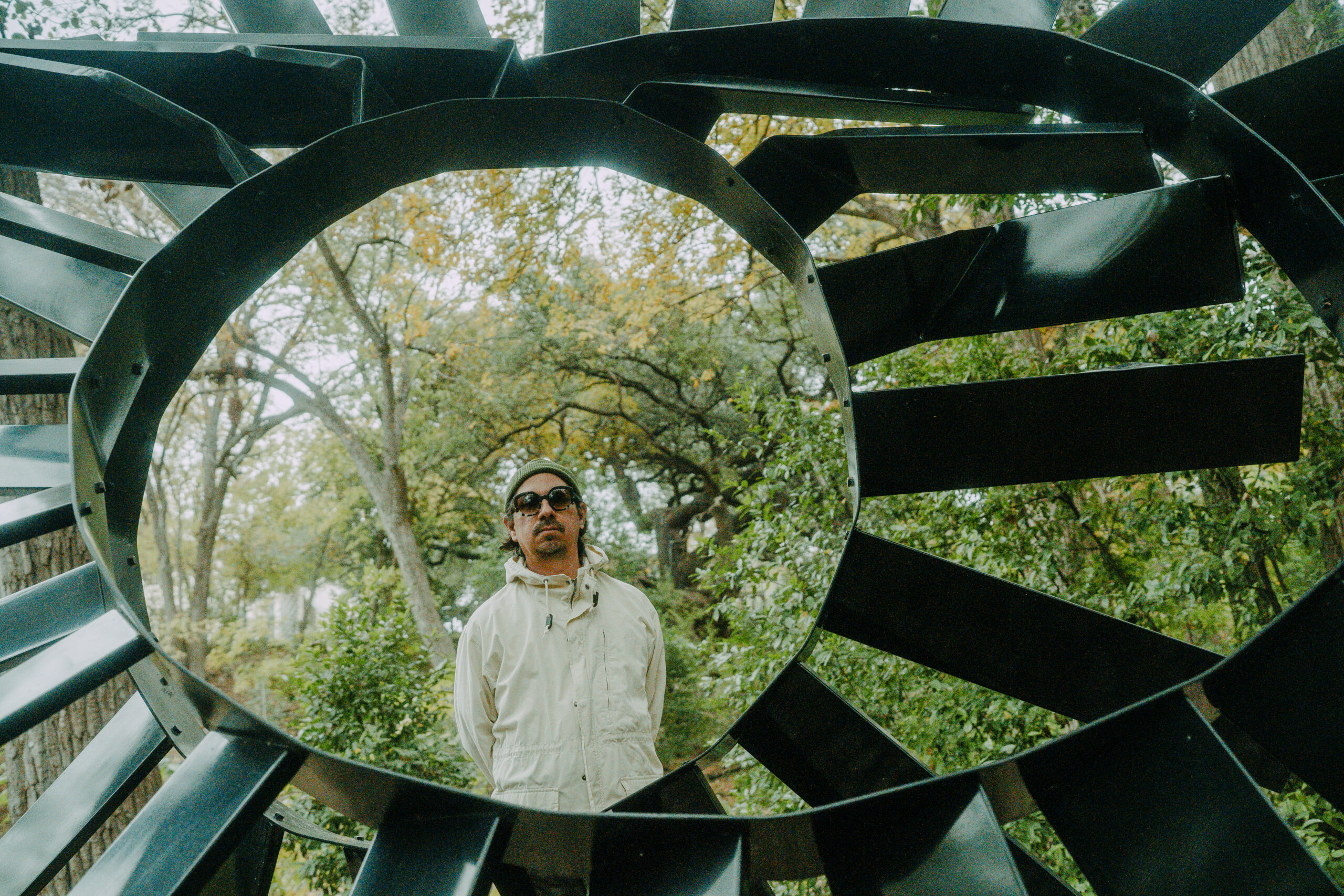
Photo by Jackie Lee Young; stitched by Victoria Villasana

And then I just sort of embraced it after I did two albums under my name. I was just like, what the hell, why not? Why hide behind another band name?

But sometimes I think about it too – it’s just kind of fun to create these little worlds for people to dive into. I have some friends that are collaborators, not necessarily in Austin but around the world, that record under like eight different names. And it’s kind of fun to just create those aliases and a whole other world and stuff like that.

But I do realize that it muddies the water and it makes things really complicated. And at this point I’m just – if it’s my own thing, I’m just going to use my name.

Listen to an extended interview with Adrian Quesada in the audio player at the top of this story.

If you found the reporting above valuable, please consider making a donation to support it here. Your gift helps pay for everything you find on texasstandard.org and KUT.org. Thanks for donating today.