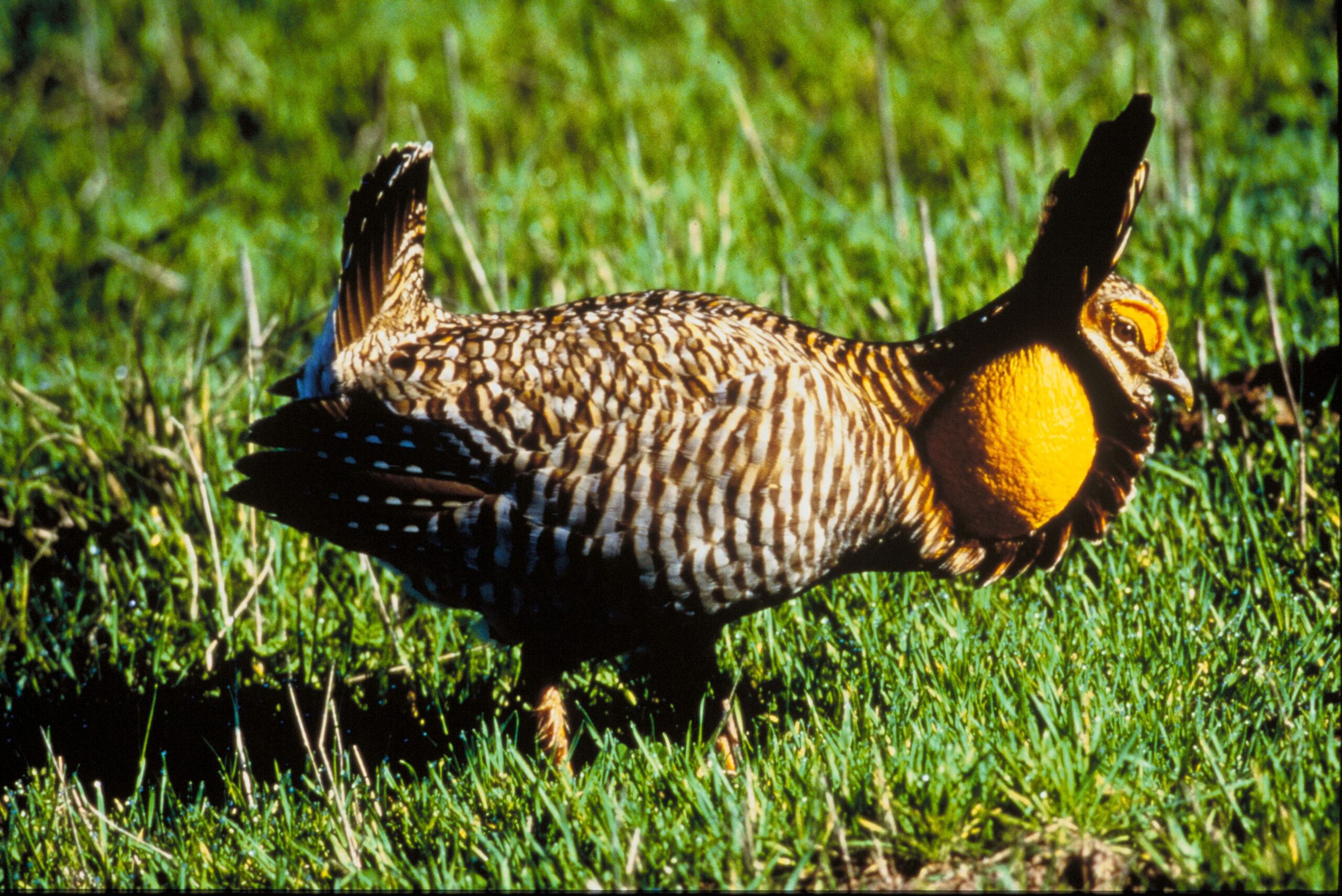
For the next few weeks, a tallgrass prairie outside Goliad will host a dance party: That is, a male Attwater’s prairie chicken, one of the rarest birds in Texas, dancing to attract a mate.
In addition to stomping, the chickens inflate two giant orange sacks on either side of their face as part of the dance. It’s quite a sight and it’s happening right now at one of very few places left in the world where these chickens still live.
Kirk Feuerbacher, working lands program director at the Nature Conservancy, joined Texas Standard to discuss. Listen to the interview in the player above or read the transcript below.
This transcript has been edited lightly for clarity:
Texas Standard: There are very few Attwater’s prairie chickens left in the wild. Why are they endangered and where can we still find them?
Kirk Feurerbacher: Well, they’re a coastal prairies and marshes species endemic to this area along the coast. And the reason why they’re so rare is because about 98% of their habitat has been changed over to something else.
So it’s this special kind of land that they need, and I understand the Nature Conservancy is working with these chickens in this Coastal Bend area of Texas. Can you tell us more about that property?
For almost 20 years, we’ve been working on a private lands property south of Goliad, and we’ve be releasing those Attwater’s prairie chickens every year, with some varying success.
And the thing is, is that these private landowners have really done a good job of managing their land, and they’re the key component to this project. They’re working with the native ecosystem to maintain their ranching heritage and supply food border by eye quality, biodiversity and carbon sequestration for society.
So how has this population grown since you started the project?
Um, it’s been hit and miss, obviously. Wet years are actually worse for these birds along the coast just because they nest on the ground and when it rains a lot, their nest can get inundated and chill the eggs and kill them. But typically, when it’s dry like it has been, we’ve actually increased quite a bit.
We’ve got to always deal with predators, or the chickens have to deal with the predators, but we just supply the good habitat for them to live in. And then we release birds every year in July and hope that about 17 to 30 percent survive.
And they’ve been increasing about 20 percent every year. Last year was 102 males on the booming grounds that we counted and this year is 138.
» GET MORE NEWS FROM AROUND THE STATE: Sign up for Texas Standard’s weekly newsletters
Well, these birds are special and this dance ritual is especially so. The males do this really wild-looking dance. Can you just describe that a little more? And I guess they only do this for a couple of weeks.
Really it’s a couple of months about from February. They start in January, but really from February on into May some, depending on the weather and such and whether or not the hens are nesting.
But from February to May, the males display on a booming ground to attract and breed females. They’re pretty vivacious in their efforts. They stomp their feet and they have their tail feathers up. And they’re called “pinnated grouse” — they have ear feathers right there above those orange air sacs that you described.
And so they’re sitting up like that with that, and they drop their wings down and blow those air sacs open and they do a “woo-woo” booming sound. And it’s really something. In fact, when you get a group of them together, you can hear those birds for up to two and a half to three miles.
Well, you guys have done so much to help these Attwater’s prairie chickens, and they seem like they’ve needed it. But I guess what service does that provide for the broader ecosystem?
I think so much of our land is getting fragmented and turned over into other things. And I think that working with these landowners and giving them a reason to try to maintain this property, the properties that they own in a large scale is very important for these ecosystem services, such as biodiversity.
Prairie chickens had to have up to 10,000 and 20,000 acres to have a really viable population. And scale is everything, so when that scale gets decreased, it’s tough to have a viable population.