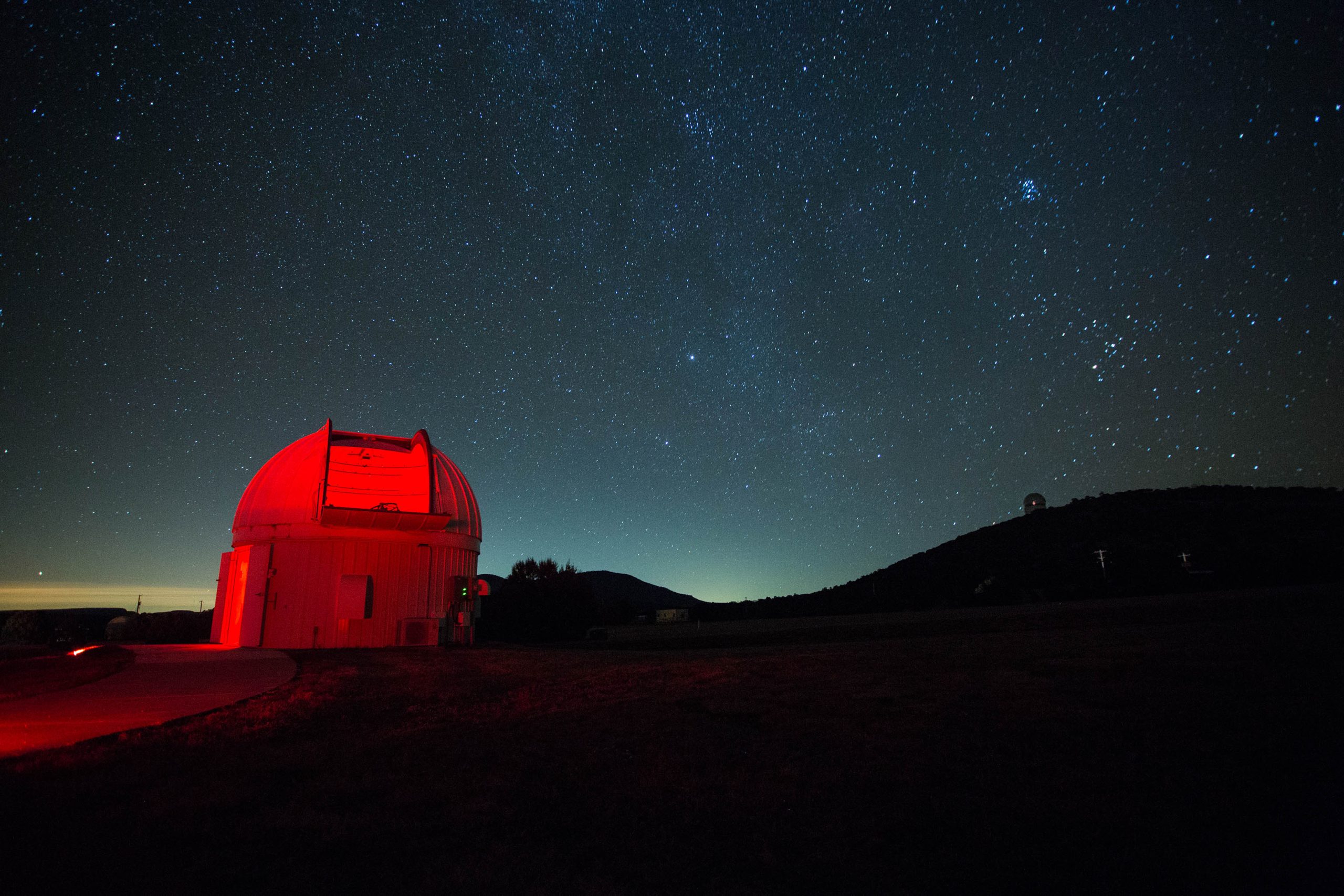
Among the many reasons people love far West Texas is the dark skies over the Big Bend region. It’s a wide-open pool of stars, complete with the Milky Way.
The skies there are some of the darkest in the continental U.S.
The McDonald Observatory, situated in the region, relies on those dark skies to study deep space astronomy — including dark energy, distant galaxies and exoplanets.
Now, many in the region fear President Trump’s plan to build a new border wall in the region will flood the area with light pollution. Dark sky defenders are sounding the alarm.
Katrina Miller sat down to discuss the issue with the Standard. Miller covers science for the New York Times. Listen to the interview in the player above or read the transcript below.
This transcript has been edited lightly for clarity:
Texas Standard: What did you learn about the importance of protecting dark skies in West Texas?
Katrina Miller: West Texas is home to the largest dark sky reserve in the world, and that enables cutting-edge astronomy research at McDonald Observatory in Jeff Davis County. It has also strengthened a decades-long commitment from residents in the Big Bend region who cherish and culturally identify with the ruggedness of the landscape — and part of that includes the darkness of the night.
So, the Dark Sky Reserve consists of several smaller sites that are certified as dark sky places, including Big Bend National Park and the Big Bend Ranch State Park. Many people down there see dark sky preservation as a means of not only protecting the land below it, but also protecting a way of life and a means of sustaining that livelihood.
You talk to people who use the phrase “dark sky maintenance” to describe how West Texans keep light at bay. What does that mean?
There are various specific guidelines for protecting and maintaining the natural darkness. And it pretty much consists of thoughtful outdoor lighting. So having nighttime lighting that is controlled, like targeted or shielded, only as bright as necessary, not excessive, even motion sensor lights, and also more reddish or amber-colored rather than blue, because blue light causes more of a glow in the night sky.
All the places I visited in the Big Bend had very intentionally designed nighttime lighting.
There’s a scientific impact, too. How could the McDonald Observatory that’s nestled in the Davis Mountains be affected?
So if the lighting that comes with the border wall is widespread enough, it could diminish the quality of observations that can be collected at McDonald.
Right now, a team of scientists using a telescope at the observatory are on the cusp of releasing a really big result related to dark energy, which is the force that’s currently causing our universe to expand at an accelerating rate. And that type of inquiry about our universe requires some of the darkest skies possible to pursue. So, any artificial light ends up degrading that data and the ability to make discoveries with it.
What do we know about the lighting that’s planned for the border wall and other border barriers? I know where I am in El Paso, some of that lighting is really bright, and there are also these mobile stations that move around and flood certain areas of the border with very bright light as needed.
The information keeps changing. Customs and Border Protection has a map on their website showing the current status of the border wall construction as well as future plans. But every time I’ve looked at that web page, the map shows something different.
So most recently, CBP is planning to build roughly 170 miles of wall along the U.S.-Mexico border in West Texas, right up to the edge of the state park. As far as what lighting will come with that, it’s very unclear.
During my reporting, CBP told me that the wall would include a mix of lighting based on location and operational needs. Not all parts of the wall will be lit and in remote areas they would forgo visible lighting and instead use things like infrared illuminators. But they didn’t give me any specifics on what would be built where.
That uncertainty understandably has dark sky advocates in the Big Bend region very uneasy. Before you even get to illuminating the wall itself, people are very concerned about what lighting will come with construction or the road upgrades or the establishment of surveillance and maintenance stations.
Actually, someone in Presidio sent me a photo this week of extremely bright lighting that had been turned on for security purposes at a staging site where a company had set up shop just to prepare for the wall construction.
Have Big Bend-area residents had any success getting the Trump administration to reduce wall illumination and also all that infrastructure illumination you were talking about? Or to use a different kind of lighting like the residents who live there do in that region?
In May, CBP did state that the lighting would not be installed within the state or the national parks because of environmental concerns, which is a milestone win, right? But I have not seen any official statement about reducing the lighting along the border wall more broadly in Texas.
I think it’s also important to note that the effort to reduce lighting associated with the wall is in many ways part of a bigger movement to stop construction of a wall in the Big Bend region altogether. And so for many residents, fighting to maintain that natural darkness means opposing the wall — whether it’s illuminated or not.