For scientists, learning more about how black holes behave is essential to understanding how the universe works. A recent discovery about what happens when black holes merge is also proving that pioneering scientists like Stephen Hawking and Albert Einstein’s theories about time and space were right.
Aaron Zimmerman is an associate professor of physics at the University of Texas at Austin, and a member of the LIGO Scientific Collaborative. He says Hawking theorized that when black holes merge, their mass does not decrease. Listen to the interview above or read the transcript below.
This transcript has been edited lightly for clarity:
Texas Standard: So why is it important to understand black holes?
Aaron Zimmerman: Well, just like you said, black holes are these really mysterious and extreme objects in our universe. And by studying them, we hope to understand better the limitations of our knowledge of physics.
So black holes are these objects that are so dense that anything that falls inside of them can’t get out – even light. And if we could jump into a black hole, we’d find that all of that stuff it had eaten over its lifetime is crammed down to a size so small, our current understanding of physics can’t fully explain it.
When we study these things, we hope we can understand what we don’t yet know.
So what did we discover recently? It has something to do with black holes merging?
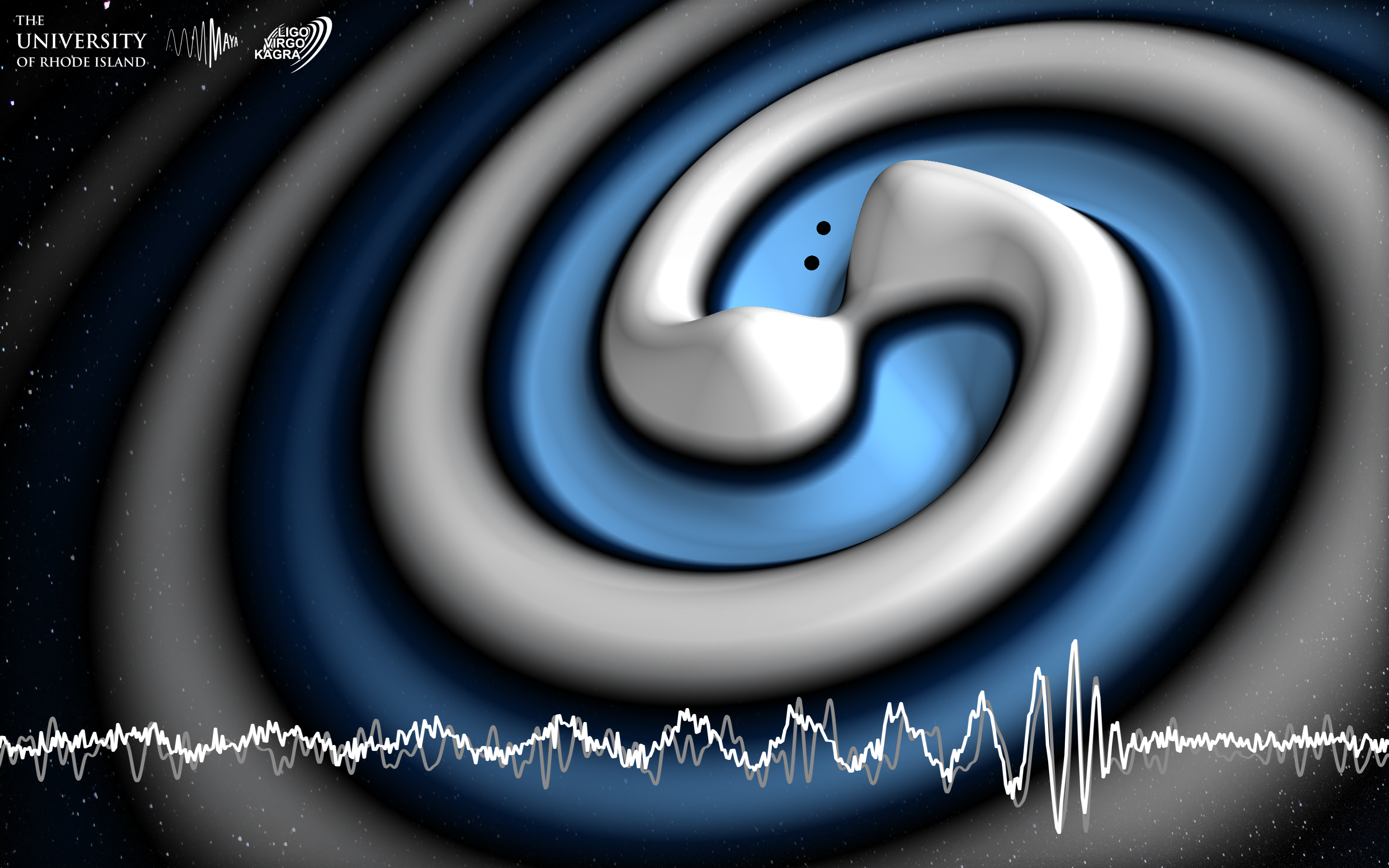
That’s right. So all the time in our universe, black holes are in orbit around each other and occasionally collide with each other. When this happens, they merge together into a larger black hole.
And we can study these events by detecting the emission they produce, not in light, but in something called gravitational waves. The recent discovery was an observation in gravitational waves of two black holes merging.
And what was exciting about this discovery was it was our clearest detection ever of such an event. This allowed us to study it in more detail than ever before.
So what does this tell us about the structure of the universe?
Our understanding of the universe and its history is governed by Einstein’s theory of relativity, which tells us how gravity works. It tells us how space and time work.
And by studying black holes, we can test our understanding of space and times in the most extreme situations. And this is especially true when black holes merge together.
» RELATED: Texas team finds oldest confirmed black hole
All right, so you mentioned Albert Einstein there. I also mentioned Stephen Hawking. So another reason I understand this is exciting for the physics and astronomy worlds is that what you’ve learned confirms what he theorized some 50 years ago. Is that right?
That’s right. One of Stephen Hawking’s great scientific hits was the proof that in Einstein’s theory of gravity. When black holes do anything – when they eat, when they merge – they always grow in size.
This is known as the area law. The area of black holes always gets bigger. Well, with this particular detection, we were able to measure the properties of the black holes so well, we could confirm that the two black holes, when merging together, produced a final black hole that was bigger than the two that went in together, confirming Hawking’s prediction from 50 years ago.
All right, this is pretty cool. And it’s from a layperson’s perspective. It’s like, oh wait, we always knew Albert Einstein and Stephen Hawking were pretty smart guys. This is like, all right, even now this many years later with new technology, with everything that we have, we can check that off. They did get their gold stars. That’s pretty amazing.
So you mentioned that this discovery was made detecting gravitational waves. So how do scientists hunt for these waves and what do you learn when you encounter them?
Yeah, so gravitational waves are ripples in the very fabric of space and time. And when they pass through objects like us or the Earth, they tend to stretch and squeeze us, but at such a tiny level that they’re really ghostly. You cannot find them with any normal means.
So scientists have built these enormous, super-sensitive detectors. An example are the two LIGO detectors in the U.S., another is the Virgo detector in Europe. And these use laser light bouncing off mirrors in order to measure very, very tiny motions in the experiment and with those measurements we can detect if a gravitational wave passes through the earth.
Amazing. All right, so this new discovery comes as the field of gravitational wave astronomy celebrates its 10th anniversary. And I understand that’s a pretty big deal, right?
That’s right, it’s a really exciting time for us.
So 10 years ago, on Sept. 14, 2015, the very first detection of gravitational waves was made also from a collision of two black holes. And now 10 years later, the field has really evolved. We’ve detected hundreds of black hole mergers.
We’ve detected other things coming together like neutron stars, which are other very exotic objects. And along the way we’ve made our detecting devices even better. And that’s the reason why today we can make this measurement of two merging black holes and measure it so precisely that we can confirm Hawking’s theory to the level that we’ve done.