Corpus Christi’s ongoing water crises has worried residents, and angered state leaders, who have threatened to intervene. City officials have begun updating the public more frequently, and securing new sources of water for the community.
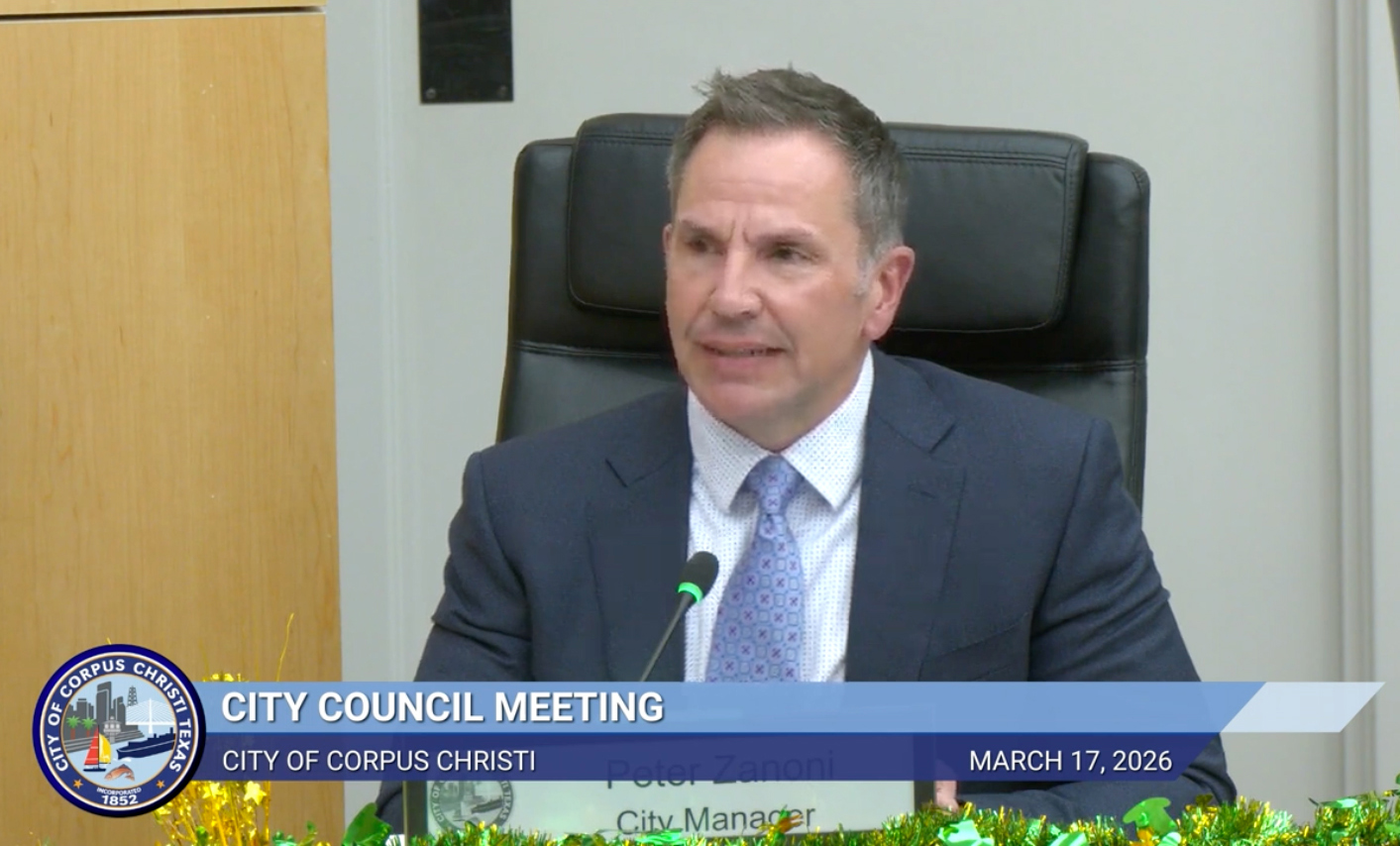
But is it enough to keep the taps flowing, and what long-term solutions will need to be put in place if the city is to get past current drought conditions, and increase industrial demand for water resources? Corpus Christi City Manager Peter Zanoni says he’s confident in the city’s short-term prospects, but that a desalination plant – converting sea water to fresh – is the only long-term solution. Listen to the interview above or read the transcript below.
This transcript has been edited lightly for clarity:
Texas Standard: I know you’ve been in this role since 2019, about seven years. Back then, what were the conversations like at the local and state level about the water issues facing Corpus Christi?
Peter Zanoni: Back then our western reservoirs were in pretty decent shape, and so the focus really was bringing on an additional water supply, seawater desalination, but it was done in a more … the conversations were more in a relaxed atmosphere. The drought that we have gone through now for the past five years was not existing then. The city for decades had relied on those western reservoirs, and had treated the region well, up until this past drought.
And so the focus then was one that had started many years prior to 2019. And that was bringing on what they described – and we still use it – as a “drought-proof” water supply or water source – seawater desalination.
What happened to that idea for a (desalination) plant?
Council term limits here are two years and policy concepts and ideas and directions have changed just about every two years.
It’s hard to get your feet in on a project like a desalination plant when you’re changing the players every two years it sounds like.
Yeah, that’s correct. This is a big project. It is expensive. And it has a rate impact. And so if you have a new council member coming in, it takes time to re-educate, educate on the project, on the financials, on the impact on the water, the benefits of the water.
It’s still here, the inner harbor desalination project is still live, so to speak. We have another vote coming up here in April that would award a design contract to the second bidder in our most recent solicitation process to get a design builder to construct the plant.
But concerns have certainly spiked in recent weeks. There have been several stories that have reported on how Corpus Christi is months away from a full-on water catastrophe, and the main sources for water for Corpus Christi had fallen below that 10% mark. And a lot has been changing over those years since you first took office. There’s a lot more industry that had come to Corpus Christi. When did the alarm bell start ringing in your office?
Yeah, and I would just correct that, you know, there’s been some additional industry. There’s a notion out there that all of a sudden we added tons of refineries and petrochemical plants. If we look at our city, the main refiners that are here, the three to four, have been here for decades.
Now, we did agreeably add a few more industrial customers that are in the petrochemical space, but It is known and it should have been known to the leaders of the city that we have a large industrial complex that uses a lot of water, and that really hasn’t changed substantially since I’ve been here or in the last decade.
So knowing it’s here, I think the bigger issue is the lack of commitment to be focused on bringing on alternative water supply projects, diversified alternative supply projects. It has been over 30 years since the city invested in a new water source. We built infrastructure, but we haven’t bought any new water sources in 30 plus years. It’s been 33 or 34 years since we’ve bought additional water sources.
Well, I think that that was what was driving a lot of the reporting on this, that it seemed like this had been mismanaged. That, as you say, Corpus Christi has known about this for decades, and yet something like that desalination plant has not moved substantially forward. That there weren’t alternative sources, serious alternative sources. Do you feel like it’s been mismanaged?
I take it, I don’t know if mismanage is the right word. I think there’s been a lack of direction and it takes time. I’ve been working on it for the past seven years. So I think that there’s been a lack of directions, a lack of commitment. And some of that comes just by the nature of how our governance structure works, which is a city council elected by the populace that have two year term limits, and it makes it tough to understand the concepts that have to be approved, to understand the policy direction of how the city is trying to move forward.
Governor Abbott, when this appeared on their radar screen in Austin, he seemed to be pretty agitated. He was threatening to take over the city of Corpus Christi and try to manage this water crisis from that point. Where do coordination efforts stand with the state right now?
Right, so the state has been an extreme partner in helping us through this drought of record and in bringing on seawater desalination. So the Texas Water Development Board has ranked our Inner Harbor Desalination Project as a number two-, number three-ranked project amongst many in the state and have secured funding, the lowest interest loan funding, from their portfolio for $757 million dollars.
The environmental agency, TCEQ, especially in recent times and these recent months, has helped expedite permits for groundwater projects. Governor Abbott and his team have directly helped, and we thank him, we’re grateful for him and we understand his position.
He is very much a business leader in the state, making this state of Texas, one of the leaders in business development. And to have that, you need predictability and you need predictable business models and we can’t be in this position where we’re not sure if we’re gonna have enough water to make it through a particular calendar year. And so we understand where he’s coming from, and he has been helping tremendously and we’re grateful for that.
Do you feel like the relationship is positive or is it a little contentious?
Well, from my standpoint, I’m not an elected official, so I think it’s very positive. He and his team are working directly with me, the city manager, and our team here. We have calls into his office, two, sometimes three times a week, and there’s no confrontation, they’re very positive, very professional dialogues that we have.
Recently you started doing weekly briefings for the city’s residents who were seeing these headlines, very concerned about the description there that Corpus Christi might run out of water. You said at that first briefing, “we will never run out of water,” and I’m wondering if you can clarify that – do you really believe Corpus Christi will never run out of water? Do you have enough water to meet demand for the foreseeable future?
You know, a local resident was commenting on that recently saying, ‘how would he know?’ But that that statement comes from a misleading headline that said our two western reservoirs are about to run out of water, and therefore the city will run out of water. And so we do have somewhat of a diversified surface water program where we get water from our two western reservoirs and water from East Texas.
Today, 70% of the water that we have here in this region comes from East Texas, from Lake Texana and the lower Colorado River. Those areas are, while in an emerging drought, generally get better rain chances than here. So as long as that supply is decent, the city will never run out of water. We may be in a circumstance where we can’t meet the daily demand, but through demand curve reduction, we can still provide water for all of our classification of customers.
You mentioned if you get the rain, but it’s very possible y’all might not get significant rainfall through the end of the year. What then?
We have several diversified projects that are coming online and are (already) online, and more water will be coming online through them. Those include three groundwater projects in this county, in Nueces County, and then a 24 million gallon a day project in the adjacent county, in San Patricio County.
The formations that we’re targeting is more secure water, not prone to drought conditions like we see here now that impact surface water. So that’ll help our supply levels, and then we’ll continue to rely on eastern sources including the lower Colorado River and Lake Texana. But that’s why 10-plus years ago, leaders in this community really highlighted sea water desalination as a best choice to mitigate effects of drought. And this area is very prone to cyclical droughts, about every five years the region enters into a drought cycle. And that’s why sea water desalination, while expensive, is really the only choice in a community like this to have better water security.
Is that going to happen?
I think as long as I’m here and pushing it, I think we have a decent chance. We have our Inner Harbor project. We have a project with the Nueces River Authority in the Port of Corpus Christi on Harbor Island. We have a smaller facility that may come back online at Corpus Christi Polymers, a plastics plant that could produce about 10 million gallons in the next year. And then we’re looking at a location on the south side of our community near the Laguna Madre. It’s a power plant that’s owned by City Public Service in San Antonio. So that’s been a long sought after site.
I think we have the state behind us and the state has made it clear to our elected leaders here that there is no substitution for the awarded funds that we have for the Inner Harbor. We either use it there or we forgo it and have to pay back everything we borrowed so far.
Well, let’s talk about the short-term here briefly because from all the stories that I’ve been reading it’s looking like within a few months the restrictions that are currently in place, if we don’t see a substantial – like we’re talking tropical storm-sized amount of rainfall– that there’s just not going to be enough rain to cover the water needs for the city and that perhaps within a few months, y’all are going to need to declare a water emergency. Am I wrong?
We’ve updated the forecast so it’s a little more than a few months, and we’ll have a final model around mid-April, based on the the performance of our most recently brought on groundwater project in Nueces County. Once we see how that is performing in terms of the quality of – because we’re discharging that water into the Nueces River that conveys it to the treatment plant – if our water quality management plan stays in check, we’ll be able to produce the amount of groundwater that we want to keep us out of that level one emergency.
Why not just declare a water emergency right now? You see where this is trending. Why don’t you just say ‘stage one water emergency, we’ve got to do more in the meantime, because we don’t know where this has headed.’
Right, because we have forecasts that show new water supply coming on. And it’s happening now, it’s been happening for several months, but more aggressively now that the governor has helped us in the last couple of weeks, and we have more on the horizon. We have another big project in the adjoining county, San Patricio County, that comes on in November with 24 million gallons in total starting after November. It starts with four and then ramps up to 12 and then 24.
So there are solutions – even if the Western reservoirs deplete to zero or to somewhere around that depletion mark – as long as our eastern supplies stay solid and as long as our new sources come online as planned, we can push back or totally eliminate the need for a level one water emergency declaration.
You don’t want to declare a level one water emergency, clearly, but what would that mean for residents if you had to?
Yeah, right. So it would be all classifications. It’d be residents, commercial businesses and large volume industry. It would mean that we would demand a reduction in use. It would a conscious effort to drive down demand so that there would be enough supply to meet that new reduced demand and keep our pressures up in the system.
And so we don’t want to panic the community or the region. We don’t want to shut down business. We don’t want to halt production from our petrochemical industry here. That’s why we’re reluctant to say, ‘hey, let’s just call it today. Let’s just call a level one emergency today,’ because there is a good chance based on the work that we have done and the policies that the city council has approved, that we can forego or eliminate altogether the need.
And so, we’re monitoring this every day of the week. And if something seems like our plans aren’t going to materialize, then we could call it sooner than we have to, but right now there’s no reason to do that.
No reason to do that? I mean it does seem like, to a lot of folks, a heck of a gamble.
Well, what we do know is the effects of reducing water consumption, especially in our petrochemical industry that is here, at our residential homes even, and at our commercial – we have a big tourism industry here, so things like hotels and the service industry – if we have to tell a region, and it’s not just the city of Corpus Christi, it’s a seven county region with over 20 communities, if we have tell everybody we’re going to have to start reducing water – somewhere between five and who knows what percent – that just would have a devastating impact.
And so it’s a calculated assessment and a strategic look at the data that we have every day, and working with city council and our partners in the region. And so we’re gonna take it one step at a time, one day at a time with good forecasting and good planning. And that’s what’s guiding us right now is that forecasting, that planning, that bringing on new water projects every day.
I was recently in Corpus Christi and I went to the tap and I opened it up and it frankly gave me chills because I thought, you know, I’ve been hearing about these stories. I don’t know how much I can afford to keep this going. I wonder, you know, about how long to go with the shower and all that kind of thing. Are people knowing what to do right now to save water? Are people taking steps, or is it people kind of feel like, well, you know, We’ve been hearing about this for as long as we can remember, why should I change my habits?
We do see in our data from all residential classifications that our residential customers have dropped demand substantially in the last two years. That’s probably primarily from the prohibition on outdoor irrigation or outdoor landscape watering. But our residential customers have done a tremendous amount responding to this drought and have literally reduced demand in some cases up to 2,000 gallons a month. The typical household is about 6,000 a month. Our charts or analysis is showing that demand use has dropped to four, and in some cases even less, thousand gallons per month. So they’re aware. I think more of them are becoming tuned in as we’re out there more and informing them of what’s happening.
Our commercial accounts are also similarly, probably from irrigation use, have used less in the last two years. And then our final and the biggest user of all our water is our industrial partners or the petrochemical industry here. And their demand has stayed consistent.
Are they doing enough, are they working with you on this, or do they need to cut back more?
They are working with us, but for them to cut back, it means they have to shut off operations, and it’s really, it’s that simple. They would have to shut off units, shut off operations, lay off employees, and then cut back in production. They’re doing some – in a level one emergency, they would be the ones that would have to do the most significant water reduction use to save on demand. So they know that we’re working with them.
Similarly as with the governor’s office, we have a great working relationship here with leaders of our plants, our petrochemical, our refineries, our steel plants. And we meet with them almost, if not every other week, once a week, to plan for this and to see what are they doing to reduce water consumption.
You’ve been very generous with your time. Let me just ask you one question sort of from the gut and I appreciate your candor here. I mean from the gut when you get up in the morning and look at yourself in the mirror, you feel like Corpus Christi’s gonna be able to avoid a stage one emergency this year?
I do, most days. Now there’s a day or two that I get up and I’m like, ‘Oh God, I don’t know if we’re going to, if we are going to make it.’ But I think the data that I see here recently and the fact that weather patterns are changing to the benefit of this region, the fact that now we do have, we’re in a season where we have our springtime rain chances and then the tropical storm, hurricane storm chances later this summer.
Plus we’re bringing on our groundwater supply projects and an effluent reuse project. So I think it’s gonna be tight, but I think we can do it if we stay focused on the delivery of this new water, 76 million gallons of new water that we’re bring on over the next year to two years. If that scenario is improved with rain, then I think that we have a chance.