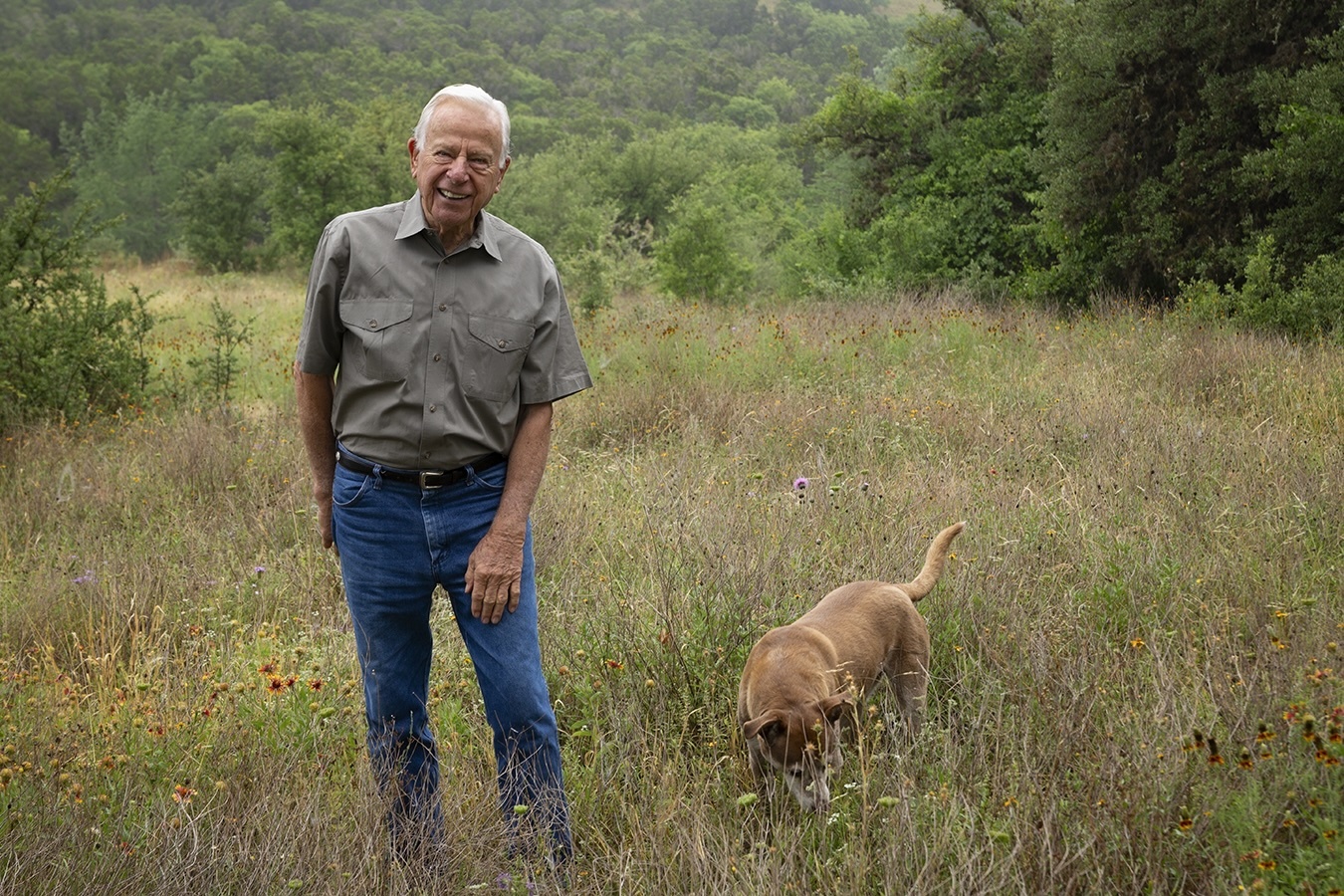
Texas-founded Church’s Chicken went from a couple of local restaurants to a nationwide brand in the 1960s, and longtime executive J. David Bamberger was part of that push.
But this story is not about chicken or even entrepreneurship. It’s about what Bamberger did with much of his wealth.
J.David Bamberger died this past weekend at the age of 97.
Pam LeBlanc wrote about his legacy for Texas Monthly and joined Texas Standard for a remembrance. Listen to the interview above or read the transcript below.
This transcript has been edited lightly for clarity:
Texas Standard: Bamberger will largely be remembered as a Texas land conservationist. How did that become his passion?
Pam LeBlanc: After Bamberger made a bunch of money in the fried chicken business, he decided that he wanted to use that money to buy what he perceived as the most worn-out piece of land in Blanco County. And he settled on a ranch that was not far from Johnson City, and he bought that ranch in 1969.
And he had been raised in a family… His mother taught him to really value nature and the land and so he wanted to take that land and see if he could turn it back, make it more lush than it had been when he got it.
What was so sorry about this ranch and what did he turn it into?
Well, the ranch was overgrazed. It was covered with invasive species, including a lot of ash juniper, which we know as Texas cedar.
And not that all cedar is bad. In fact, there’s a species of endangered bird, the golden-cheeked warbler, that needs the bark from those trees to build its nest. But he noticed that it shouldn’t be everywhere.
And there are a lot places in the Hill Country that just covers the landscape. And by taking some of that out, or most of it out, it brought back water to his land, wildlife return, lots of things just got better. You could swim on the property, and that wasn’t even possible when he bought it.
Have you been to the ranch? I understand it’s open for educational purposes, right?
Sure, absolutely. I wrote a book about Bamberger back in 2018, and in the process of writing that book, I spent a lot of time out there at the ranch. And up until he passed away last weekend, I still visited the ranch regularly.
I went hiking with Bamberger after Thanksgiving. He was still up and running to charge around his property. He always had a project going, so I loved being out at the ranch with him.
Well, let’s lean into that personal relationship that you had a little bit with him. What was that like going on a hike with this 90-something-year-old talking about the things he loved?
I just loved Mr. Bamberger. He was like a second father to me. And he was so fit and spry. I just could not believe that he was 97 years old.
I’d just have a hard time believing that one of my closest friends was almost 100 years old, but he loved to be outside. He loved to be working with his hands.
And his wife, Joanna, is just wonderful. They’re just such a wonderful couple. I got to photograph their wedding, which really made me happy a couple of years ago.
Well, tell me a little bit about his specific interests. One was bats?
Yes, David got interested in bats when he got involved with the Bracken Cave down by San Antonio, which is one of the largest places for Mexican free-tailed bats, or possibly the largest in the country.
And so he decided that he was going to build his own bat cave on his property. So he picked a spot. He had this cave dug out of the side of a hillside and then he just waited for the bats to come.
And everyone thought it was a colossal waste of money. What is this crazy person doing out in the Hill Country?
And the bats didn’t come for a couple of years, but I think it was maybe year three or four, the bats did show up. And now if you’re out at the ranch in the summer, you can see hundreds of thousands of bats streaming out of his cave in the evening on their way to go feast on mosquitoes and other insects.
Well, and then there’s this plant he’s worked to revitalize. I’m not sure I’ve seen it and it’s supposed to be native to where I live in the Texas.
Well, the Texas snowbell is really more west of here. It’s not so much in the Hill Country. It’s a lot in West Texas, but he got involved with a project to save this endangered… It’s a flowering shrub.
It’s beautiful. It has little white flowers on it. And he got an involved in a project to save that. It’s was one of his proudest achievements, I think.
Well, it seems a little small, a 5,500 acre ranch in relation to all of Texas, but is Bamberger’s impact larger than that?
Bamberger’s impact is huge. He has taught landowners how they can preserve and maintain their own ranch land, even if it’s not as big as his ranch, and how to do it affordably.
He had great little tips. He wanted people to plant native grasses on their ranch land. He suggested even if you don’t want to go out and spend money on buying all this seed, you can go to the side of a highway at certain times of the year and collect these seeds off the plants that are growing there wild and then use those on your property for free.
He was very frugal and just hilarious, had such a great sense of humor.
Well, what message do you think he’d had for Texans, maybe those who don’t even have an acre to their name?
Protect your land, go outside, enjoy your land. Take out invasive species if you can. Try to attract bugs and insects and all native species are good. So he would want you to do everything you can to save your land.
Bamberger Ranch, to this day, offers field trips for school kids, especially underprivileged students, and it also offers workshops for landowners that teaches more specifically about what regular people can do to make their property healthier.
Well, Pam, I am sorry about the loss of your friend, although 97 years and this wonderful legacy is certainly something to celebrate. Is there anything else that you want to let us know about David Bamberger?
He was just a great guy and my friend, and I’m gonna miss him terribly, but thank you very much.