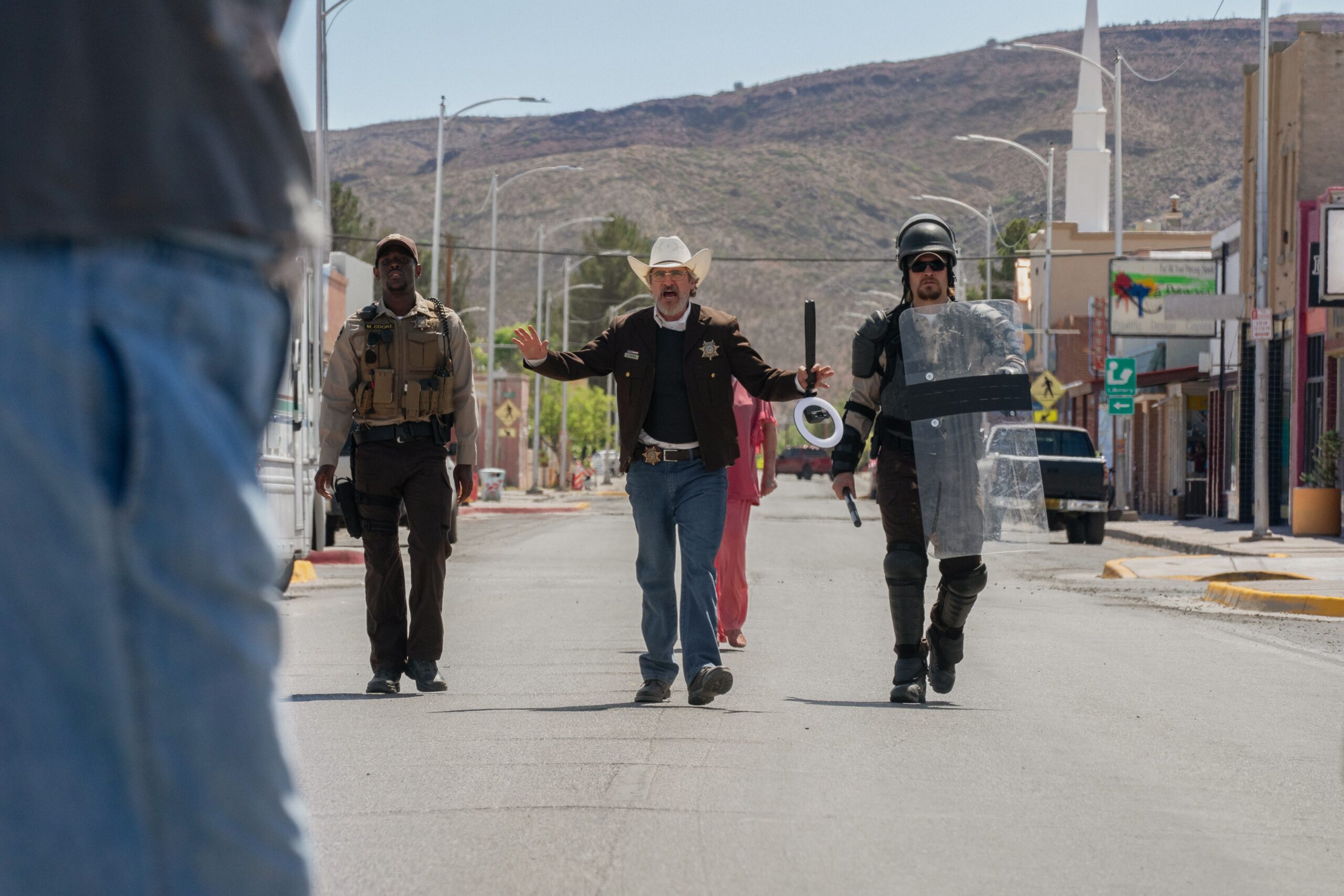
Writer and director Ari Aster’s films make you feel something – usually discomfort, dread or just plain horror. He’s best known for the films “Midsommar” and “Hereditary.”
He’s got a new one out July 18: A Western that’s set just a few years ago during the pandemic and growing Black Lives Matter protests. But the discomfort, dread and horror still arise – just in different ways.
Aster joined Texas Standard with more about “Eddington.” Listen to the interview in the player above or read the transcript below.
This transcript has been edited lightly for clarity:
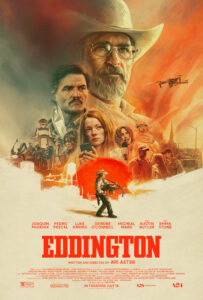 When I saw the trailer for “Eddington,” I thought this could be Texas. It was obviously a small, Southwestern town. The sheriff was wearing cowboy boots, a cowboy hat.
But it’s our neighbor, New Mexico. You grew up there and have family there, so you know it well. Could you talk about why it had to be New Mexico?
Well, I did grow up there. I spent my entire adolescence there, and my family still lives there. So when I go home, I go to New Mexico. So that’s why it had to be New Mexico, which is because it’s the place that I know better than anywhere, even better than New York, where I live now and have lived for a while.
And so, you know, I’ve always just wanted to make a very good movie about the Southwest. And so that’s the attempt here.
Well, there is a little Texas. I was looking for it. I noticed one Texas license plate. And I heard you screened “The Last Picture Show” for the film crew.
I did. I screened “The Last Picture Show,” which is just a great small-town portrait and one of the great movies, and I screened “Nashville.” And I was planning to screen “JFK” and “Fat City,” but we didn’t get around to it.
Beyond the boots and the cowboy hats, this film is a nod to the Western in its setup. It’s a little dusty, and there’s an actual division between the sheriff and the Native American population. Can you talk a little bit about what you wanted to do with the Western?
Well, you know, I think the Western is particularly fascinating because it’s sort of the national genre. You know, it’s about the building of America, and it’s about law versus lawlessness, borders.
And it felt like the appropriate genre for this moment, because it feels like we’re living through the collapse of something, but it also feels like we’re on the cusp of something and we’re living at the edge of a new frontier.
And also, you know, I think the Western is very interesting because it’s about the dream of America and that heroic myth of America, while also being about, you know, I think at its best about the reality of America. And so all of those things were on my mind when making this film.
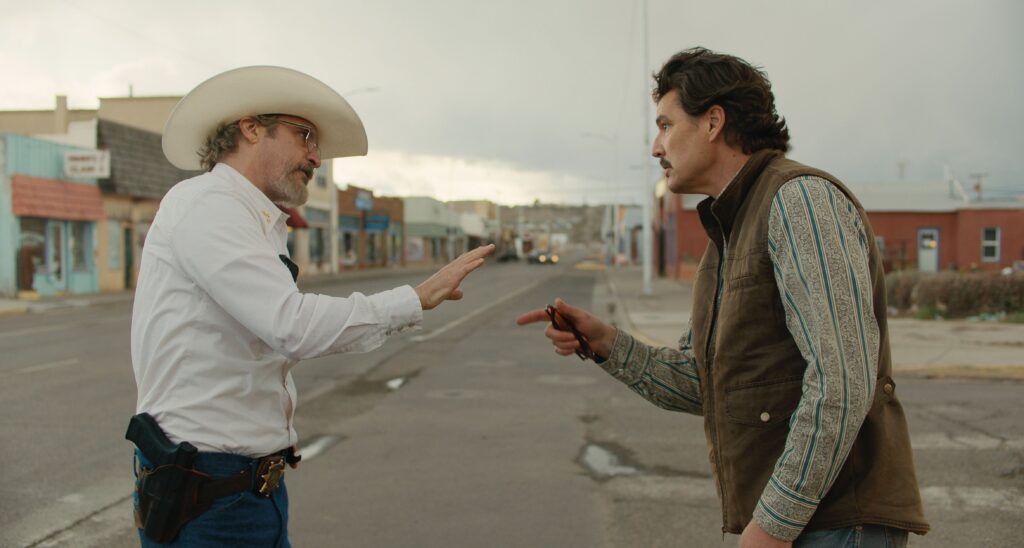
Joaquin Phoenix and Pedro Pascal face off in “Eddington.” (Courtesy A24)
Fans of your work will find something different at the start of “Eddington,” especially. You’ve called it more grounded. It’s maybe scariest in the beginning in its familiarity in a way, like you see yourselves there in good ways and mostly not-so-good ways.
There are several characters we follow closely, and I would say they’re all sort of some level of bad guy. There’s maybe one exception in a character named Butterfly. But do you think that that’s true of the world, that we’re all kind of horrible?
Well, no, to be honest. I see all of these characters, not as bad people, but as complicated and as being complex.
And I would say, you know, this is a movie about a bunch of people who really care about the world, but they’re living in different realities and they’ve become unreachable to each other.
And some characters I think are more maligned than others. And I think some of these characters see themselves as being maybe better than they are. And some are more on the sadistic, manipulative, ugly side. But I wanted to make a film that was very empathetic. It’s just empathetic in multiple directions. And some of those directions are oppositional.
» GET MORE NEWS FROM AROUND THE STATE: Sign up for Texas Standard’s weekly newsletters
You also make us laugh, and it’s almost always an uncomfortable laugh. And it feels like it could be very telling as to what makes people laugh. Have you watched for that, or is it interesting to you what makes people laugh?
I think, you know, we’re living in a pretty strange, absurd, in a lot of ways, obscene time. I actually think one of the things that’s most insidious about this moment – it feels like a very dangerous moment and a catastrophic one, but at the same time, it’s ridiculous and absurd and impossible to take seriously. And I think that was something I wanted to capture.
But I’m glad you found it funny. The film is supposed to be funny and exciting, and it goes off the rails at the end. You’ve got a big action climax. I hope it’s fun.
Well, one of the ways you create your signature uncomfortable feeling is with the presence of conspiracy. And you sort of touched on that and it reaches, as you say, this incredible peak at the climax that I won’t spoil.
But coming back to this idea of, I guess, different versions of reality: How pervasive do you think conspiracy really is in the United States right now?
Well, it’s become incredibly pervasive. I think we’re in a moment where everybody kind of knows that something is wrong, but very few of us agree on what that thing is. Also, I think one of the consequences of living on the internet, which we all do, and living in, you now, these algorithms, is that these things have proliferated.
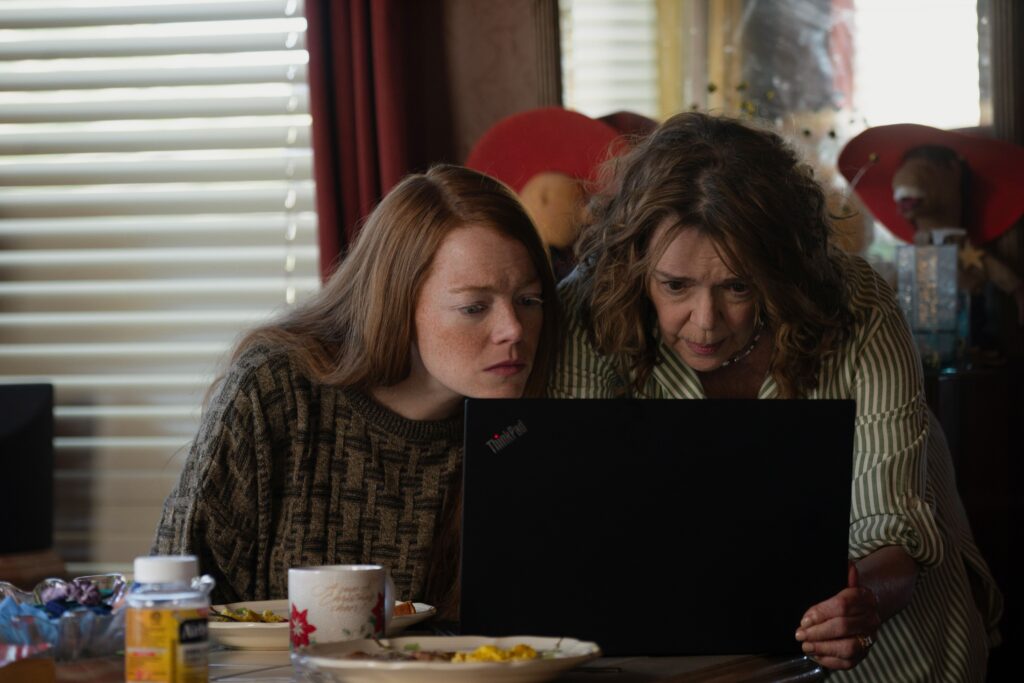
Emma Stone and Deirdre O’Connell in “Eddington.” (Courtesy A24)
I want to ask you about something else, because I saw that you’re kicking off a project that’s going to happen in Austin in October for filmmakers.
Why Austin for this venture? Do you think there is something about the film scene in Texas that is, I don’t know, exciting for indie film?
I do think so. I think it’s been that way since the early ’90s.
My producing partner, Lars Knudsen, lives in Austin, and it is a city that I’ve always loved. And it feels like there’s a real, there’s very exciting culture here that I could only point to a few cities outside, you know, LA and New York that have what I think is so distinct here in Austin, which is that it feels like a magnet for artists.
And so I’m excited that we’re gonna do this here in October, and I hope it’s able to attract young filmmakers who are looking for a way to break in. It’s getting harder and harder.
I wanted to ask about this, and I don’t know if this is exactly what you’re getting to, but another Austin filmmaker is Robert Rodriguez. He’s just started a crowdsourcing thing for action film ideas.
I wonder if it says something about Hollywood that auteur filmmakers are taking a bit of control helping to spur along indie film?
Yeah, well, I mean, speaking of Robert Rodriguez, his story is one that was hugely inspiring to me as a young aspiring filmmaker.
It’s a really confusing moment for a lot of young filmmakers because there’s so little taste for risk. I’ve been very lucky in my relationship with A24 and that I’ve been supported and that I’ve been able to make my films, and that I haven’t had to be too strategic in my thinking.
But ultimately, the films I want to see are the films that people are burning to make, not because they think they can, but because it’s important to them.
If you found the reporting above valuable, please consider making a donation to support it here. Your gift helps pay for everything you find on texasstandard.org and KUT.org. Thanks for donating today.