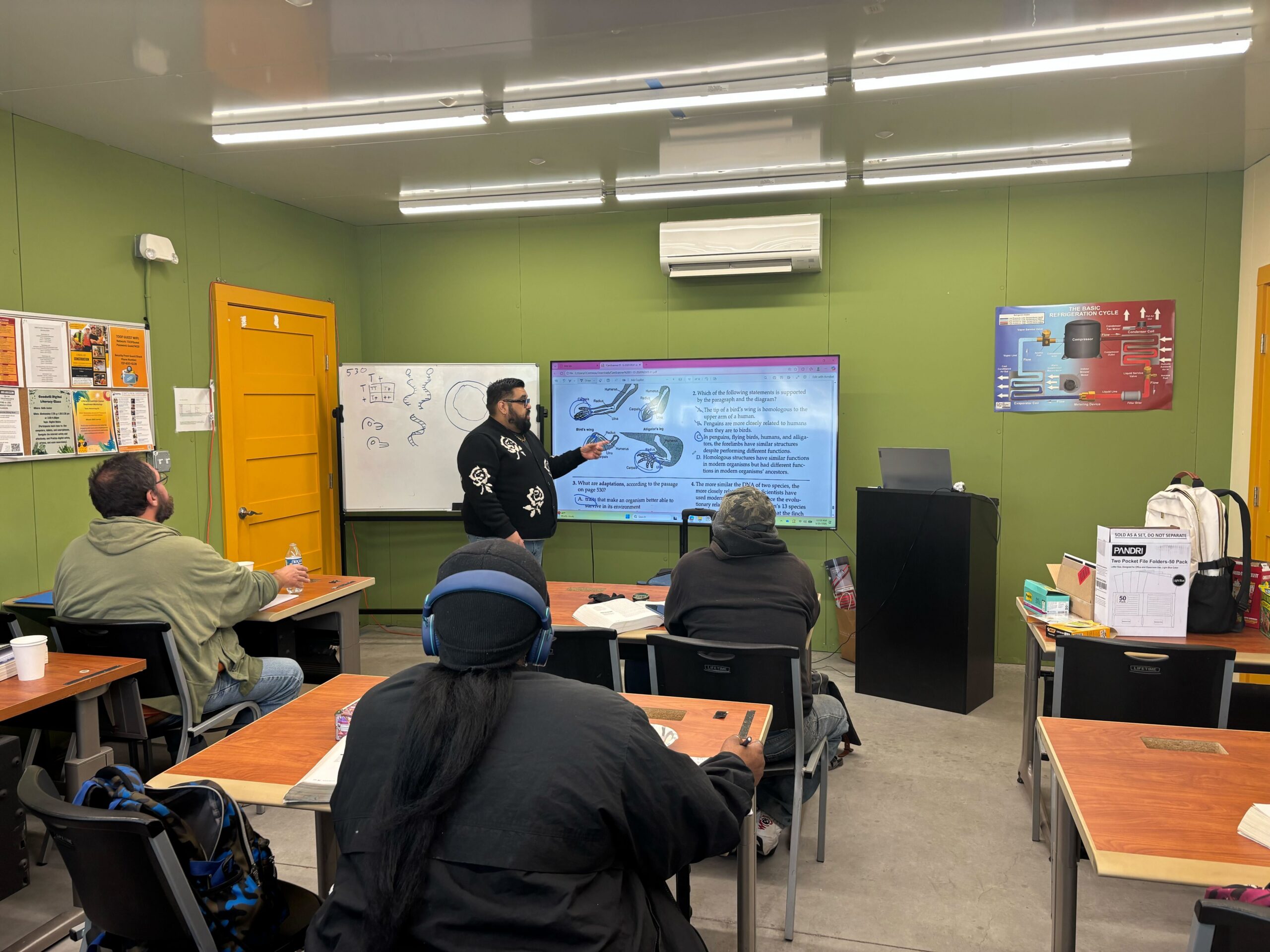
In a small building off Highway 183 by the Austin airport, people impacted by homelessness gather twice a week for GED classes.
The classes are hosted at a transitional housing facility called the Esperanza Community.
Colin Melton moved in about two months ago, but has been attending GED classes for even longer. Melton turns 49 this year and says it’s interesting to be back in a classroom after a few decades.
“I’m doing better at it than I thought I would, so it’s actually nice. It kind of makes me realize I should have done it a long time ago. I didn’t have to be scared of it,” he said. “Basically, I won’t have doors closed is the whole point. I won’t have to be worried that you didn’t get a piece of paper 20 years ago, so now you can’t plan your future.”
There are about 43,000 people experiencing homelessness in Texas. About 3,200 of those folks are in Austin – sleeping in cars, in shelters or on the street on any given night.
This housing facility, run by The Other Ones Foundation, is one place folks can go for services.
» MORE IN OUR ADULT EDUCATION SERIES: ‘What’s the point of a library?’: This town found an answer in adult literacy programs
Vocational Services Coordinator Alex Gideon says the goal is to connect people with long-term stable housing and gainful employment. GED classes are just one tool to achieve that, but Gideon says it’s an important one.
“In my last role, I served as an employment specialist,” he said. “I can’t tell you how many times I helped someone apply to a job and we’d get hit with that roadblock where you need your GED or high school equivalent to fill out this application and even apply to the job.”
Staff at the Literacy Coalition of Central Texas started offering these classes last spring. While none of the students have completed the GED yet, a few of the 25 enrolled right now are getting close.
Literacy Coalition CEO Lisa Stewart says one reason this program works is because it brings educational services to people who are in a position to make use of them.
“If a person experiencing homelessness has a stable housing spot… They have a great deal higher success rate to complete their GED,” she said.
Statistics bear this out. While there is not a lot of data about homeless adults working on the GED, studies show that homeless youth in the K-12 school system struggle to graduate without housing stability. Not only that, but anyone who drops out of school is more likely to be homeless in the future.
Carlos Contreras, the GED teacher on site, says his goal is to break this cycle and help people view themselves as life-long learners.
“I think one of the big challenges with adults is really teaching them that it’s okay to make mistakes and it’s okay to trip and fall,” he said. “(GED) gives you those skills in everyday life to kind of navigate those harder things, like signing a contract, being able to read… You know what papers are in front of you before you make an agreement, and those things like that.”
» GET MORE NEWS FROM AROUND THE STATE: Sign up for Texas Standard’s weekly newsletters
Alex Gideon says the confidence Esperanza residents gain when they make progress in the classroom is a big part of what makes the program valuable.
“Just getting back into the learning environment and building confidence for people – that I can do this, I can be successful,” he said. “This is gonna help me in the next step of whatever my learning journey, whatever my career looks like for me.”
Melton said he’s noticed that confidence in his own life.
“I’m actually pretty good at (this), or better than I thought it would be at least. It kind of helps to get your confidence up,” he said. “There’s things you can do, and if you can do this, then you can probably do other things that you didn’t think you were going to be able to do.”