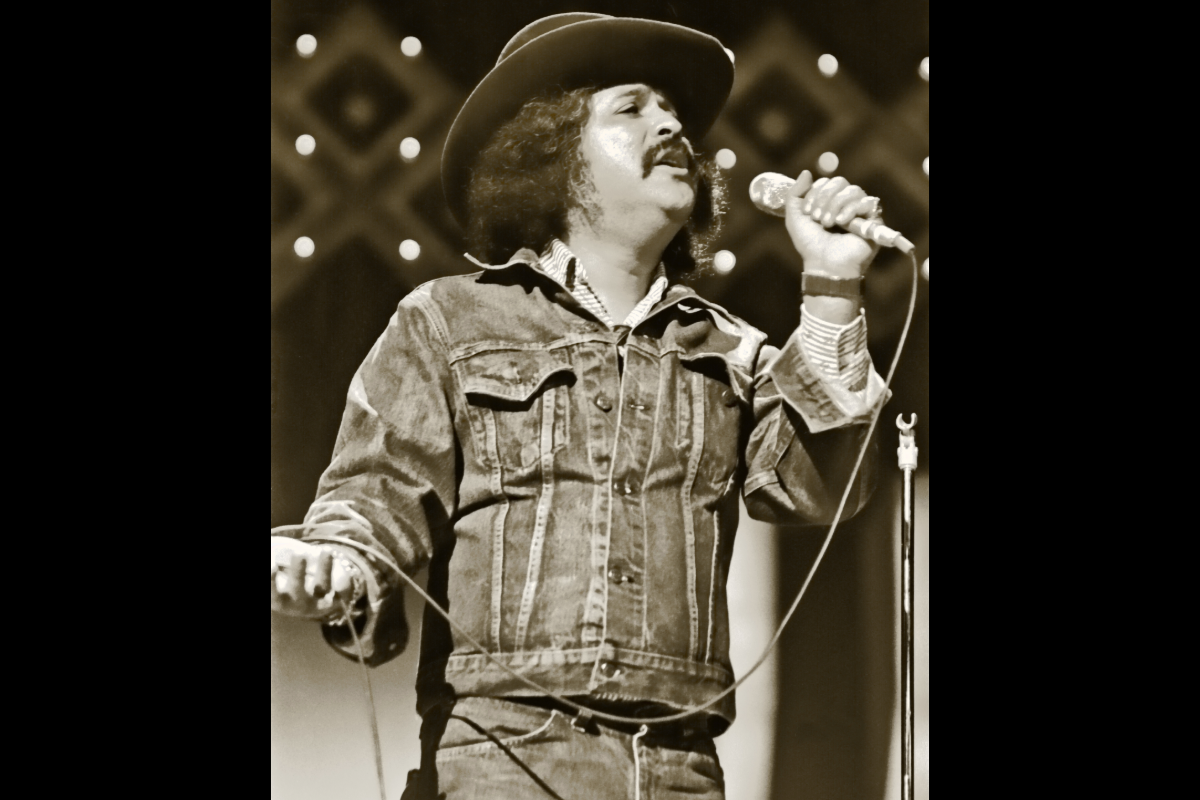
Baldemar Garza Huerta, better known as Freddy Fender, was born in 1937 in the small town of San Benito in the Rio Grande Valley. His family worked in cotton fields during his childhood.
Fender made his first public appearance at the age of 10, singing a Spanish song on a South Texas radio station. He dropped out of high school to join the Marines. But after three years, his heavy drinking got him a bad conduct discharge.
“In the Marine Corps, all you have to do is one little bad one, and from there on they just keep mounting up,” he told Australian talk show “Down Home Down Under” in the 1980s. “Consequently, it was not a very good time of my life in the Marine Corps.”
After his discharge from service, Fender returned to Texas and began performing in bars under the name “El Be-Bop Kid,” singing Spanish covers of popular Elvis Presley songs. Small South Texas regional labels distributed his first few albums.
In 1958, he legally changed his name to Freddy Fender, as his manager advised.
“He said Baldemar, you’re gonna have to change your name to an American name so that when the gringos put a quarter in the jukebox and read your name instead of your Spanish name, they won’t have a problem with it,” Fender told “Down Home Down Under.” “And I said, well how ’bout – and I looked at the amplifier; it said Fender on it, you know – how about Fender? … Freddy came out of the air.”
» MORE: ‘It’s all part of who we are’: New institute aims to immortalize the sounds of Texas music
That same year, Fender moved to California, looking to appeal to a larger audience. He got record deals but couldn’t get traction.
Fender’s meandering in and out of different genres was an obstacle throughout his career. But he felt it represented all parts of him.
In 1959, Fender released the hit “Wasted Days and Wasted Nights,” a fully English song. That should have launched his career – but the following year, he was arrested with two marijuana cigarettes in Louisiana and sentenced to five years in Angola State Prison.