Many a Texan has traversed that atmospheric boundary separating us from the stars or who are perhaps charting the future of what space travel might look like.
But one byproduct of more traffic in space is what to do with some of the stuff left behind. Such waste, or space junk, could include food wrappers, old tools, wires, old satellites or even batteries that may have outlived their lifespan.
One Texas-based company may have found an answer for how to deal with such waste – and in the process, may even provide sustainable solutions here on Earth. The concept, dubbed reGen by Austin-based Gensler, caught the eye of NASA as part of its LunaRecycle Challenge.
Kirsten Cessna, co-managing director of Gensler Austin, joined Texas Standard with the details. Listen to the interview above or read the transcript below.
This transcript has been edited lightly for clarity:
Texas Standard: So “reGen: Recycling in Space” is quite the concept. What’s been holding us back on this front? I guess part of it would be where are you going to do this? Because I would imagine this consumes a certain amount of space and resources.
Kirsten Cessna: Right. So, you know, NASA put out this challenge called the NASA LunaRecycle Challenge, and it really set up a unique opportunity. They want to be tackling the space junk, like you mentioned, and how do we do that?
So we developed reGen, which is really leveraging newer technologies: AI, robotics, digital twin …
Digital twin? What is that?
So digital twin is where you can actually take the data and pull it off to the side and really start to analyze it and really understand in two different spaces how the information is talking to each other to better produce something.
So it’s another way of analyzing.
It is analyzing.
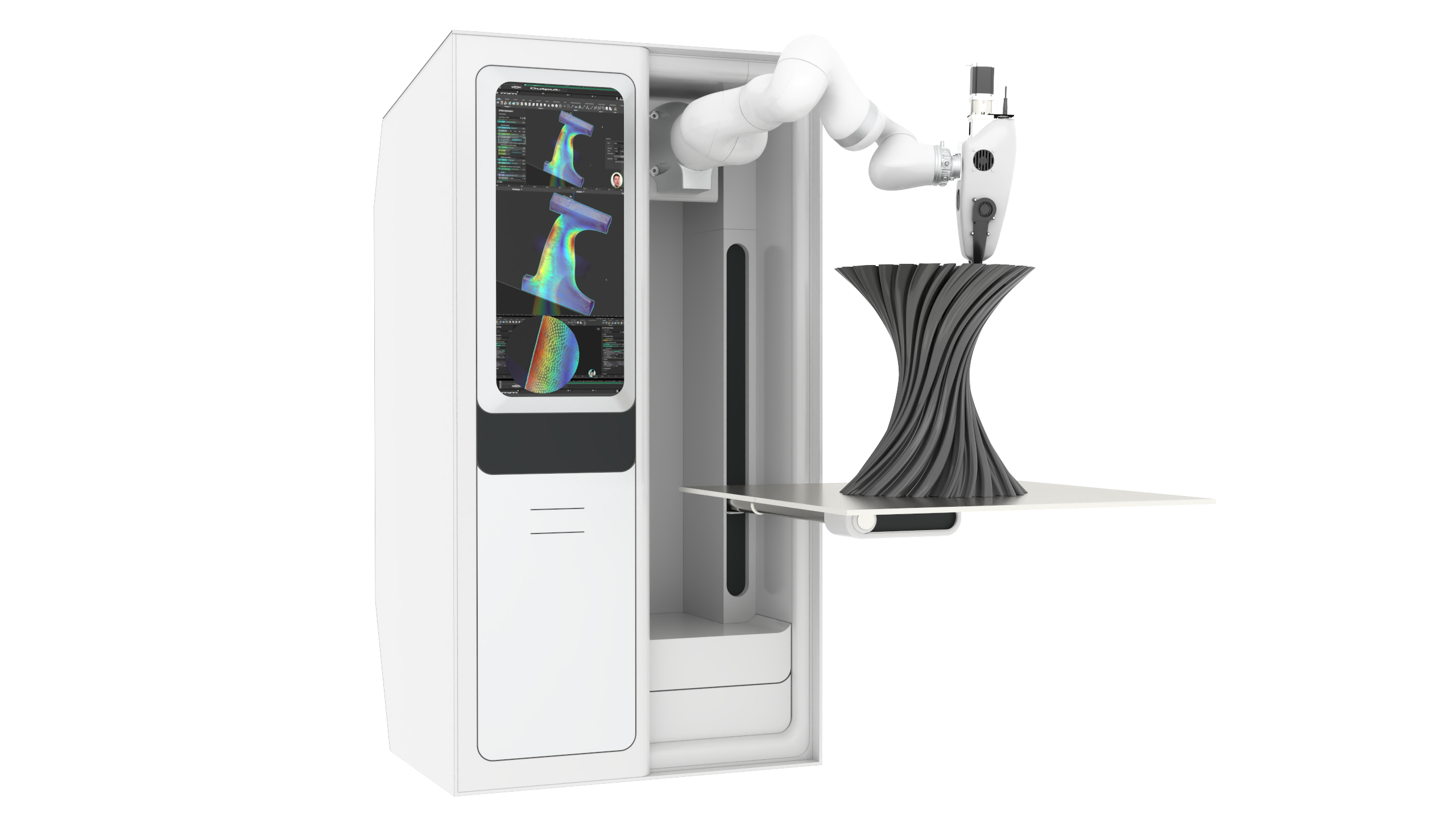
A rendering shows the reGen system 3D printing with a robotic arm. Courtesy of Gensler
Okay, so how exactly does this reGen solution work?
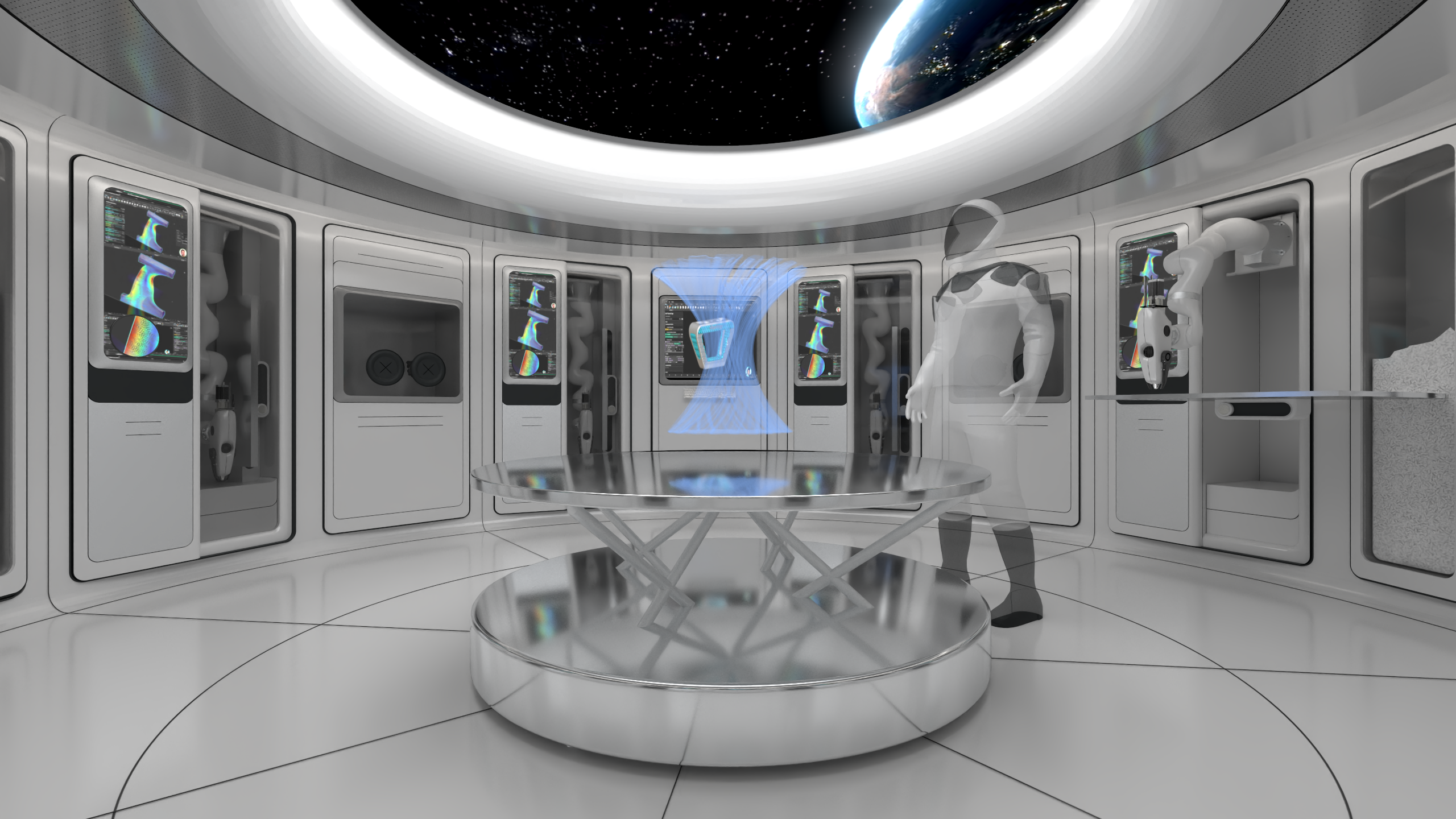
So what we have designed is actually a system that is utilized in space vessels with astronauts that are on long-term missions.
And what this does is we take the waste, we actually put it into a contraption that starts to break down this waste into different molecules that is then taken into a 3D printer. Then a robotic arm then prints out different products that they might need to utilize in the future on that space mission.
That’s interesting. I’m going to try to describe this. Tell me if I’m too far off the mark.
You would take, say, old food wrappers or what-have-you, put it inside this machine that you’ve developed, and this would be held on reserve for the moment when you need that part that you may be missing. And then this machine could 3D print that part you need, for example, right?
Correct, yes.
This is fascinating. How big is this unit we’re talking about?
So it’s the size of a space rack. It’s about 30 inches by probably about 24 inches. So it is a really compact area, because when you think about when you’re in outer space, there’s not a lot of space for these astronauts and everything has to fit in really neat, tight modules.
I’ve been hearing a lot of talk about space junk in terms of the context of, say, satellites that have been out in orbit and now they’re just floating around out there creating hazards. But it seems like this is a rather compact unit.
Are you talking about the possibility of, what, trying to seize some of that space junk that’s out there in outer space and then perhaps dismantle it?
Yes. So, ideally, the challenge initially set up the challenge of kind of just looking at the astronauts’ use, but we really saw with all of the space junk out there, when we break those down and make them into smaller pieces, they can go through this product.
So yes, ultimately, the goal is we can actually start cleaning up space with this type of product.
» GET MORE NEWS FROM AROUND THE STATE: Sign up for Texas Standard’s weekly newsletters
It also seems to me like this wouldn’t be an afterthought that you’d put on to a space mission. That you could, at least in theory, perhaps, at some point in the not-too-distant future, have a specific mission that’s like a constantly-on recycling vehicle in space.
That would be fantastic if we could actually leverage it that way and really clean up space and make it safer for much more future missions where we can really go and take exploration beyond and not have the hazards that our astronauts and these missions go through right now – having to, you now, go around all of these different obstacles.
How close are you to making this a working concept? I mean, how close to reality are we talking here?
So this was phase one of NASA’s LunaRecycle Challenge, and there were 1,200 submissions into it, and there 19 winners. Gensler Austin was one of those winners.
Now NASA has actually launched phase two, which actually goes into the prototyping. We’ve received that solicitation and we’re evaluating it, but we’ve also been starting to talk to a few collaborators on the potential of starting to build a prototype of this.
So we’re looking at both avenues of what’s the right way to go move this project forward, because we think it has so many applications – not just in outer space, but also here on Earth.