The civil rights movement that gained strength in the 1960s was marked by citizen activism – as well as police violence against those protesting racist policies.
Though much has been written about FBI surveillance and attempts to compromise civil rights leaders, local police departments also kept tabs on activists and used violence against protesters.
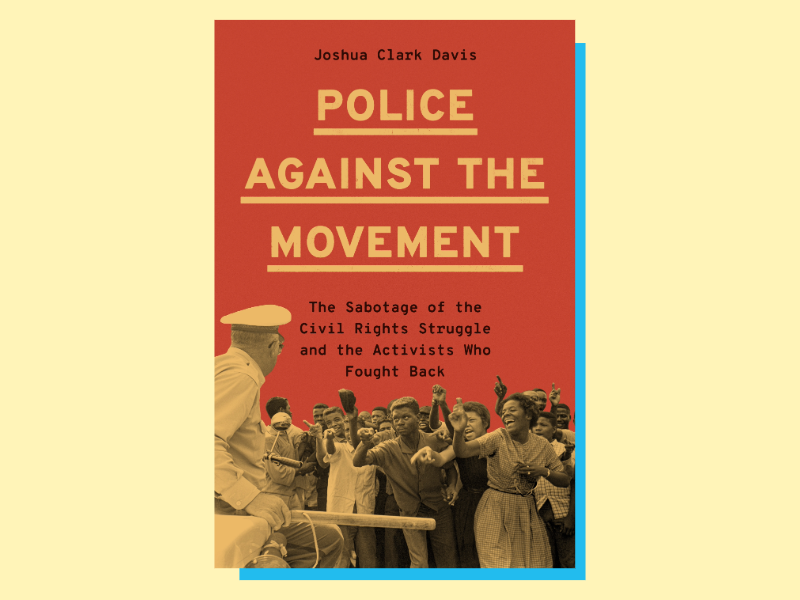
In his new book, “Police Against the Movement: The Sabotage of the Civil Rights Struggle and the Activists Who Fought Back,” Joshua Davis chronicles the history of this violence in American cities, including Houston, and he looks at how it resonates with Black Lives Matter protests and beyond. Listen to the interview above or read the transcript below.
This transcript has been edited lightly for clarity:
Texas Standard: I think many of us know about Black Americans seeking civil rights in the 1960s and how they often faced police violence, but what don’t we understand about how that violence impacted the movement and its goals?
Joshua Davis: I think the top two myths that I really set out to shatter with this book was, first, that the civil rights activists simply endured – suffered police violence without fighting back through protest.
We often think of groups like the Black Panthers, who, of course, protested against police brutality. But we don’t think about the civil rights movement of earlier in the 1960s as doing that. And they did all kinds of things – from picketing, to protesting in front of police stations, any range of things. That’s the first myth.
The second myth I was trying to shatter with this book was that we think of the sophisticated tricks of surveillance, infiltration, defamation and trumped-up felony indictments… We think of that as coming only from the FBI, J. Edgar Hoover, COINTELPRO, when in fact, there were local police departments all over the country that were doing those things before the FBI and before the FBI was doing that against civil rights activists before even what is widely known as COINTELPRO.
So local police did that much more than we realized. They didn’t just use physical violence against activists. They used these very sophisticated tricks that we think of as J. Edgar Hoover’s kind of province.
Well, civil rights activists from groups like SNCC and CORE saw police brutality on the local level as a component of white supremacy, rather than simply a response to civil unrest. You write that little or nothing was done to hold local departments and officers accountable for that violence. Why?
I think there’s a few reasons. I think first of all, most white Americans simply didn’t understand the many ways that police departments could undermine and attack the civil rights movement.
It was almost as though anything short of that film footage from the Edmund Pettus Bridge in Selma, anything short of brutal, brutal physical violence caught on film was, for many white Americans, not sufficient to consider proof of police abuses against the civil rights movement. I think that’s the main reason.
I think the other thing is that many Americans simply thought that law enforcement were really almost beyond reproach outside of a few bad apples… Birmingham’s Bull Connor, the sheriff in Selma. The idea was, “oh, these are little places in Alabama that don’t treat citizens equally based on race, but that’s not a problem in the rest of the country.”
So that’s part of why the civil rights movement’s protest against those groups, against those entities, really didn’t find as much success.
There’s other reasons too, and that’s just simply that the media preferred to tell stories about things like voter desegregation, public transportation. These things were less threatening, I think, to most white Americans – the idea of changing.
Your book focuses on the surveillance carried out by local police departments, and it was often an extension of the “red squads” that were created in earlier decades to identify communists and socialists. How did that surveillance typically work, and how did police use the information they collected?
We can think of “red squads” essentially as little FBIs within each major city police department. They were political intelligence units. They were local entities that basically made it their job to surveil, track, and disrupt political activists. They did it themselves often, for example, police officers, and this happened in Houston.
Police officers would assume the identity of an activist and they would join groups and they would watch them and often play absolutely pivotal roles and getting them in prison or at least indicting them.
And again, we kind of think of this as the work of the FBI. We don’t think of how sophisticated these local units were and how they undermined these groups. But that’s essentially what happened. And sometimes it’s years before COINTELPRO started in 1967.
Tell us a little bit more about the experience of Houston. It had some 300,000 Black citizens during the 1960s. How were residents engaged in the civil rights struggle, and what were they dealing with at the time?
Houston has a really interesting civil rights story because compared to most other major Southern cities, such as Nashville or Atlanta or New Orleans, its movement was fairly small for the first half of the ’60s.
But what happened in 1966 and ’67 is that SNCC, the Student Nonviolent Coordinating Committee, ended up starting a chapter at Texas Southern University. And that really alarmed Houston authorities and Houston police. They had a group called the criminal intelligence division that was a red squad and that basically started surveilling student activists and a whole lot of bad things happened.
Among other things, the Houston police ended up raiding a Texas Southern dorm with something like 50 officers shooting over 1,000 rounds of live ammunition into that dorm. No students were killed, but a police officer was killed named Louis Kuba. And the Houston police asserted that he had been killed by a sniper’s bullet. They indicted five young college students from TSU and indicted them on felony murder charges.
The [suspects] were indicted for over three years. Nothing ever came of it. The charges were all eventually dropped. A lot of the problem was that virtually no guns were found inside the dorms. Only three of them.
Most importantly, there were many eyewitness accounts of the police shooting thousands of bullets and no ballistics were ever done on the very tragic death of Officer Kuba. And the police never released any forensics, for example, to say where that bullet came from.
And on the ground, civil rights activist Bill Lawson, who’s still very well-remembered in Houston, he had said himself that he thought there was a very good chance, sadly, tragically, that a Houston police officer may have inadvertently shot their colleague.
But this became a thing to bring felony murder charges against these five activists. Again, they were dropped eventually.
Another activist, Lee Otis Johnson, thrown in prison, charged with intent to distribute marijuana for holding a single joint. And he was given a 30-year sentence and he became an international cause célébre, a rallying cry of political prisoners around the country. He ended up being released after three years because a federal court determined that his constitutional rights had been violated again by the Houston district attorney.
And this incident got the attention of the U.S. Senate?
They got the attention of the U.S. Senate. They got the attention of media all over Europe and the world.
John Lennon and Yoko Ono even sang a song about another activist named John Sinclair in which they have a stanza that refers to Lee Otis Johnson. Angela Davis wrote about him. He’s a major, major figure, and most folks in Houston of a certain age remember him, but it’s really amazing how he’s virtually forgotten otherwise.
» GET MORE NEWS FROM AROUND THE STATE: Sign up for Texas Standard’s weekly newsletters
Well, your book certainly does remind us of those who may remember and introduces it to a whole new generation, or generations. So how does this history connect to today?
I think the starting point for my book, in a sense, was that I was very curious when I heard lots of media beginning to report in 2014, 2015, 2016, that this new movement, Black Lives Matter, was picking up where the civil rights movement had stopped. That they were taking care of the unfinished work of the civil right movement.
And I thought, “that’s right, I really haven’t heard much about the civil rights movement of the ’60s doing much to confront or combat police violence. I wonder if they did anything.” And I was just blown away after several months of starting the research on this project to see, wow, the civil rights activists of the ’60s did a tremendous amount to speak out against not just physical violence from police, but also surveillance, also infiltration by undercover activists also trumped-up selling the indictment.
And it became clear to me that this was a lost chapter of the civil rights movement, in a sense. And this in no way undermines just the incredible significance of what the Black Lives Matter movement has done. But what I think was important is that, in a way, we have made the civil rights movement more unthreatening, less radical, less modern by saying, oh yeah, they never got around the police violence. They were just focusing on desegregation.
When in fact they were laying a very important foundation for later activists. Not only BLM, even groups like the Black Panthers in many ways took cues from groups like SNCC and CORE in terms of what they were doing against police violence.