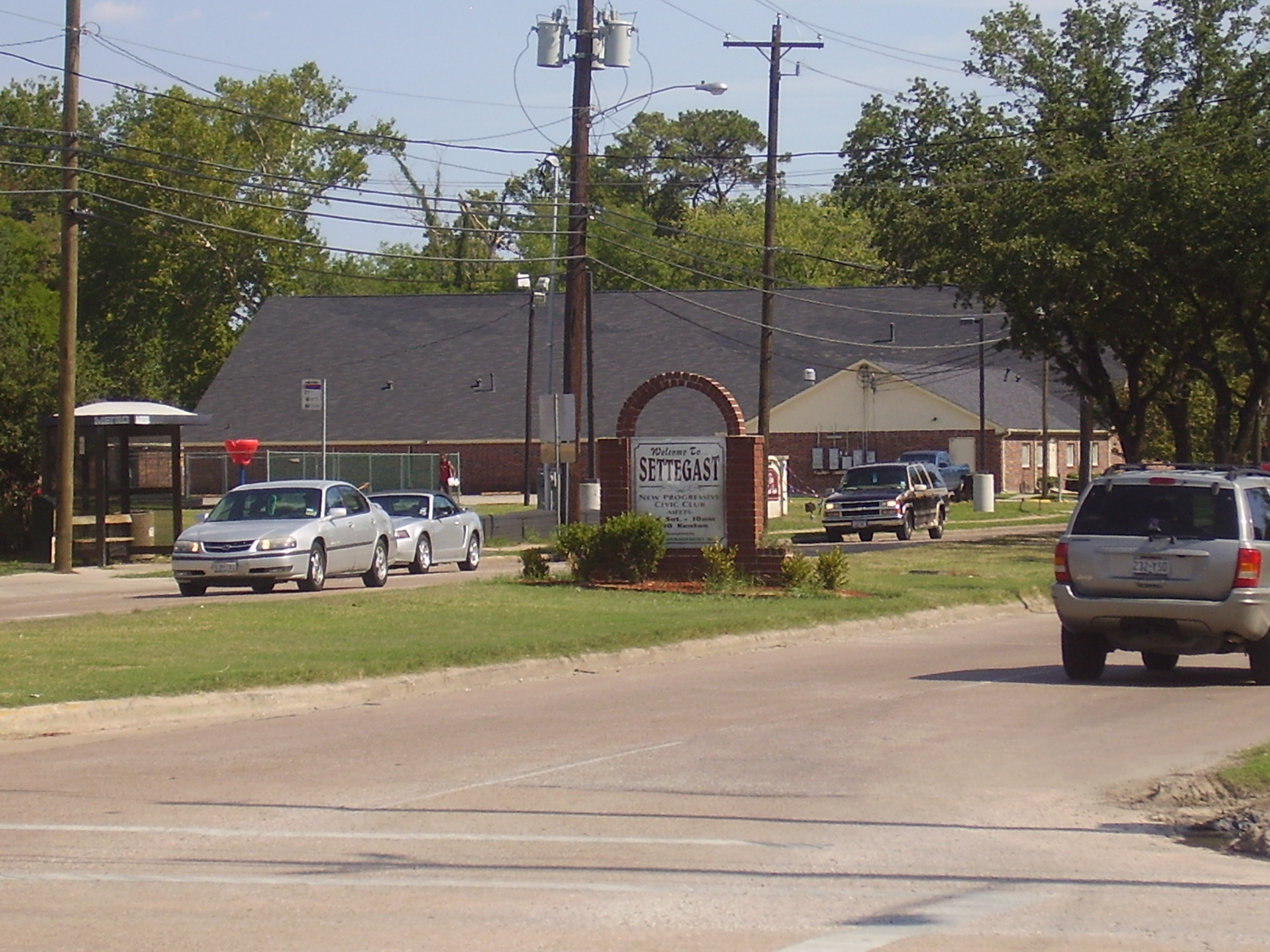
For the last three years, an air control monitor maintained by the Texas Commission on Environmental Quality has detected some of the state’s dirtiest air in Settegast, a northeast Houston neighborhood.
The monitor shows high levels of an air pollutant known as PM2.5, an extremely tiny particle that can lodge itself deep within the lungs.
Rebekah Ward, climate an environment reporter for the Houston Chronicle, spoke to Texas Standard about how the air effects the residents of Settegast. Listen to the interview above or read the transcript below.
This transcript has been edited lightly for clarity:
Texas Standard: So I understand PM2.5, some kind of particulate pollutant, is much smaller than a grain of sand, but can you give us a sense of how the size may factor into just how harmful this pollutant might be for residents?
Rebekah Ward: Absolutely. So PM2.5, sometimes just known as soot, is essentially very small particles of solid or liquid that are so small that they can penetrate deep into the airways. And because they can penetrate deep into your body, they can cause a lot more severe health effects than larger particles that you might more easily be able to see.
The components of smoke that are more visible might not be able to penetrate as deeply, whereas the ones that are so tiny you can’t even see them are actually able to penetrate more deeply and can therefore cause a lot more cardiac problems, lung problems.
Yeah, I was going to ask you about the health effects, because Settegast residents have been living under poor air quality conditions for years. Can you say more about what this means for those living in this neighborhood?
So it’s actually… It’s interesting because Settegast, it is an old neighborhood in Houston and it is the neighborhood with the lowest life expectancy in Harris County.
That doesn’t necessarily mean that that low life expectancy is because of this pollution. However, a lot of the things that people are dying from, including things like cancer, are worsened or made more probable when you breathe in large amounts of PM2.5.
» GET MORE NEWS FROM AROUND THE STATE: Sign up for Texas Standard’s weekly newsletters
The state has yet to have any answers for Settegast residents because of, as I understand it, some sort of technicality. Can you say more about that technicality and what it would take to improve the air quality for this community?
So many individual, small industrial facilities do need to seek permits from our state environmental agency. And that state environmental agency, when a county does have sort of an overage above the federal standard of the levels of PM2.5 that that county is emitting, they can take specific actions to control that.
That can include, you know, limitations on some of the producers of PM2.5, the industrial producers in neighborhoods like Settegast. But in the case of Harris County, because the monitor in Settegast is actually quite recent – it was only installed a little over three years ago, and it takes three years of continuous data to even determine if you’re out of compliance with the federal standard and then another potentially six years before they have to start implementing any plan to make it better…
That’s a long time for people to live with pollution after they realize how bad it is.
I understand, historically, Houston residents have had to deal with another air pollutant that causes health issues. Can you say more about what you were reported on, what this may mean for a solution for Settegast residents?
Another pollutant that Houston residents have long had to deal with high ozone levels. And ozone is a pollutant that forms in the atmosphere. So some of the same polluters contribute to both PM2.5 and ozone, such as car exhaust has both particulate matter and it has the [volatile organic compounds] VOCs that contribute to ozone pollution.
But the fact that for years, Harris County has been out of compliance with the federal ozone standard and has not yet since it fell out of compliance, been able to bring those levels back down, does not necessarily bode well for its ability to bring us under the threshold for PM2.5.