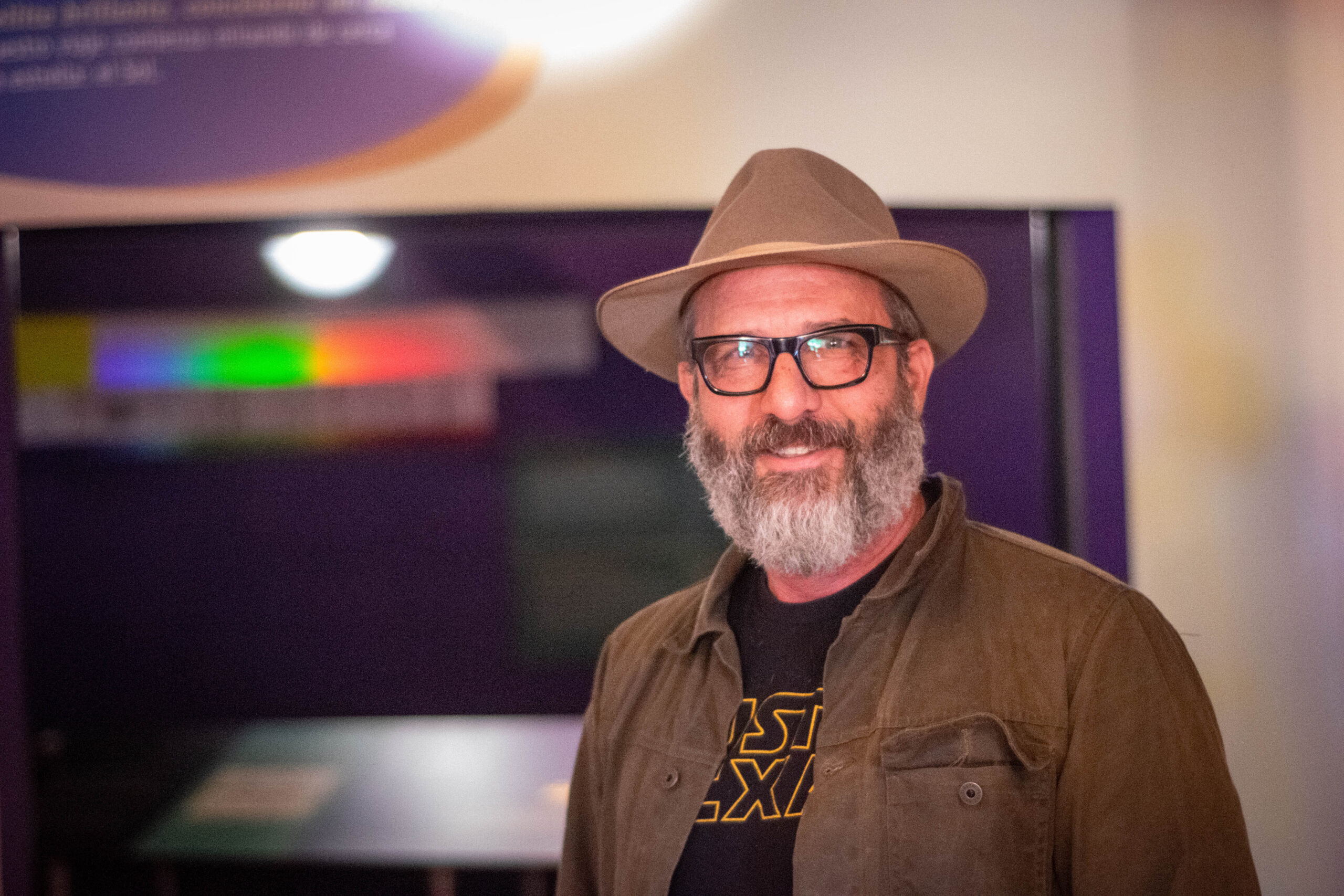
Billy Henry helps bring the stars within reach in his role as the host of StarDate, which airs on public radio stations across the country.
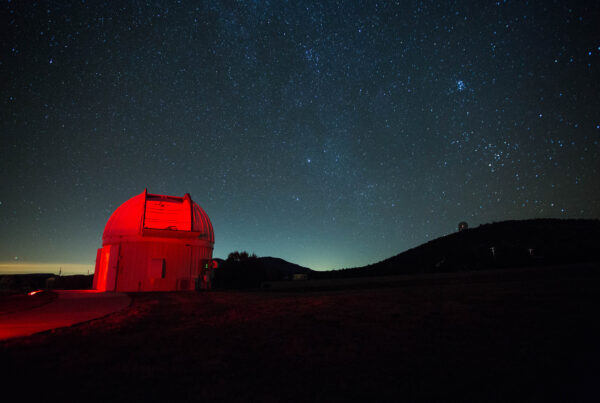
He sat down with Texas Standard during our broadcast from the McDonald Observatory to talk about what he’s learned and what he thinks of when he looks up at the night sky.
This transcript has been edited lightly for clarity:
Texas Standard: Well, you are the third host of StarDate and had some big shoes to fill. Had you heard StarDate before this opportunity came up?
Billy Henry: Oh, absolutely. I worked with both of them at different points, Joel Block and Sandy Wood. Sandy used to record in the same studio that I was a composer at for years and years.
And then my assistant Shayna Brown, she recorded all those for years. It had to have been ’98 or something that she started doing those and recording that there. And then Sandy, I think she did it total like 29 years or something like that. And then Joel did it before, and now me, six years, I think.
Which episodes do listeners seem to respond to the most?
Let’s see. Most of the time there’s a, you know, “walk outside and look to the west” and see stuff. So they usually like those.
But interestingly enough people sometimes write in and go, “you know, you should do a story on ___.” And we’re always like, yeah, we did that, but it was 28 years ago. So those, I don’t know, I wonder.
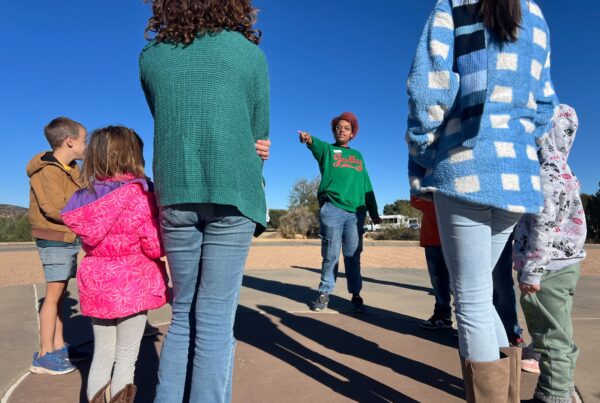
» MORE: Homeschool day at the McDonald Observatory: ‘Kids ask the best questions’
Yeah. It goes around and around and around. Can you share something that you’ve learned as a host that kind of blew your mind?
Oh my gosh. Every time I read a script, it blows my mind. I think the distances are the things that I can’t wrap my mind around.
I couldn’t even process meters when he was talking about size. I was like, could you give that to me in inches?
Even the telescopes. I mean, you come out here and you see the telescopes and you can walk around it … yeah, I think the distances in light-years. So you’re thinking, oh, just go a hundred thousand – I mean, that’s like nothing – a hundred thousand light-years away, and you can see that with a telescope, but the light is a hundred thousand years old … it just starts to, like, break your brain.
Well, you know, a meteor shower is a great thing to mention on StarDate. Are there times when there’s just not as much going on in the night sky and you have to like dig deep?
No, it’s always something. Or we there’s an anniversary of, say, first person on the moon, all that kind of stuff. So never. And even like what you might start to think is mundane.
Thinking back on your other question, probably the moons. When we talk about the harvest moon, that seems to be a big popular one.
Something I learned that through StartDate, going back to the other question, was that the moon is the same size, it’s just our perception of it – meaning like even if you were to measure it, right? Like we have the horizon, and it looks like the moon is huge. And then it gets into the sky … so you know, it can be closer, it can be further away and all that kind of stuff.
Let me ask you, what do you think of when you look up at the night sky?
Time. And small. Just 13 billion light-years?
I mean really, I don’t even know how to … I remember as a child looking up in the middle of a field out in the country and just going, why is it so bright out here? There’s no moon; it’s the stars. You know, how many could there be?