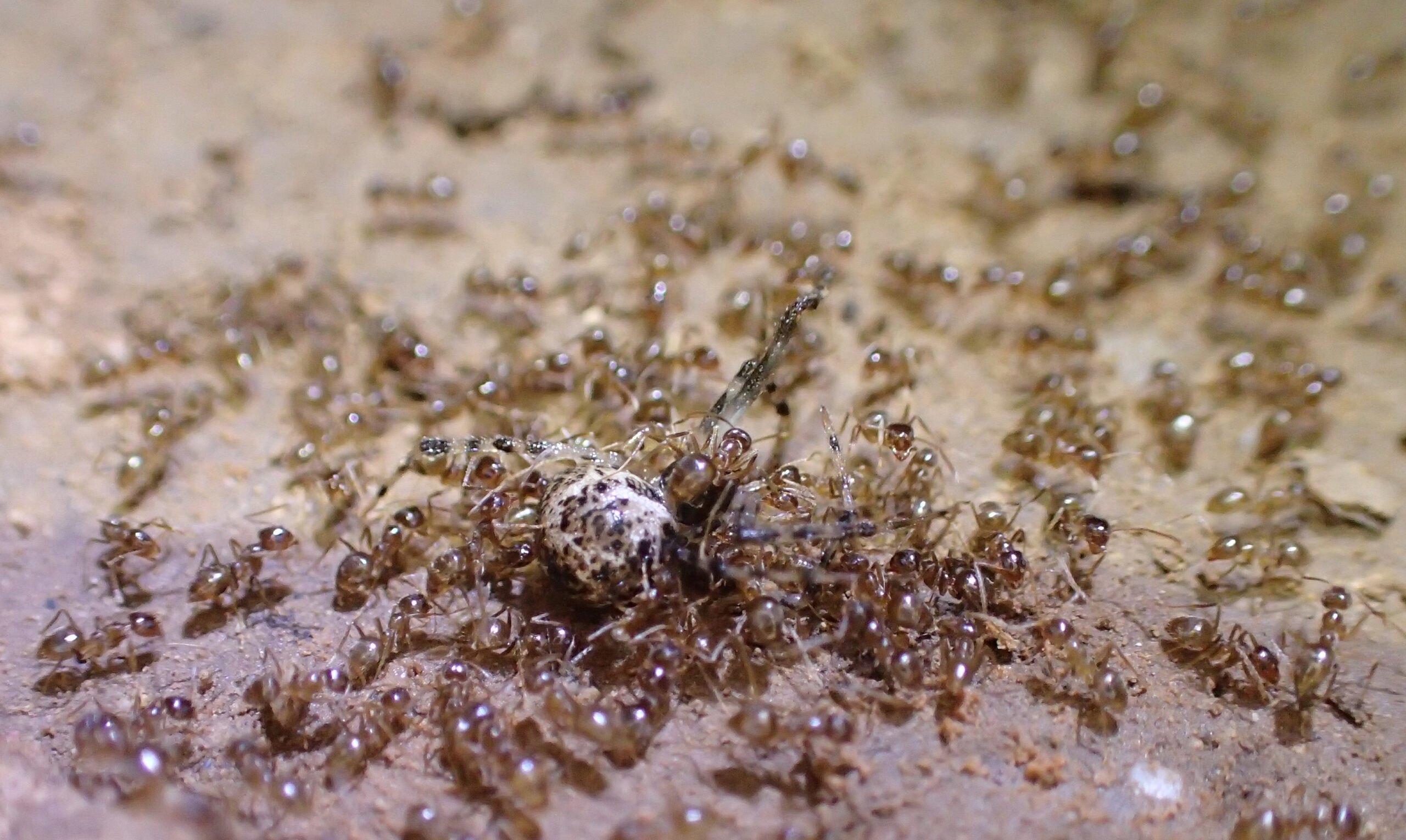
Tawny or Rasberry crazy ants have been a problem in Texas for at least the past two decades.
They’re an invasive species that was first spotted around Houston and have made their way to parts of South and Central Texas. While they don’t sting like fire ants, they can bite and they’ve created their own set of problems.
Some years back, researchers at the University of Texas discovered what they called a “kryptonite” for crazy ants. And now there’s more hope for ridding them from Texas.
Edward LeBrun has been leading this effort at UT. He’s a research scientist based at the Brackenridge Field Laboratory and joined Texas Standard to discuss their efforts. Listen to the interview above or read the transcript below.
This transcript has been edited lightly for clarity:
Texas Standard: Well, let’s first remind folks why we want to get rid of tawny crazy ants in Texas.
Edward LeBrun: Tawny crazy ants, as you said, they’re an invasive species, and unlike some introduced ants that just stay in urban environments, tawny crazy ants invade a variety of natural habitats and they eliminate a large fraction of the insect fauna in these environments, which creates all kinds of cascading problems.
They’re an extreme nuisance to live with for people. They come into structures in really large numbers. There’s some very environmentally damaging pesticides you can use to keep them out of your house, but there’s no effective chemical way to deal with them on the landscape.
So people in sort of the southwest corner of Texas might have these in their yards. Would they know if they’ve got them or would it be hard to tell?
So they’re sort of in the southeast down through the Gulf Coast region. And yeah, if you live in these environments, you know it. They’re not like fire ants. They’re, not all over Texas. They’re in isolated super colonies is what they are.
And in these environments, which can be several kilometers in diameter, they are very, very dense. And so when you go outside, you see ants everywhere. And you only see tawny crazy ants. You don’t see any other kinds of ants.
» GET MORE NEWS FROM AROUND THE STATE: Sign up for Texas Standard’s weekly newsletters
So several years ago now I mentioned you guys discovered a natural pathogen that one ant could help spread to others, wiping out a colony. Why was that only half the battle?
We can introduce this pathogen by introducing live, infected ants into an uninfected super colony. And the reason that is possible is because all the super colonies of tawny crazy ants in the southeastern United States are the same super colony, they’re descended from the same introduction and they share the same genetic cues that determine colony recognition, how ants tell if another ant is part of their colony or not.
And so it seemed like it should be very simple to move the pathogen around, but it proved quite difficult.
Why was that? They kind of outsmart us in a way. Is that right?
So when we were working in the laboratory, what we found was that if we introduced infected ants into a nest box of uninfected tawny crazy ants, the disease transmitted 100% of the time. But in nature we struggled.
Ants use a variety of behaviors to protect against disease transmission. Infected ants, when they’re introduced near the queen, the core of the colony, they migrate to the periphery. And they take on primarily the task of removing dead bodies from the colony.
Whereas, uninfected ants do a variety of different… All the foraging and the care for brood. In this disease, in order for it to transmit, infected workers have to take care of larvae. Larvae are the only ants in the colony that are susceptible to acquiring the infection.
So, initially, when we’re doing inoculation efforts, we’re either introducing onto foraging trails, which are distant from the colony, or we were very carefully introducing into the nest without trying to disturb the nest as little as possible in order to preserve this host nest that was going to be our breeding ground for the pathogen.
What we’re doing now, instead, is we are destroying a three-dimensional structure of the nest, forcing them to go to a new nest site and reorganize.
So when we talked to you back in 2022, you were excited, but you recognized that where you were at the moment wasn’t gonna help the homeowner get rid of their crazy ant population, at least on a large scale. Are we getting closer to that now?
Unfortunately, not a lot has fundamentally changed about the economics of this activity.
So we are helping some homeowners that happen to live near preserves and other natural areas where we are doing this inoculation to protect endangered species and sensitive habitats.
The work from inoculations to the ant population starting to decline is two to five years. It’s costly, it’s labor-intensive. If we can get public investment, we can take care of whole super colonies, but for an individual homeowner, an individual lot, it’s too expensive for too delayed of a benefit.