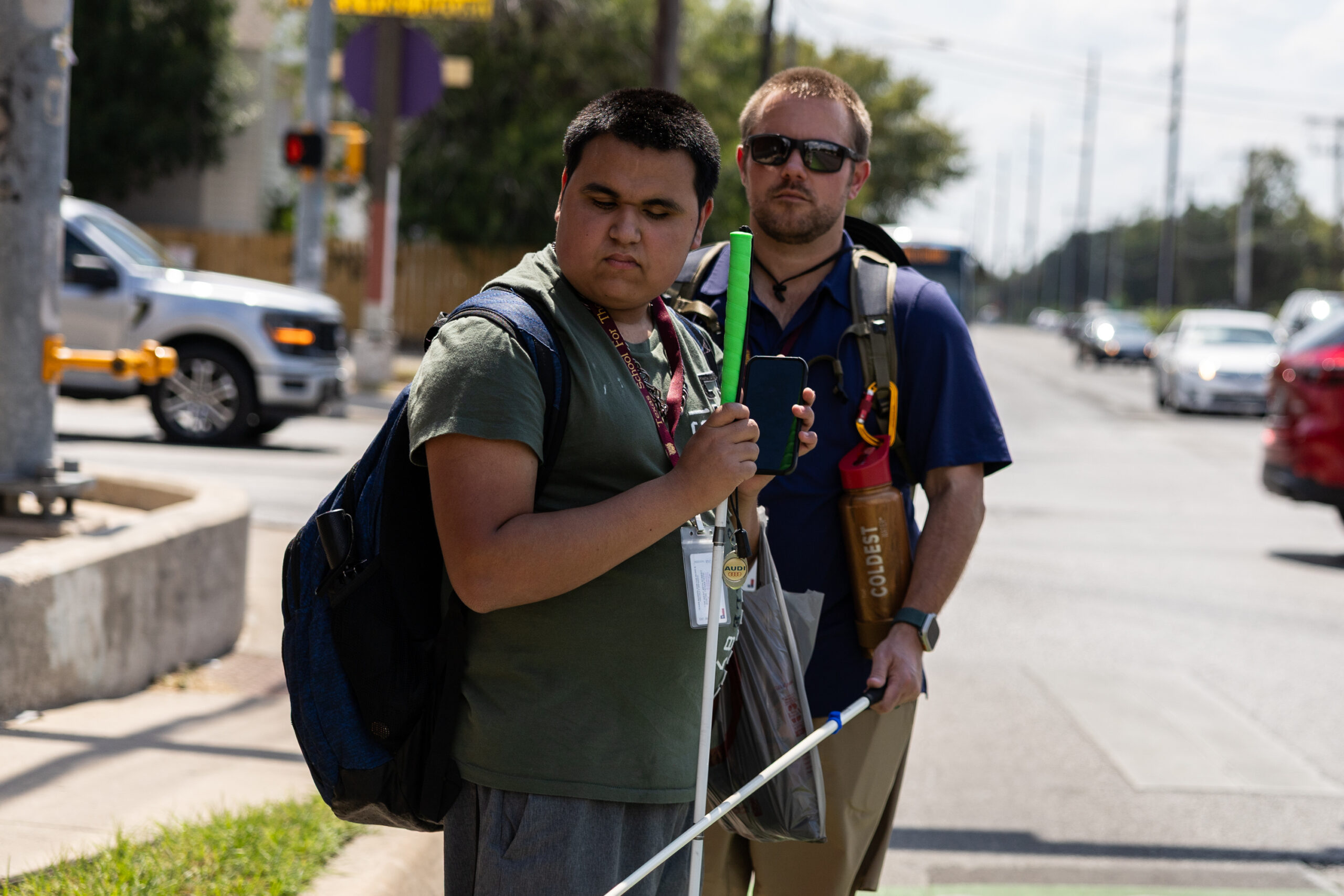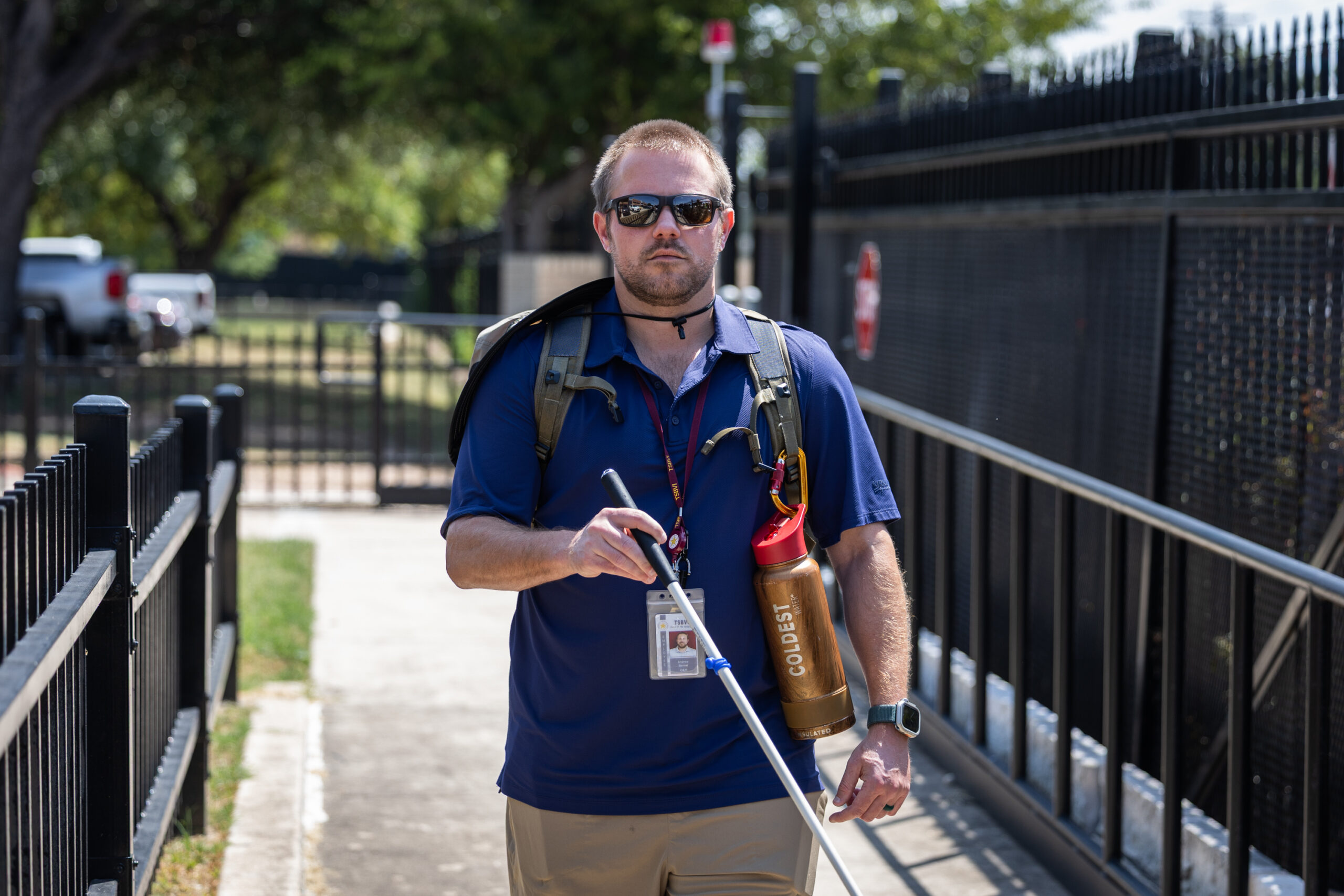
On a sweltering morning near the University of Texas campus, Drew Bernet took me on a walk.
Bernet lost his vision about a decade ago when he was in college and studying to become a veterinarian, which means that in order to get around safely, he uses his smartphone, assistive technology, help from strangers and a long white cane.
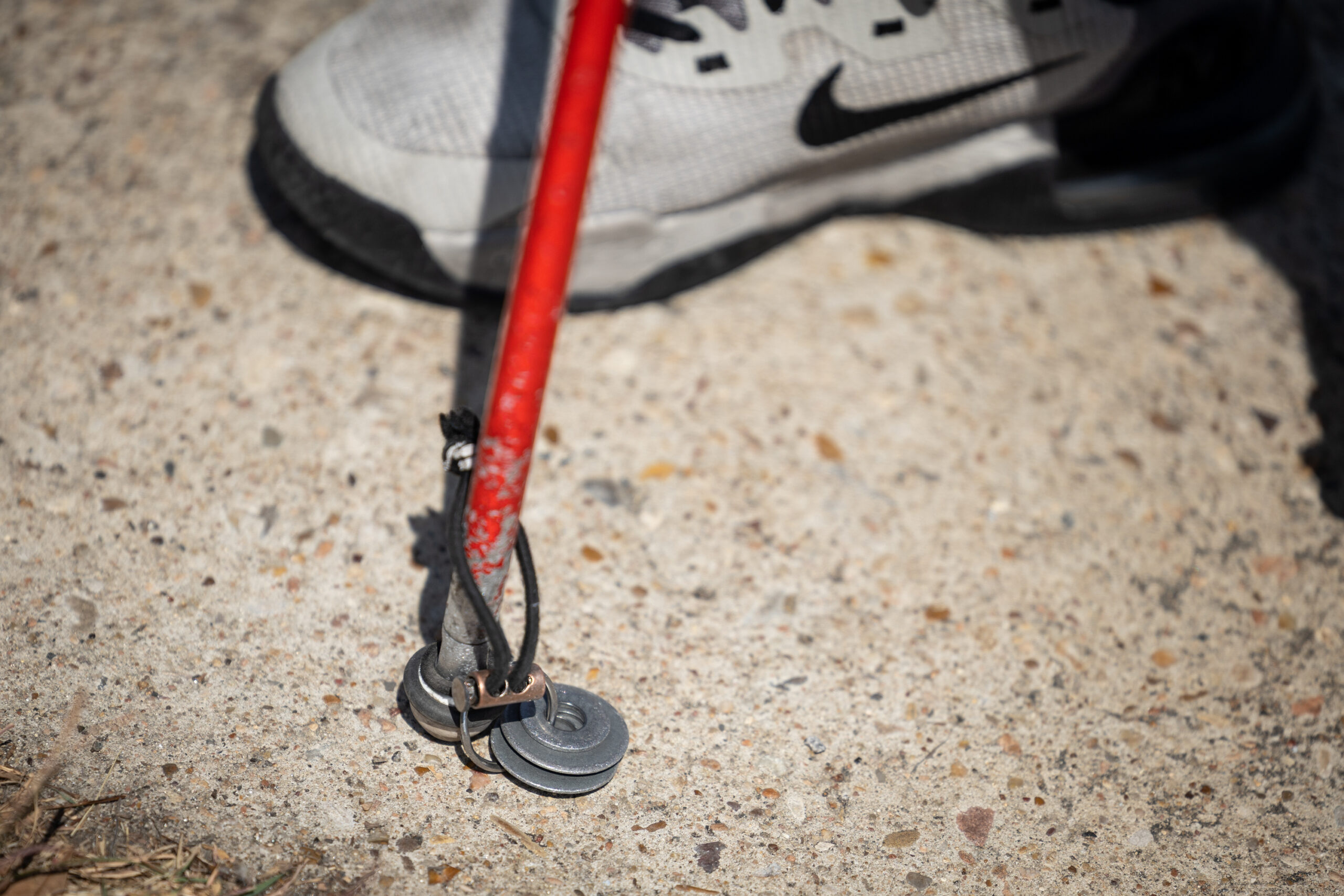
As he walked along the sidewalk, he’d gently swing his cane a few inches past his body and tap the ground. He’d then lift it up, swing it to the other side and tap again.
“It’s a side-to-side arc, kind of like a pendulum going back and forth,” he explained.
This technique is called two-point touch and it’s one of many taught in orientation and mobility (O&M) training, the field of study that teaches individuals with blindness and low vision.
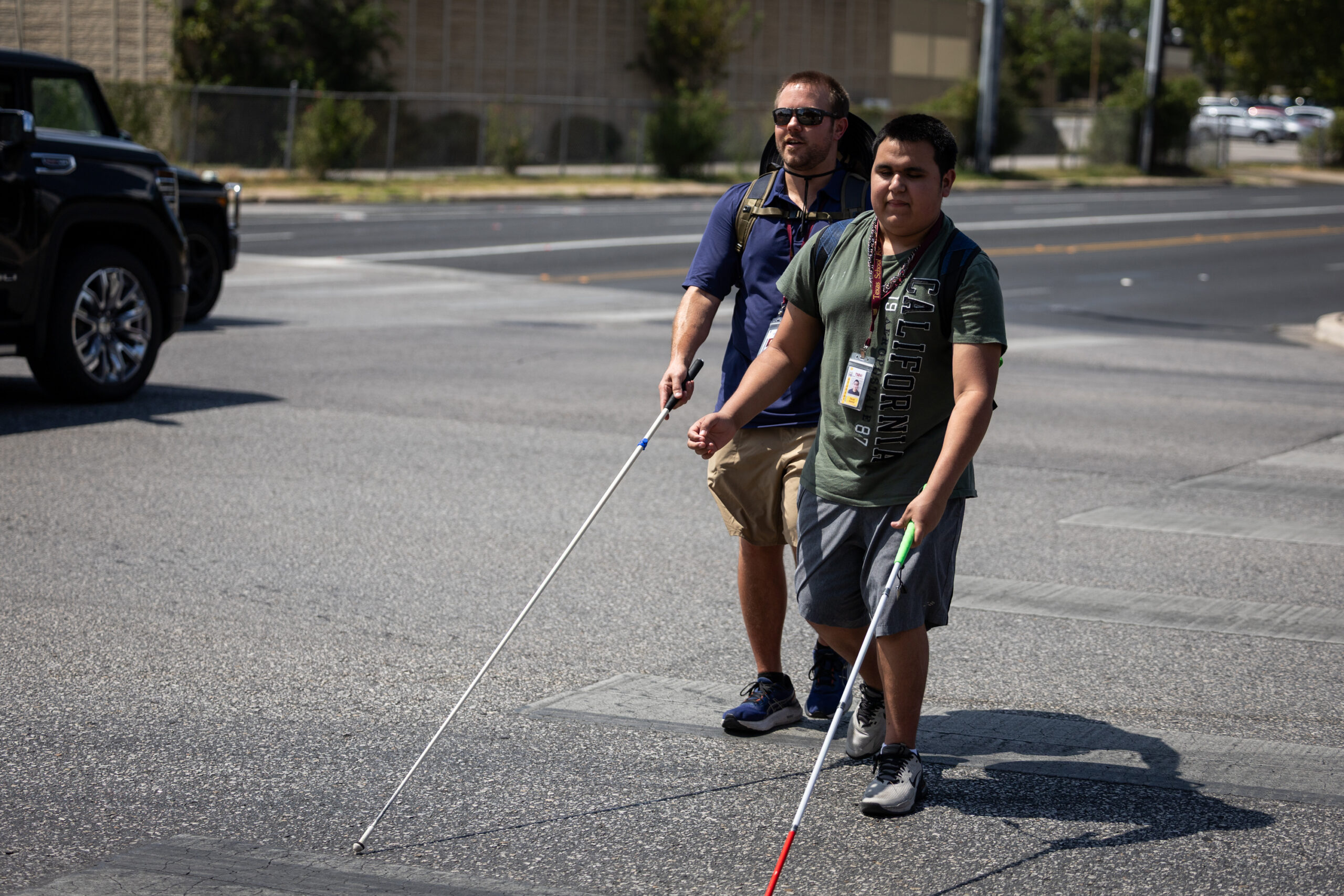
During our walk, Bernet showed me his process for crossing busy intersections. As we approached a street corner, he paused and listened to the flow of traffic.
“I can imagine a line based on the sound of traffic,” he said.
He knew that the streets we were on run on a grid system and connect at 90-degree angles so when he hears cars drive by, he can mentally draw lines and figure out where the intersection is.
Bernet uses this information to align himself and when traffic to his side starts up, he goes for it.
“More times than not, parallel traffic acts as a blocker for any perpendicular traffic,” said Bernet, “and so if you go while they’re going, then it’s relatively safe as you can get for crossing.”
The method Bernet showed me for crossing streets doesn’t rely on guidance from strangers or use of the pedestrian push buttons found on many street corners.
“There’s a lot of buttons that are still older and [not helpful],” he explained. “Relying on the sound of traffic is really the thing to do.”
People who have blindness or low vision have been around forever, but the field of orientation and mobility is relatively new.
“Any kind of formal anything really didn’t start until the veterans from World War II came home blinded and nobody knew what to do with them,” said professor of special education at Texas Tech University Rona Pogrund.
The first university program for O&M instructors was launched at Boston College in 1960 and today there are currently just 19 universities in the U.S. that offer O&M certifications.
Texas has two of them: Texas Tech University and Stephen F. Austin State University.
Each program currently has between 50 and 60 students studying to be visual impairment professionals. In addition to navigation techniques, students learn about the origins of and challenges in living with visual impairments.
The overwhelming majority of people who go into O&M careers are sighted, which means that as part of both Tech and SFA State’s curriculum, students go under blindfold and practice the techniques they’ll be teaching.
“They usually love that because it’s really pretty intense,” said Pogrund. “Some of them are scared and by the end they’re all cool and they love the experience.”
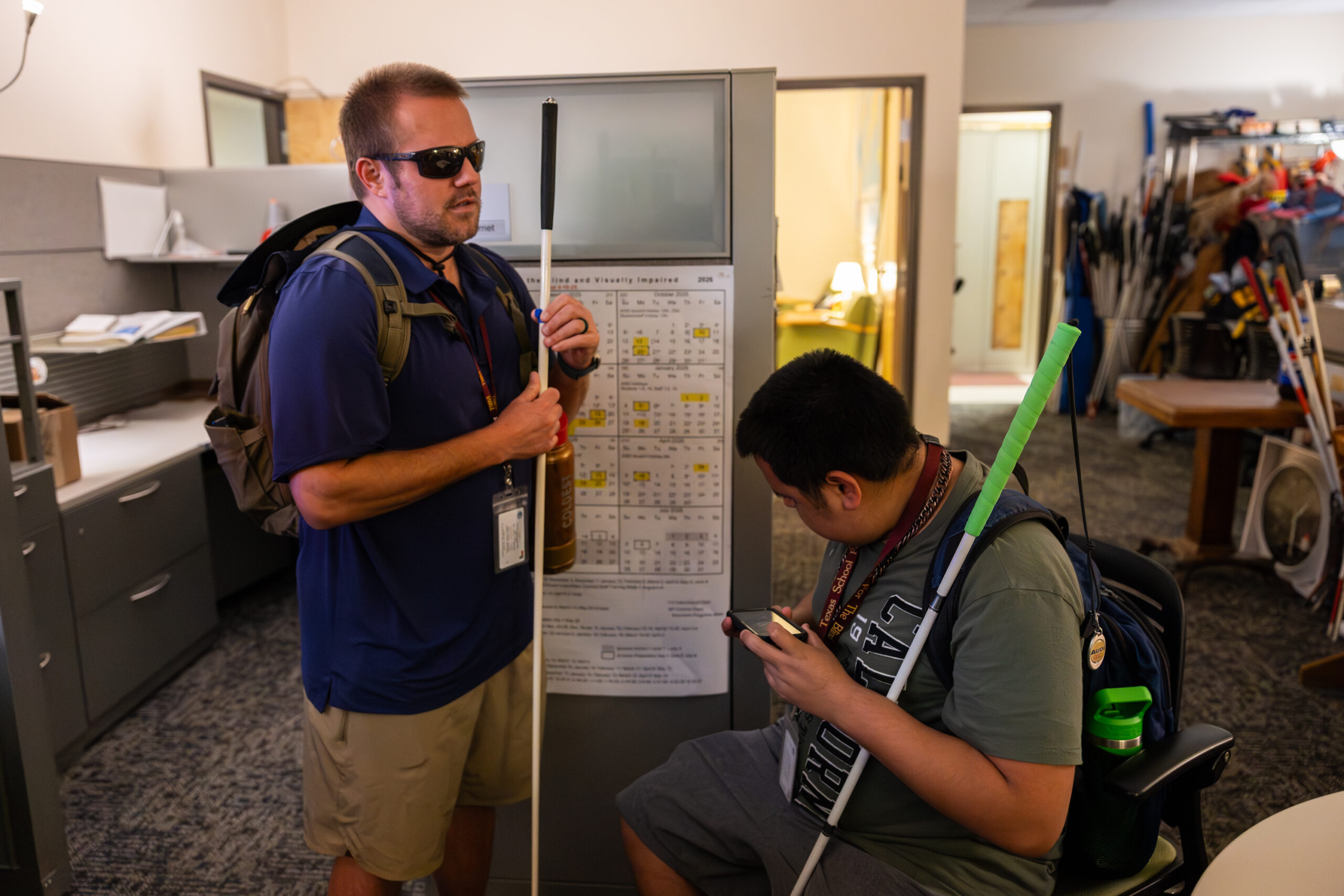
One of the people who went through this process was Bernet, who graduated from SFA State and now works with the Texas School for The Blind and Visually Impaired (TSBVI).
He’s one of nine O&M trainers who works at TSBVI and he has a caseload of sixteen students who he teaches the same techniques he had to learn for himself.
“The only thing you really need is a white cane,” said Bernet.