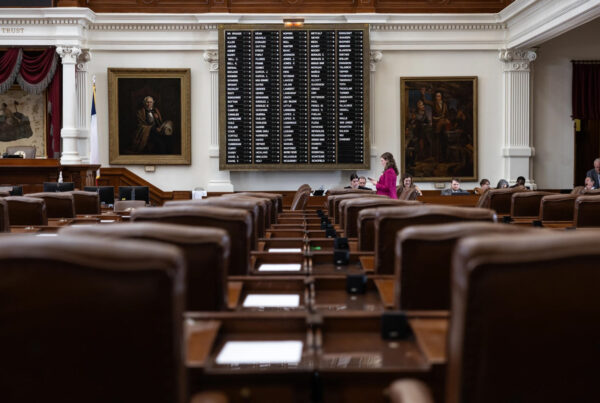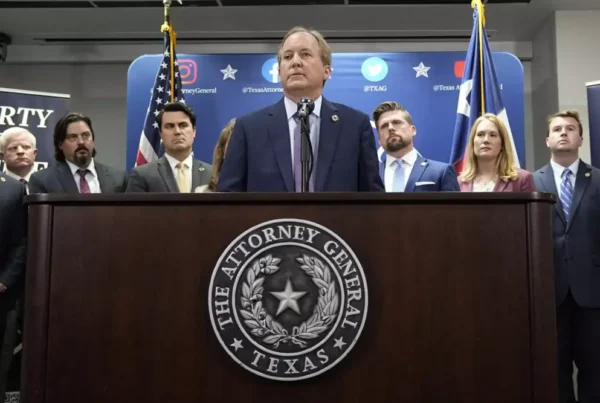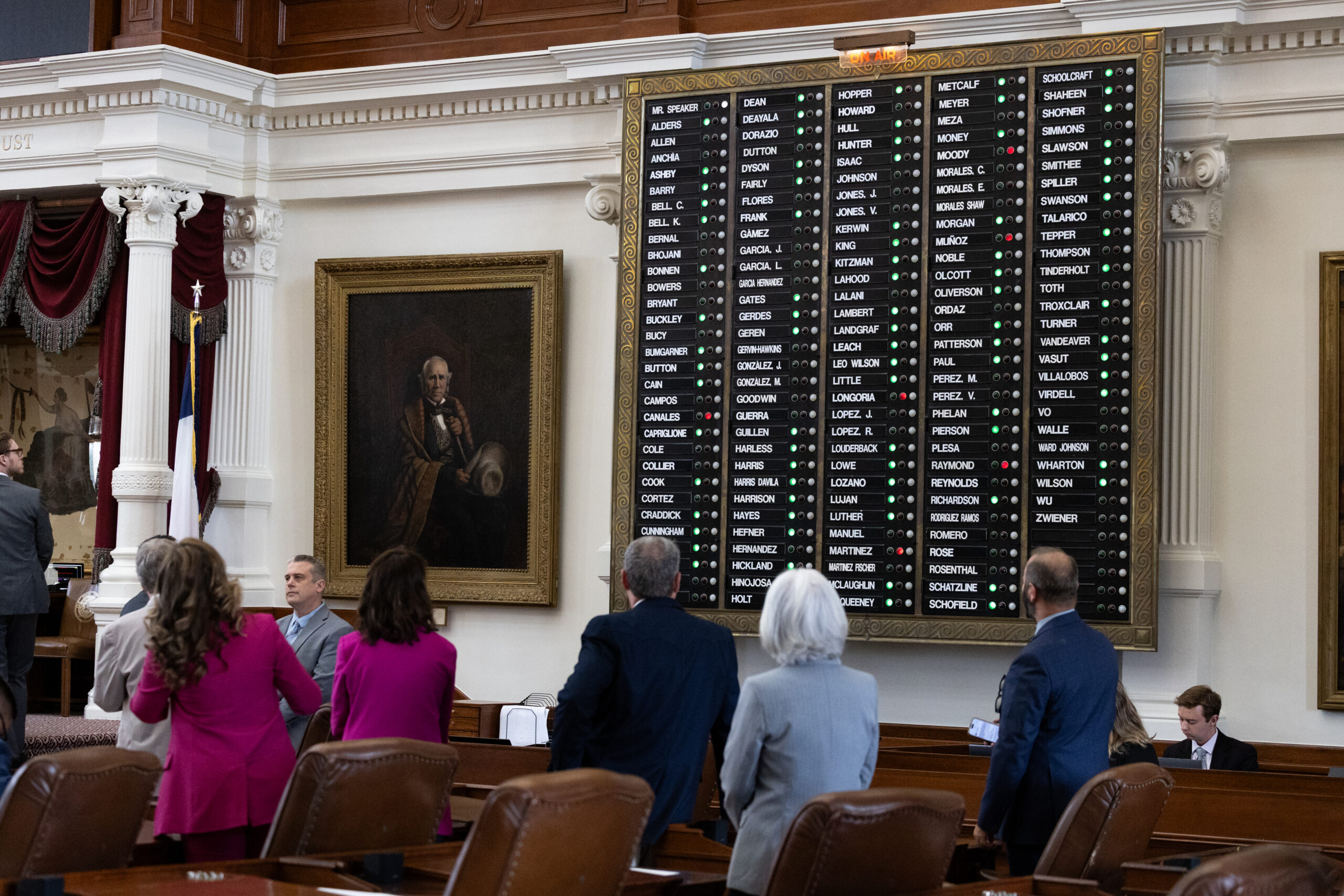
Texas House Democrats have left the state to delay congressional redistricting set to favor Republicans. If all this sounds familiar, it’s probably because Texas Democrats walked out in 2021, in 2003, and beyond.
As in many other states, Texas has a long history of partisan redistricting and gerrymandering. In the early 20th century, the state regularly elected its entire congressional delegation at large because legislators could not agree on district maps. And well into the 1950s, Harris County was represented by a single congressman with more than a million constituents.
Texas Standard spoke with historian Daron Shaw, Frank C. Irwin Jr. chair of state politics at the University of Texas at Austin, about the long history of partisan apportionment in the state. Listen to the interview above or read the transcript below.
This transcript has been edited lightly for clarity:
Texas Standard: Has redistricting always been a partisan fight in Texas?
Daron Shaw: Well, yes and no. It’s always had strong partisan dimensions, but Texas was essentially a one-party state.
After the Civil War, the Democratic Party was ascendant. In fact, a lot of the laws that we have on the books with respect to primary processes, et cetera, assumed that there was one party and that if you didn’t allow any registered voter to participate in the Democratic Party, that person basically had no say in who represented them in Congress or in the Senate or, you know, ultimately electoral college votes.
So you’ve had internecine fights within the Democratic Party over district lines, et cetera, but within the context of the Democratic Party utterly dominating the state politics. So it’s kind of an interesting story.
It’s a classically Southern story. This is not exclusive to Texas. You’ve seen it in other Southern states as well. But party politics have always mattered. Historically, though, the internal politics of the Democratic Party, sort of conservative versus moderate, have been more at the forefront of redistricting than traditional Republican-Democratic differences.
A big portion of that time there were concerns about Texas using apportionment to entrench segregation. This was especially true during the Civil Rights era, right?
That’s absolutely correct. And in fact, when I say “conservative Democrats in Texas versus moderate Democrats,” that conservatism is largely defined by the issue of civil rights.
What marked the end of that period and the way that partisan apportionment is seen today?
Well, there’s a couple of really important facts. The first is the passage of the Civil Rights Act in 1964, and then by extension, the Voting Rights Act of 1965, which outlawed all sorts of pernicious electoral practices that were occurring in a lot of places, but certainly in Texas.
Classically, we call these white primaries and grandfather tests and literacy clauses and things like that that disenfranchised African-American voters. Those are sort of at the level of the individual voter.
But it’s also the case that that legislation was of a piece with federal statutes that mandated one-man, one-vote requirements. And one-man, one-vote requirements mean that you have to draw districts in a way that there can be no more than a single voter discrepancy in the total number of eligible voters in a particular jurisdiction.
So in other words, you can’t have the situation you mentioned earlier where the entire Houston population is represented by a single person, and West Texas has two or three people representing a much smaller portion of the population.
» GET MORE NEWS FROM AROUND THE STATE: Sign up for Texas Standard’s weekly newsletters
Does today’s redistricting effort at the Texas Capitol differ in any substantive way from past partisan gerrymanders? Does it seem to cross a line that others have not?
Here’s the argument: I think the argument would be that in the 2003 case, in advance of the 2004 elections, the maps that had been adopted after the 2000 census were from a redistricting commission. The Republicans had a majority. Bill Ratliff, you’ll recall, a famous centrist Republican, had basically sided with a more moderate map that left in place a lot of the lines from the 1990 census.
Now, the 1990 was a particular Democratic gerrymander. You know, it was one of the greatest of all time. Michael Barone famously said, “It’s a work of art. It ought to hang in the Louvre.” Republicans were dissatisfied with that map. And so, under the urging of Tom DeLay, they reconvened. But that was the first time the Texas state Legislature had taken a whack at drawing lines after the 2000 census.
In this case, the Texas Legislature has already had a whack at it. They’ve already taken a bite at the apple. These are their lines. And so, one of the objections is that y’all could have done this last time, that you drew a fairly conservative gerrymander, largely because Republicans, I think, were concerned that the flight of suburban communities towards the Democrats that occurred after the 2010 census and redrawing of lines had cost them some seats.
And so, I think they, instead of being okay with a 55-45 Republican seat, they wanted 58-42 Republican seats, right? A little more margin built in. And that kind of limited the districts that they were claiming. With the results of the 2024 election, and particularly the movement of Latino voters away from the Democrats and towards the Republicans, I think they regret that.
So, it is, of course partly the urging of the president and the national political context of the desire to get more Republican seats to keep the Republican majority for 2026. But I also think that there’s a sense within the Texas delegation that they probably could have done more. They look at the maps in Illinois and California, and I think there’s a little bit of, you know, “boy, we should have gotten more out of that.”
What is the end game, at least if you are a Texas Democrat? Do you just stay out of the state until November of 2025, which would be the deadline for declaring your intention to run for office, or couldn’t the governor continue to call special sessions ad infinitum?
Yeah. The reality is that the hand the Democrats have here is pretty weak. I think the longest quorum-busting effort we’ve had is 60 days. And you can see why.
People have emphasized Abbott’s legal threats to arrest them, to vacate the seats under an advisory opinion of the AG, to go after them for the sources of revenue from which they’re paying fines for missing days, and all that kind of stuff. But I actually think the political and the family pressures are the ones that eventually end these quorums.
The political pressures are that it’s not just redistricting that’s on the agenda in these special sessions. There’s aid to families in Central Texas, victims of the flood, there’s some education and health issues that are gonna be on the table. And I think Republicans will point to quorum-busting Democrats and say, “look, because they want Democrats to do better in the national elections, they’re neglecting the business of the people of Texas.”