For over two decades, the Texas Dream Act gave undocumented Texans the chance to attend college at the cost of in-state tuition. Now, Texas public universities have started their first full semester under new tuition rules that are at the center of a federal court fight.
A lower court order siding with the Trump Administration’s Justice Department challenging the Dream Act is under appeal right now at the Fifth Circuit.
On campuses like UT-Austin, this isn’t some legal abstraction. Spring tuition bills have already gone out under the new classifications and students are having to adjust in real time.
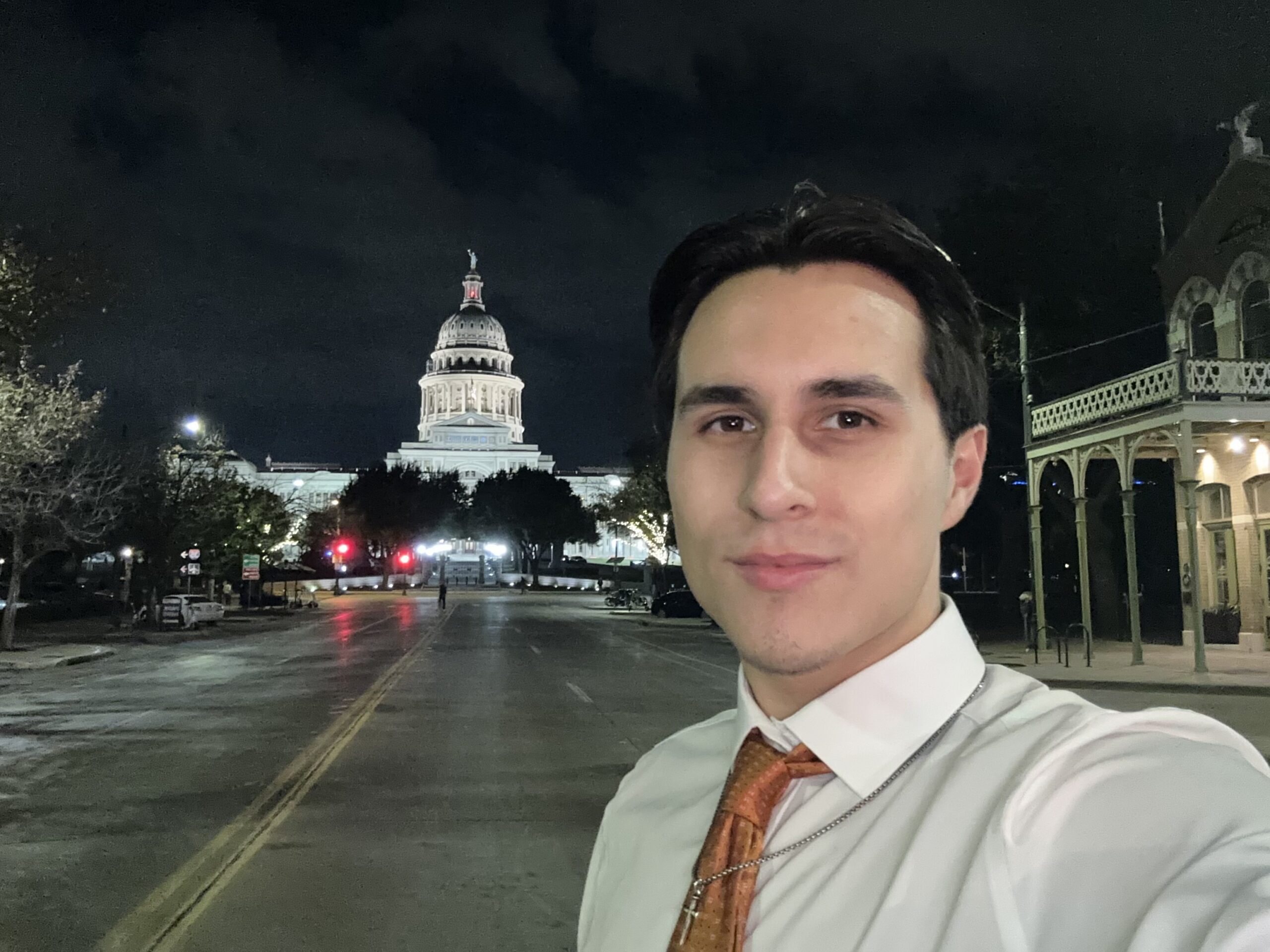
Marco Julian Gonzalez is a dual-degree double honors junior at UT and a member of Sigma Lambda Beta, a Latino-founded fraternity whose Eta Alpha chapter has stepped into the legal fight as amicus in US v Texas alongside the Xi chapter of the Latina-founded Sigma Lambda Gamma Sorority. The Pi chapter of the Latina-founded Kappa Delta Chi sorority also aided the efforts.
Listen to the interview in the player above or read the transcript below.
This transcript has been edited lightly for clarity:
Texas Standard: Can you briefly explain, in everyday terms, what’s changed this semester and what students are seeing in their tuition bills?
Marco Julian Gonzalez: Yeah, and I guess I’ll pick up on what we’re not seeing – is thousands and thousands of students all over the state of Texas attending these in-state public universities that they’re admitted to because they can’t afford the cost of tuition.
What we have seen is some of the people that we know, their tuition bills have spiked from some, I don’t know, $7,000 for a semester to about $22,000 a semester – seemingly overnight.
» RELATED: College students relying on the Texas Dream Act remain in limbo with the fall semester looming.
You’ve described this as a rare moment where student organizations move from legislative advocacy to state rulemaking to now, here you are, in a live federal appeal.
What did that journey look like from your vantage point as a member of this fraternity joining into this huge legal fight?
We know many people who are affected by the end of the Texas Dream Act – and I guess not the end because it’s still in litigation, but right now it’s not in enforcement, right? And 57,000 students across the state of Texas, many of these students feel that they can’t speak and share their own testimonies because of the predicament that they’re in.
So we feel the need to step in and be able to speak for them, for the people we know, for the people that are being called, I would say, unjust labels.
These aren’t members of Tren de Aragua or MS-13. These are students that study in the same libraries, go to the same dining hall, go to same rec here at UT-Austin alongside of us. We know who they are, we know who [they] aren’t.
The appeal is still pending in the Fifth Circuit Court. Can you give me an example of how this is affecting the lives of some of your fellow students?
For example, I have a friend who dreams of being a doctor. She was brought here when she was really young, went to our Texas public schools, graduated from Texas high schools, remembers the Alamo, remembers everything about Texas. And they got here to University of Texas at Austin.
This was supposed to be their senior year. They were expecting to apply to different medical schools to be a doctor because they want to help save lives in the state of Texas. And because of this, she has all of her requirements for her degree met, except for some semester or two. And that semester or two is charging her about $22,000.
She and her family weren’t expecting that type of price, right? And so now she’s had to unenroll, put her educational career on pause until we can see the outcome of this litigation.
For me and my fraternity, it’s not about politics, it’s not about party. For us it’s about the people, the people that we know in our lives who are affected.
I know you mentioned specifically that this isn’t a political thing. This is about the impact on others. And yet, here we are in a very important election season.
Do you imagine that there will be any political implication as a result of these changes, or not so much?
To be honest with you, I never asked that question. It kind of goes back to – I mean, we never expected to be where we are today, right? We never expected to testify in front of the Legislature, the state executive committees. We never expected to be named the amici curiae in the federal circuit court. It just so happens to be, you know, one step along the way, here we are.
We feel like we’re here to defend meritocracy in America. We feel the political implications that Texas prides itself on the free enterprise system. And these students did everything that the state asked them to do: got good grades, studied for the SAT, ACT, to get to where they are today because they’re hardworking. They dream to be an American and they dream to be a Texas citizen.
And that’s part of the implications of the Texas Dream Act. In order to be eligible, you have to commit yourself in a sworn affidavit to pursue lawful, permanent status. These people want to be Americans. They’re already tax-contributing, and so I feel the biggest implication is just that, you know, a loss to the meritocracy in our state of Texas.