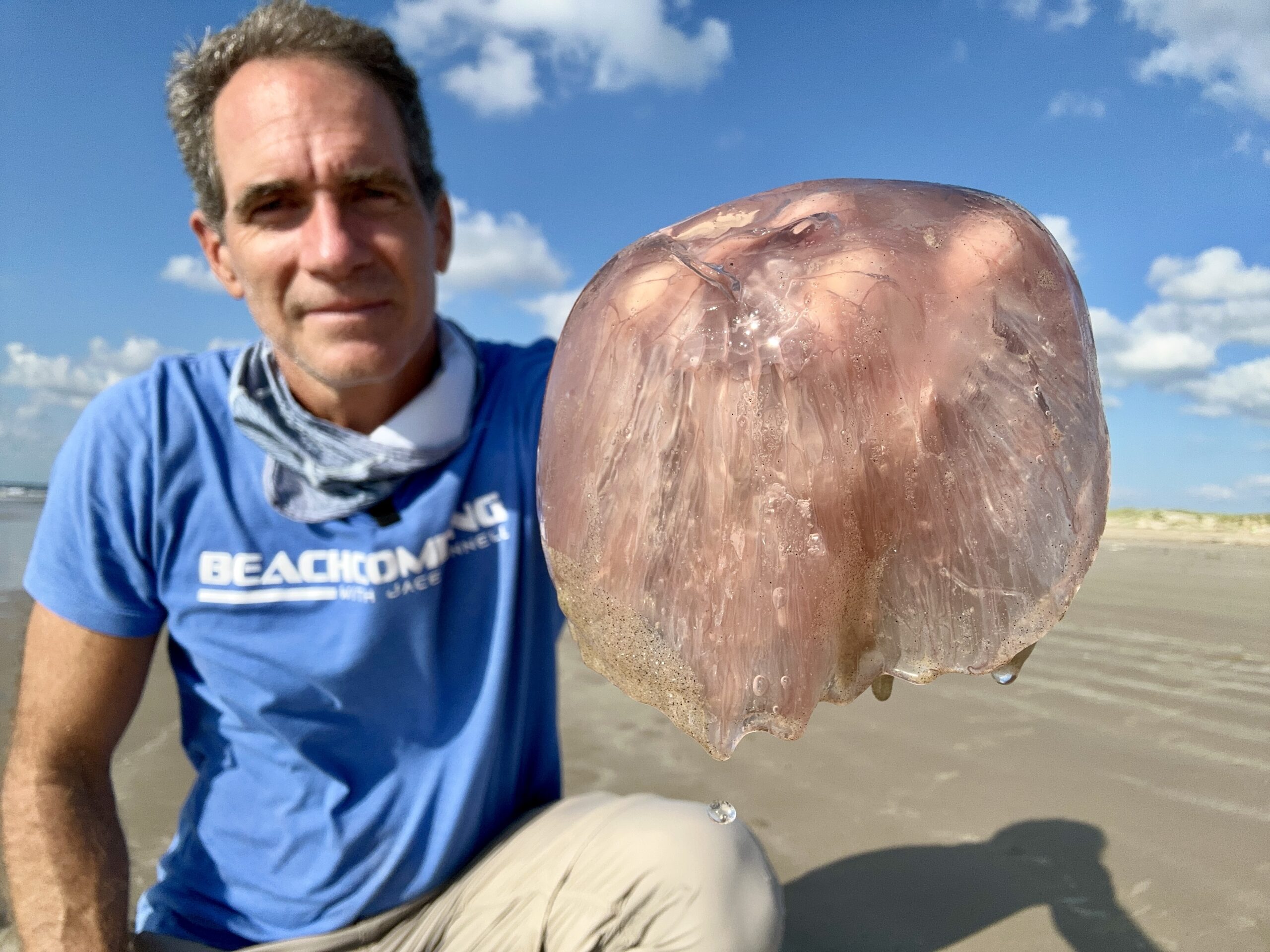
‘A once-in-a-lifetime thing’: Rare ‘pink meanie’ jellyfish descend upon Texas shores

Jace Tunnell, of the popular “Beachcombing” YouTube series, says the species may be around these waters until the first cold front.

By Raul AlonzoOctober 14, 2025 9:40 am,

Texas beaches draw vacationers to the Lone Star State all year long – especially as summer temperatures stretch well into the fall months.

Now, a rare jellyfish is among those visitors soaking up the last bit of summer.

It’s called a “pink meanie,” and if you take a walk along the shores near Port Aransas and Corpus Christi as much as Jace Tunnell does, you may be lucky enough to spot one.

Tunnell is the director of community engagement at the Harte Research Institute and host of the popular “Beachcombing” series on YouTube. He joined Texas Standard to share details about the pink meanie. Listen to the interview above or read the transcript below.

This transcript has been edited lightly for clarity:
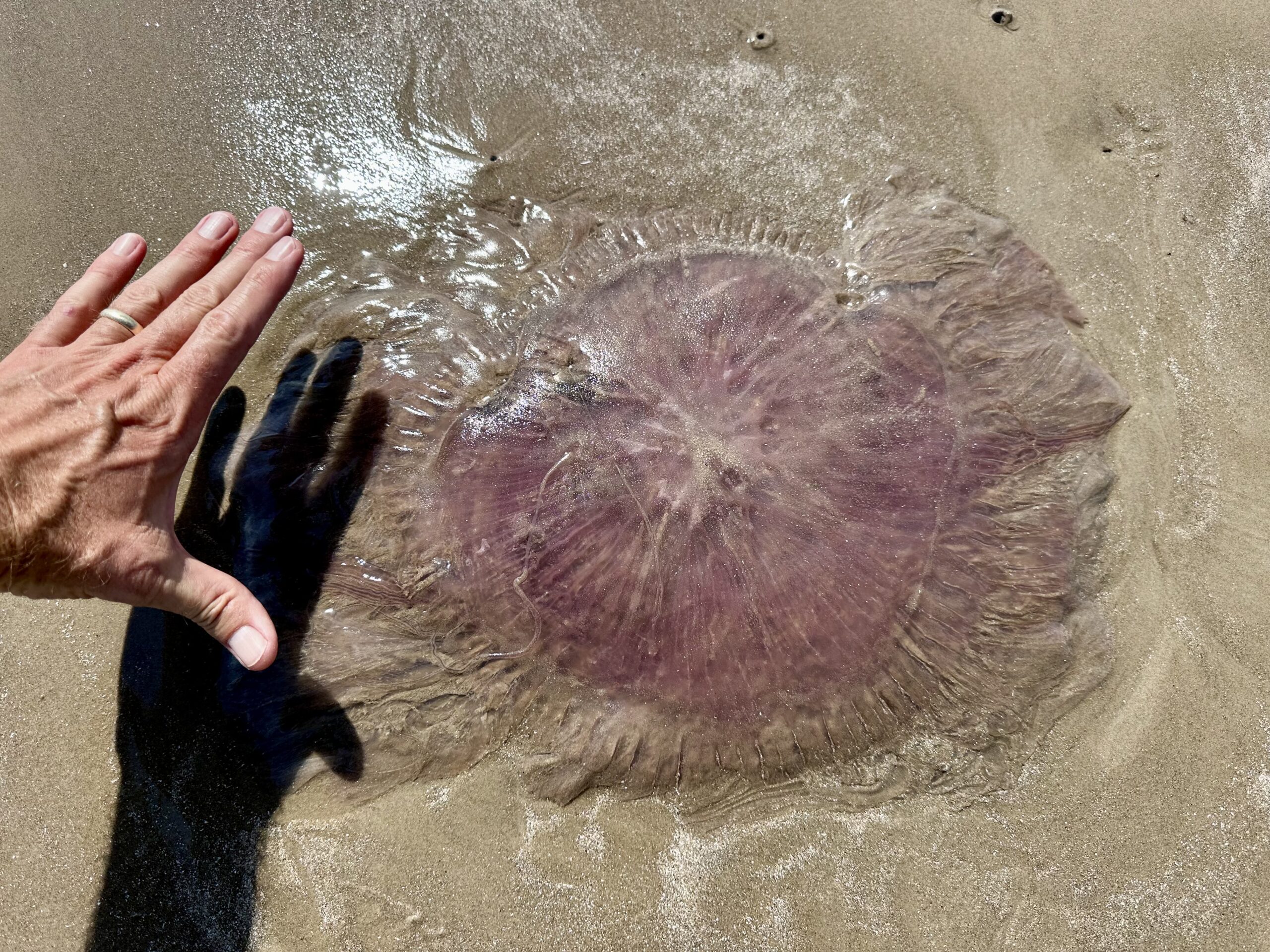
Pink meanie jellyfish can get quite large, with some clocked at weighing as much as 50 pounds. Courtesy of Jace Tunnell / Harte Research Institute

Texas Standard: I feel like the name “pink meanie” already may conjure up an image for some folks, but how would you describe this jellyfish?

Jace Tunnell: Yeah, it’s super exciting to see these jellyfish out there.

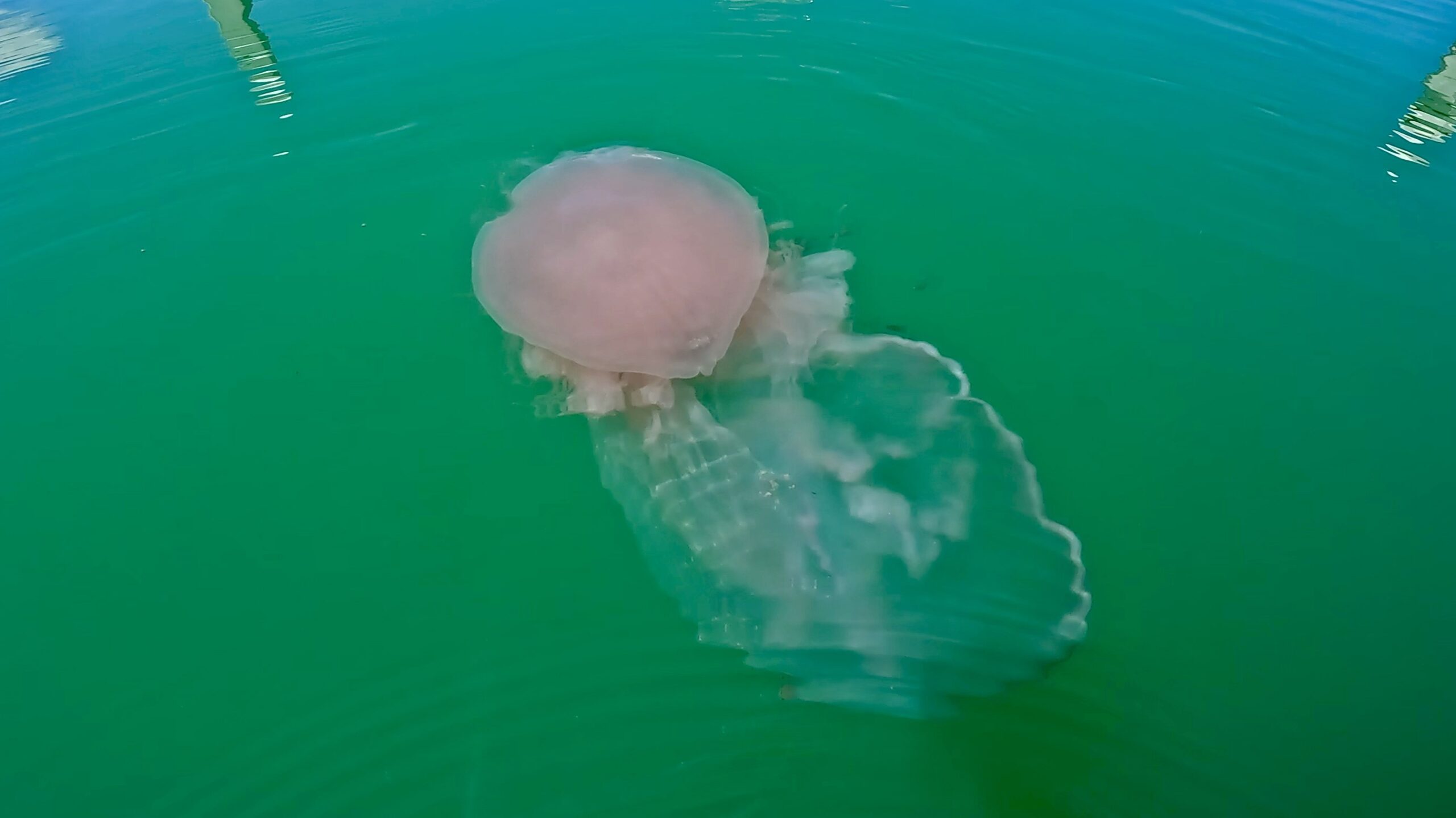
They’re bright pink. I kind of tell people they look like cotton candy floating around in the water, and they have a lot of tentacles and oral arms and things like that that hang off of them that kind of make them look like cotton candy.

And I can understand they can get quite big as well.

Yeah. So people have recorded these things being up to 50 pounds and having the tentacles going out 70 feet long. So huge jellyfish.

So I’ve read that this is a relatively new species. When were they first identified? Like when did we learn about this?

So the first documentation of them was around 2000. And then they didn’t actually discover it as a new species until 2011. And so this is very rare that we’re able to see these blooms of them showing up.

And actually, you know, I’ve been doing these beachcombing surveys for close to a decade. And this is the first year that I’ve actually seen them. And I’ve seen quite a few of them.

If people are wanting to see them, this might be a once-in-a-lifetime thing.

You know, in the video you posted, you’re handling and touching the pink meanie quite a bit. Do they sting?

Yeah, so they… You know, I’ve been known to handle man o’ wars and, I mean, any kind of jellyfish. I’ve [been] stung by all kinds of things out there. So I’m not a good person to ask if it stings or not.

Did you feel anything?

Yeah, so my fingers were tingling and so I’d give it about a 2 on a scale of 1 to 10.

But you know, after we posted the video, somebody did put a picture of themselves and they had been stung on the leg and you could clearly see that they had a red rash around their leg. So people ought to be aware it could be up to a 5 sting rating out of 10.

So whenever you did stumble upon this pink blob in the water, did you know what you had stumbled upon immediately? Or what was that experience like?

Actually, I heard about these pink meanies and so … I was ready. I had actually written a script a year ahead of time because somebody sent me a photo of one that they had seen and there was only one report. And so I was like, well, I’m going to go out and I’m gonna find it.

And so, I have this script and right when I saw it, I knew that it was different. And I picked it up, I put it in the water, and you could clearly see that it looked different than any other jellyfish out there.

When I find something that is rare, that’s not normally what you see, I get excited about it. And so it was really something fun for me to be able to present to the public.

» GET MORE NEWS FROM AROUND THE STATE: Sign up for Texas Standard’s weekly newsletters

What makes them come to the shores? Have you seen any others since you’ve been around? I know you’ve already mentioned that you’ve seen quite a bit.

Right. Over the last couple of weeks, there’s been reports up and down the coast of these, and it has to do with their food source.

How they get their name, “pink meanie” is, of course, their color, but then they’re mean because they eat other jellyfish. And so the jellyfish that is showing up in droves right now is the moon jelly, and that’s their main food source.

And so how much longer do you expect them to hang around?

Well, the moon jellies are still pretty thick, so they’re probably still going to hang around till we get the first cold front. They do not like cold water.

And so once we get that first cold front in, the moon jellys will disappear. And same with the pink meanies. We won’t see them anymore.

Courtesy of Jace Tunnell / Harte Research Institute

Pink meanies found along the Texas gulf may stay in the area until their food source moves to warmer waters following the first cold front of the season.

And hypothetically, if I was stung by a pink meanie, what should I be doing at that situation?

Well, you know, after you get done crying, I’d say get the vinegar. You can pour it over the sting site and it will neutralize the stinging cells that have the venom in it.

And so that should help. And then after that, just warm water rinsed over the sting site.

I gotta ask: I am, myself, a bit of a fragile guy. I’m not gonna lie. Whereas you are actively trying to touch these things. What was the motivation behind starting this “Beachcombing” series?

Well, I was out on the beach already doing sea turtle surveys and counting endangered species birds. And I’ve always enjoyed photography and videography. So I said, well, why don’t I just go ahead and take some photos out there?

And it sort of snowballed into this thing where now it’s an education program where we’re educating people about what’s in the Gulf, what’s washing up, and it’s really turned into a way that we can educate the public and bring them into understanding what’s out there so that they can help protect and conserve, is the ultimate goal.

If you found the reporting above valuable, please consider making a donation to support it here. Your gift helps pay for everything you find on texasstandard.org and KUT.org. Thanks for donating today.