When we talk about fame these days, we tend to mean visibility: movie stars, pop icons or influencers who live in the constant glare of one spotlight or another.
But there was a time not that long ago when a different kind of figure could draw a following — not through spectacle, but through ideas and how they were communicated.
In the 1990s, a philosophy professor from Texas built a quiet, unlikely kind of notoriety.
Rick Roderick wasn’t filling arenas, but his lectures, which were recorded by a company known as the Teaching Company, circulated widely passed hand to hand, mind to mind. For a certain audience, he became something rare even then: A public intellectual.
Now, years after his death, his life and work are being revisited — not just as biography, but as personal memoir, too.
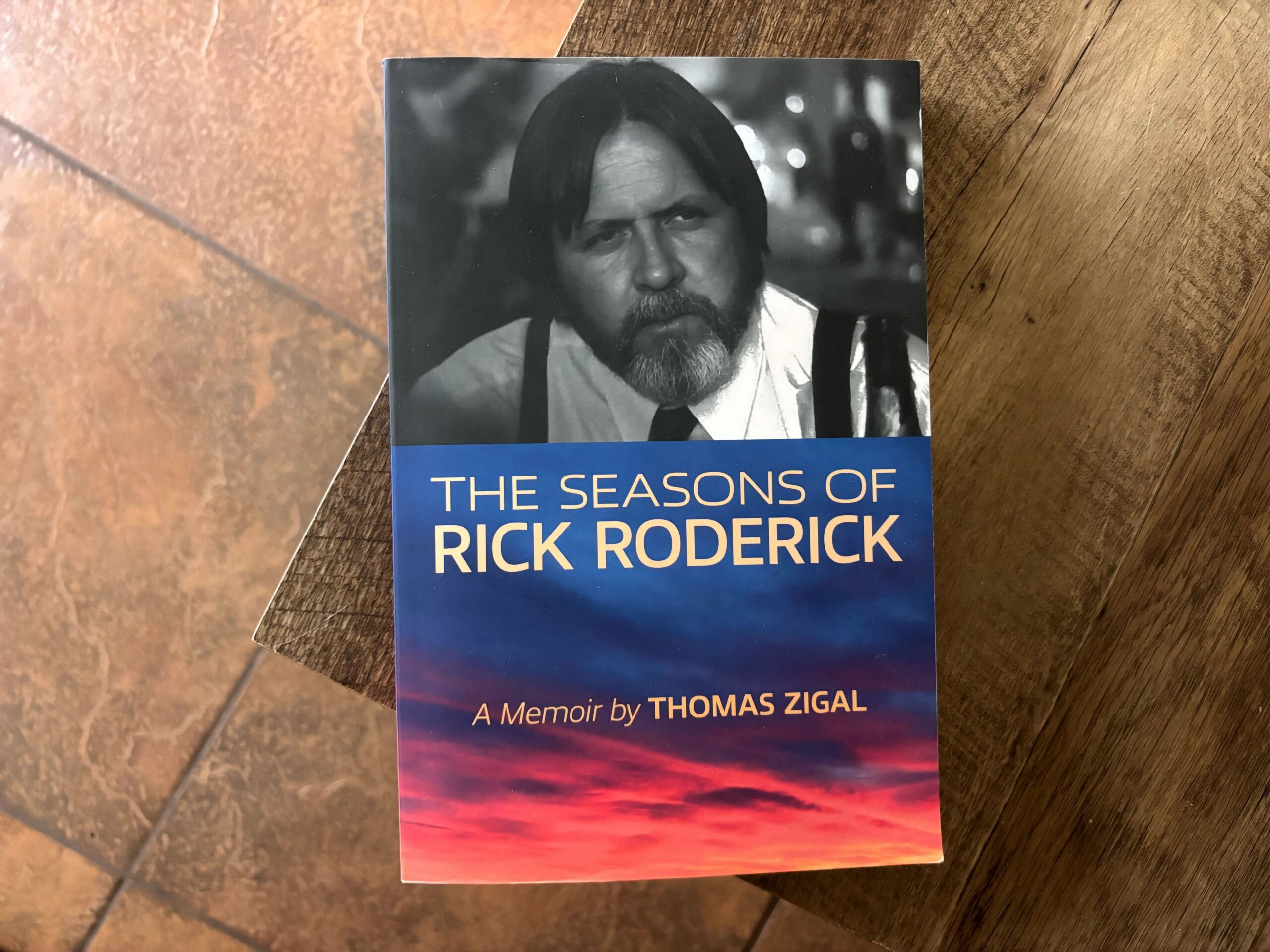
Thomas Zigal, author of “The Seasons of Rick Roderick,” joined the Standard to discuss the philosopher and his work. Listen to the interview in the player above or read the transcript below.
This transcript has been edited lightly for clarity:
Texas Standard: I’m curious what drew you to write this story. I know that Rick Roderick was a friend of yours, right?
Thomas Zigal: I met Rick at University of Texas at Austin, when we were undergrads, in an unlikely way. He was looking for a room to rent in the dorms, and I was trying to get out of my dorm lease.
He came wandering down the hallway with that really thick West Texas accent saying, “hey people, does anybody have a spare room here?” Initially, I didn’t think I’d ever see him much again, but we became best friends for the next 30 years.
It’s rare to find somebody where there’s like a spark, but a lot of people felt that spark with Rick Roderick. What was it about him? Can you account for what it was that drew so many people to him?
As I say in the book, he was part Falstaff, part Hamlet.
He was the funniest man I’ve ever met and also the most deeply serious and probing. He had read extensively, even by the time I’d met him at age 20 or 21. He had read enormous amounts of books.
He had a tragedy in his teen years which sent him into a kind of dark night of the soul, and he used reading to bring himself out of that darkness. And he went to the bookmobile in this little town, Tuscola, Texas, 20 miles south of Abilene, to stock up on books.
He dropped out of school after an auto accident where a young woman was killed. And he taught himself.
Take us back, if you will. We’re in the 1990s and he’s recording lectures for The Teaching Company. I think people have seen advertisements for The Great Courses. He’s doing those sorts of lectures.
How big was his fame at its peak?
He was the best-selling videotape of that era in terms of the company itself, The Teaching Company. He was basically doing a survey course of Western Civ in terms of philosophy, and he did it in 24 lectures.
It was just his charismatic manner, plus that West Texas twang.