Commuters going between Austin and San Antonio may have the experience of not being able to tell the difference between one city ending and another beginning.
Now, depending on where you live in Texas, this is nothing new, but it is increasingly the case along I-35 in Central Texas, especially between Austin and San Antonio, which has long been home to some of the fastest-growing cities in the U.S.
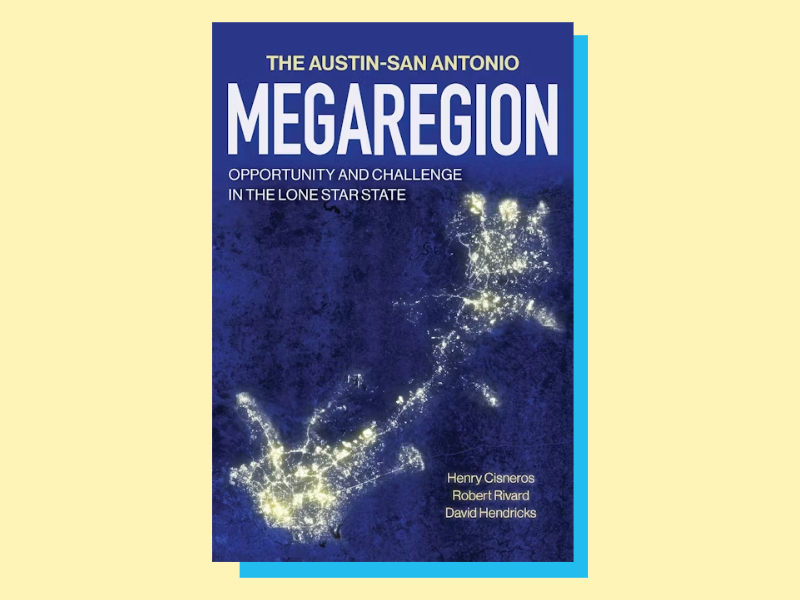
These two big cities in Texas are becoming what the authors of a new book are calling a “megaregion.” It’s written by former San Antonio Mayor Henry Cisneros, who also served as the secretary of housing and urban development during the Clinton administration, and by longtime journalists Robert Rivard and David Hendricks.
Cisneros and Rivard joined Texas Standard to discuss “The Austin-San Antonio Megaregion: Opportunity and Challenge in the Lone Star State.” Listen to the interview above or read the transcript below.
This transcript has been edited lightly for clarity:
Texas Standard: Well, this has got to be something that has been on your minds for years. Can you talk about what led you to think that a book needed to be written now?
Henry, would you like to start?
Henry Cisneros: Let me just say, I’ve been working on Austin-San Antonio issues for the better part of the last 35 years or so. In the years that I was mayor, I noticed that in other parts of the world, cities that were this close collaborated. I saw that on a trip to Japan.
Later asked the leaders of Austin to join San Antonio when we went to Japan together. And it was a blowout success at universities, at research centers, at corporations. They love the idea of a region like this.
And over the years, it’s only gotten tighter. We created something called the Austin-San Antonio Corridor Council. They’ve been working together. And then I think the biggest development is the growth, as you said, of other communities, both between us and around us.
Between us are two of the fastest ten growing counties in America, in Hays County and in Comal County. San Marcos is now almost 100,000 people with a 41,000-person university at Texas State, and New Braunfels is over 100,00.
It’s just very clear this is really a region now, and we need to work on planning the future together, or we’re gonna just kind of crash into each other.
Well, Bob, you’ve been based in your career primarily in San Antonio. When did you realize, “gosh, I’m going to have to start paying attention to all this Austin stuff and the things in between as well”?
Robert Rivard: That was after Henry called me on the telephone. Seriously, I took note of the “Texas Triangle” book that he and David [Hendricks] did that I think kind of woke people up in the state to the size of the economy that had grown between Dallas, Fort Worth, Houston, and Austin-San Antonio.
And then as we looked at how I-35 just filled up, it used to be all cows and and now it’s nonstop Amazon, you name it, between the two metros and all of these corridor cities.
It just became evident that we needed to look at this growth and look at the opportunities and challenges that come with it because we didn’t feel like – particularly at the state level but also regionally – we just didn’t have the planning in place to prepare ourselves for where the city would be or where the region would be by 2050.
Related: Listen to an extended version of this interview on the Texas Standard podcast!
Well, you mentioned opportunities and challenges. That’s in the subtitle of your book, Henry. You already mentioned traffic. You already mentioned water. But where do you want to focus first though? Opportunities or challenges?
Henry Cisneros: Well, I think the opportunities is, for me, the upside here. From northern Austin to southern San Antonio, today are 5.3 million people – today. So the upside includes better wages, more jobs, opportunities for philanthropy, building great universities, enhancing our schools.
To me, that’s the upside of this.
All right, Bob, that means you get to start with challenges. What sticks out, what starts at the top?
Robert Rivard: Well, the number one challenge certainly is part of the public conversation in this part of the state is the growing gridlock that exists between San Antonio and Austin on I-35.
It’s just about come to a standstill multiple times during the day and night. It doesn’t matter what day of the week or what hour you’re moving there or whether you’re in a truck or an automobile. It’s a horrendous experience.
And not only is it dangerous, not only is it inefficient from a transportation point of view, but it limits economic activity because people can’t get from point A to point B, and yet there’s no plan in place. Even at the same time that we’ve exceeded the cap on the state’s economic savings account, the rainy day fund, it’s $25 billion right now.
The state could afford to address some of these critical issues like the housing shortages, like the transit, the lack of multimodal transit in the state. We have the funds to do all that. I’m not sure that we have the state focus on it. And I know that we don’t have the regional planning entity.
Well, there’s another thing that goes along with that and Texas Standard listeners won’t forgive me if I don’t ask about electricity and reliability of the grid, which of course affects much more than just the Austin-San Antonio region, but we’re seeing new data centers go in in this area.
Is that something that you all identify as a potential limiting factor as well?
Henry Cisneros: I don’t think of it as a limiting factor. We do talk about power because I, you know, living in San Antonio, we have worked very hard to create adequacy of power by having access to coal, to nuclear, to wind, and to solar in an extensive and diversified way.
Austin has some tighter energy challenges, and you’re right, the data centers, nobody could have planned for that – the electrification of the society generally, including electronic vehicles, electric vehicles. So yes, power is one of those things we need to be working together on.
Bob, you were gonna add something.
Robert Rivard: The only thing I was going to say is that, you know, I think we’re both blessed with really vibrant municipal-owned utilities. I think the price of energy for residents in the region has been among the lowest prices and the most reliable in the state.
But there are increasing demands. The data centers, not just the ones that want to locate within our geographic footprint, but the ones I want to look at out in West Texas and are looking to Central Texas and South Texas to provide the energy they need.
You know, we have a Legislature which, in defense of oil and gas, which is sacred in Texas, has removed incentives to people that are engaged in renewables which I think is unfortunate because renewables aren’t a threat to the carbon industry, they’re an adjunct to it and we need everything.
People are taking a fresh look at all sources of energy to meet the growth because the growth is unstoppable. It’s coming. It’s a matter of, are we gonna prepare for it?
Well, can I end on a somewhat silly question? I’ve been wondering, San Antonio is the bigger city. Why does Austin get named first in the mega region? Is it just alphabetical, or is it easier to say?
Henry Cisneros: I think it’s alphabetical and I think, you know, “Austin,” it just rolls off the tongue faster than “San Antonio.” But I’ve heard people jokingly refer to combinations like “Austin-tonio” or something like that.
Robert Rivard: We San Antonio journalists wanted people in Austin to buy the book so we put you first.