Texas brands tend to command a lot of loyalty, maybe none more so than Buc-ee’s.
The travel stop giant has become famous for its massive arrays of gas pumps and adjoining stores, to the point of advertising on tongue-in-cheek billboards hundreds of miles away that your bathroom break can wait. And with the brand’s fast-paced expansion as of late, the brand’s cult-like following looks to be growing even stronger.
That growth is the subject of a new video essay from youtuber Phil Edwards, who joined Texas Standard to discuss his findings and analysis. Listen to the interview above or read the transcript below.
This transcript has been edited lightly for clarity:
Texas Standard: Buc-ee’s does seem to have something of a cult-like following, but I’m impressed with how seriously you took this phenomenon. Someone you interviewed for this episode called Buc-ee’s “the Trader Joe’s of convenience stores.”
Could you unpack that idea a little bit?
Phil Edwards: I think so much of the coverage around Buc-ee’s centers, rightfully so, around the massive number of pumps or around the restrooms. But as I dug into it, I learned that it’s really the products that are the differentiator.
Those products are not limited to the fudge and the brisket, but also just all the stuff that you see around the store with the Buc-ee’s logo stamped on it. Those are all private-label goods, and they’re really innovative for being so ubiquitous in the store.
In the video, you make some important observations. At first glance, you come up on a Buc-ee’s, and it looks like a truck stop, but there are no trucks. Trucks aren’t even allowed.
You point out they make barbecue and fudge, but there’s really no place to sit down and eat it. And then, what kind of convenience store sells socks and pajamas and branded home decor?
It’s almost like the gas pumps are a distraction. It can be hard to put your finger on what Buc-ee’s business really is.
Yeah, I mean, it’s weird, because after a while you start to perceive the gas pumps as not so much as the service that Buc-ee’s is selling, but as a form of marketing for the stuff that is inside the store.
This is a truth that grocery stores have embraced – Walmart has added gasoline sales to its stores because it knows that gas drives traffic, and especially road-trip traffic in those long road-trip stops where Buc-ee’s is kind of an oasis at the end of it.
What they’re really doing is just marketing the inside of the store, and the same thing goes for the restrooms. The restrooms are just marketing for the rest of the store as well.
I was fascinated with what you did to try to get to the bottom of what was going on inside that store that seemed to be so appealing. You actually mapped out a typical Buc-ee’s in 3-D, and started removing the elements one by one in search of that core concept.
So what is it? What is it that Buc-ee’s is selling ultimately?
Yeah, to me, it was really important to figure out exactly what Buc-ee’s sold, because that was the thing that kind of always got passed over in all the other reports that I had seen. They mentioned the flashy stuff, but then you don’t really understand where they’re making the money.
The restrooms don’t make money on their own. They’re free to use and they are great, of course, but as I went through the store, I did a 3-D scan, and then I augmented that with some video that I took of the whole store that I could refer to later on, just to kind of double check my facts.
My goal wasn’t to map out exactly what the goods were that were being sold, whether it was jerky or candy or anything like that, but whether it was a private-label good – which means Buc-ee’s is stamped on there somewhere – or a traditional good; that’s a candy bar sold by Hershey’s, or Fritos, or something like that.
When I mapped that out, I discovered that a shockingly large proportion of those goods are ones that have the Buc-ee’s label on it, and that was what really interested me. It was like visual proof of something that I had a sense of, but I wasn’t sure about until I mapped it out.
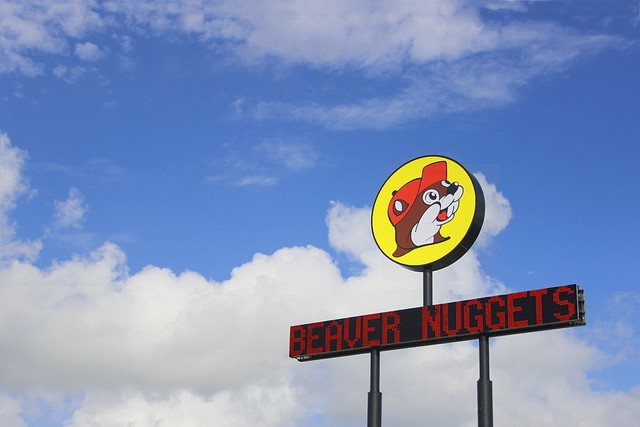
So, not to put too fine a point on it here, but at the end of the day, is Buc-ee’s just selling the Beaver? At the end of the video, you sort of seem to say as much. You slap your shirt and you say, “Buc-ee’s is selling this,” and it’s that Beaver.
I think in a way, it’s both the most overlooked aspect of Buc-ee’s – because it’s just a cartoon Beaver. Anyone could come up with that. It doesn’t even have a narrative, or a story behind it, and yet, that seems to be the thing that people are buying into with the pajamas, the shirts, the stickers, the keychains and so on.
Yeah. And I mean, I actually was reading the Buc-ee’s children’s book to my children last night, and this story did not seem relentlessly compelling to me, or related to the kind of Buc-ee’s ethos that I imagine. So it’s not like there’s a big mythology that exists around the Beaver, but I do think that there’s a lot to it just being a really, really good logo.
I went through this one exercise in the video where I look up exactly who the possible manufacturers of various Buc-ee’s goods might be. Of course, this is all guesswork ultimately, because there are non-disclosure agreements that everyone signs when they work with a company like Buc-ee’s or Trader Joe’s, but I came to some pretty reasonable conclusions.
You can match up the ingredients pretty well. And it was a bit disillusioning to see that, but it still led me to the conclusion that what’s really adding value here is Buc-ee, the Beaver.
Let’s pull back for just a moment. Let’s say you’ve watched your video and you’re thinking, hey, I’ve got to figure out a way to do this. If it comes down to just a Beaver, shoot. I ought to have a I ought to come up with, like, say, an alligator in a cowboy hat.
You’re referencing the Choke Canyon lawsuit that happened. And, gosh, you know, I’m not a lawyer, but you can understand, even if you don’t understand the lawsuit, why Buc-ee’s would feel so strongly about protecting their trademark, because it represents so much value for them.
That’s really what it’s about. It’s about this idea of having a convenient store that sells private-label brands, using a particular brand that has some bit of cartoon charm. You don’t even have to have much of a story built around it. That’s what Buc-ee’s is trying to protect with the lawsuits that it takes on some of these competitors.