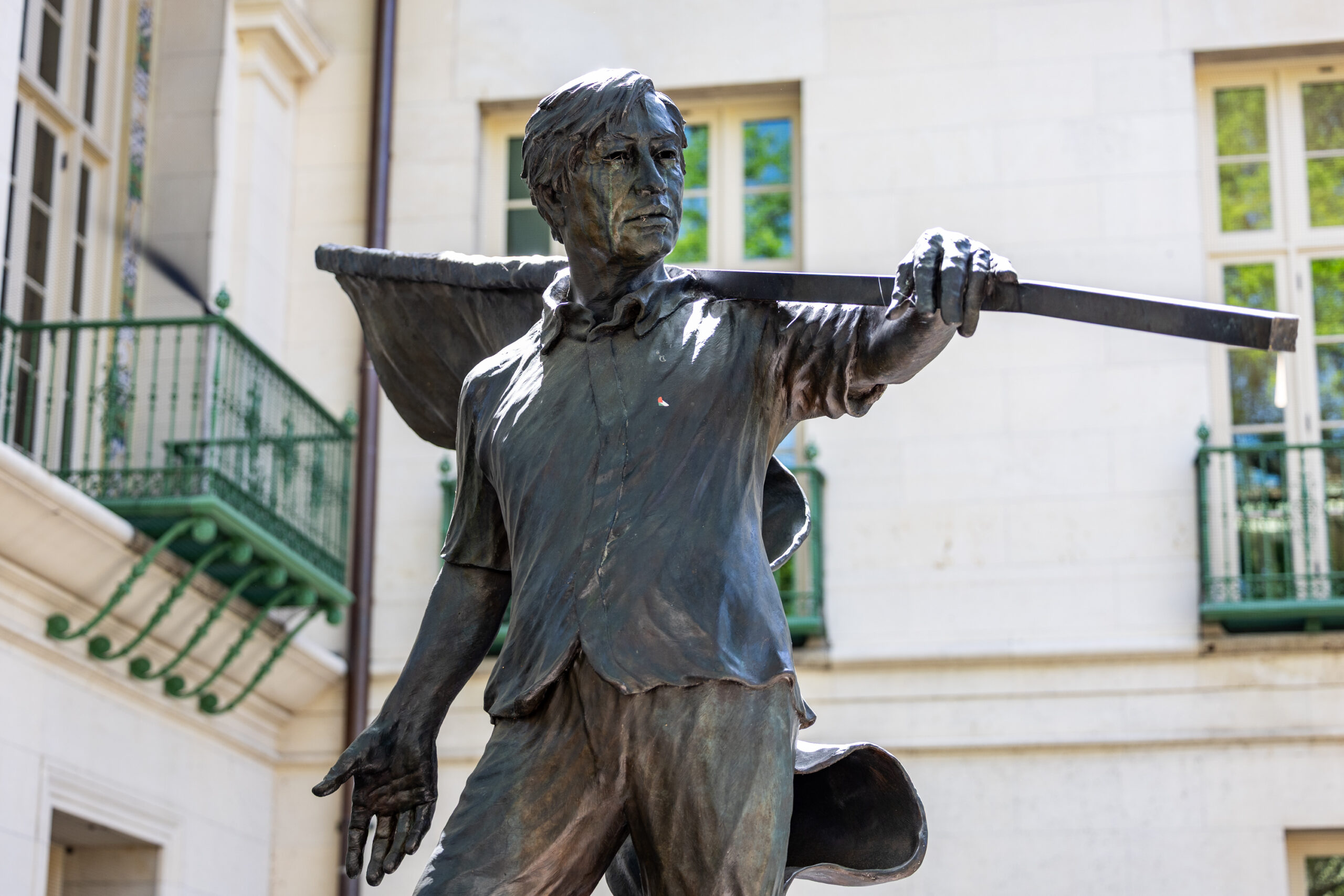
For many around the nation, March 31 was supposed to be Cesar Chavez Day. But in the wake of allegations against the labor leader brought up in a New York Times article a few weeks back — including charges of sexual assault against women and minors — governments in Texas and across the world have been rushing to remove Chavez’s name from public spaces, street names and monuments.
There have been calls to rethink his legacy, and the fallout has been swift in the Mexican-American community.
Mando Rayo has been thinking about all this. He’s host of the Tacos of Texas podcast, and joined Texas Standard to discuss. Listen to the interview in the player above or read the transcript below.
This transcript has been edited lightly for clarity:
Texas Standard: As we begin, I just want to make note, obviously, your thoughts here reflect the way that you’ve been thinking about this, not trying to put you in a position of being a spokesperson for the Mexican-American community or anything like that.
Mando Rayo: No, not at all.
But you must have had some really deep reactions, feelings about this.
I did, I do. I grew up with it in schools. It’s everywhere — the street names, the murals, the statues. For Mexicanos and Mexican Americans here in the United States, that’s kind of like, you know, the icon that we used to kind of look towards of like “hey, I can do something bigger than myself.”
And so when these allegations came through, I was shocked, disbelief, sad because of what happened, but also not surprising because of the culture of machismo and power, I would say, within the U.S. — what the culture is in the U.S. but also what the culture is in the machistas of the Mexican culture, too, because I grew up with that too and we all kind of have to find our way to shed some of those things that have been passed on to us by generations.
Do you think that’s common, a lot of people sort of saying we need to rethink this or not so much?
As a man that grew up with very, very traditional father figures and men, I think I don’t know how deep it goes.
I know that I have, obviously, I have a daughter. It really kind of rings true for me because what I want is to create a world where women can feel safe and they can feel seen — where movement leaders aren’t held up as idols, but it’s more about the cause or the movement.
You know, for the most part, I’ve seen that, yeah, that there is a reckoning. There is a reckoning, right? But at the same time, I’ve also seen this whole idea around blaming the survivors and questioning, “well, why did they take so long to come forward?” And when you don’t have that empathy, that connection with people that have gone through trauma, that’s probably gonna be your first reaction — and that’s rooted in machismo.
You know, you alluded to this earlier, but I want to sort of dig in a little bit deeper thinking about Chavez as not just a man, but as a symbol, as a figurehead for a movement that was much bigger than Cesar Chavez.
What do you see these events meaning for the lasting legacy of the farmworker’s movement?
It’s hard. We’re at a time where there’s a lot of things happening to the Latino communities across the U.S. There’s a lotta hurt. And now we have to reckon with our own internal view of our own heroes.
And, you know, I think that that’s kind of like the conversation that we need to have as communities, right? We need to have conversations around what does this mean when we prop up one individual versus the movement versus when you think about the work that Dolores Huerta and other organizers did.
And it wasn’t just him, right? It wasn’t just him. So we need to prop up and uplift the people in the movement. We need to uplift women and we need to believe women when harm comes to them.
One of the reasons I ask that about the legacies, I note that Gov. Abbott has asked that the teaching of Cesar Chavez be halted altogether. Do you have any concerns about that directive?
You know, I don’t think that comes from a place of doing the best for our communities. I think there’s a history there of Gov. Abbott being anti-Latino, anti-immigrant, anti DEI, and just voter disenfranchisement, right?
And so I don’t think it comes from a place of like, “oh, let me help the Latino community.” If he really wanted to support us, he would do it in a different way that was more meaningful. Then let’s talk about farm workers. Let’s talk the movement, versus also trying to just dismantle not only the legacy, but the history, you know?
And then part of this process is not just, you know, it’s not an erasure of our history. It’s just like not propping up one person for the work of thousands of people and generations of work.
You know, I’ve noticed the speed at which we’ve seen statues covered up and streets renamed. But it’s worth noting the rapidity with which there’s been a reaction with the covering of statues and action to rename streets that were formerly named “Cesar Chavez Avenue” and that sort of thing.
I think what that stands in stark contrast to is perhaps not so swift action for others who have faced similar allegations. What do you make of that?
You know, I think part of that is people’s immediate reaction. We’ve seen so much hurt in our communities that nothing has been done. But when it happens to our own community, within our own communities, that’s a natural response.
I think it’s an example of when people are just tired and wanting to do something — and swiftly, right? I think there definitely needs to be a dialog around what does that mean? Okay, how do we have a conversation around not truly erasing the work that has been done and naming them, naming the organizers, naming people — Dolores Huerta and everybody that’s part of that movement that all of a sudden people feel that their history’s been erased, right.
So lift up those other stories that have been under-told.
How do you see the community moving forward at this point, Mando?
Uh, it’s hard. It is hard. You know, I think it’s going to take some time, And like I said, we need to have deep discussions around what does this mean about our own community and as we look at idols and heroes, how do we kind of come to terms with that?
But as well as like how we can uplift, you, know the mujeres in our community and believe survivors?