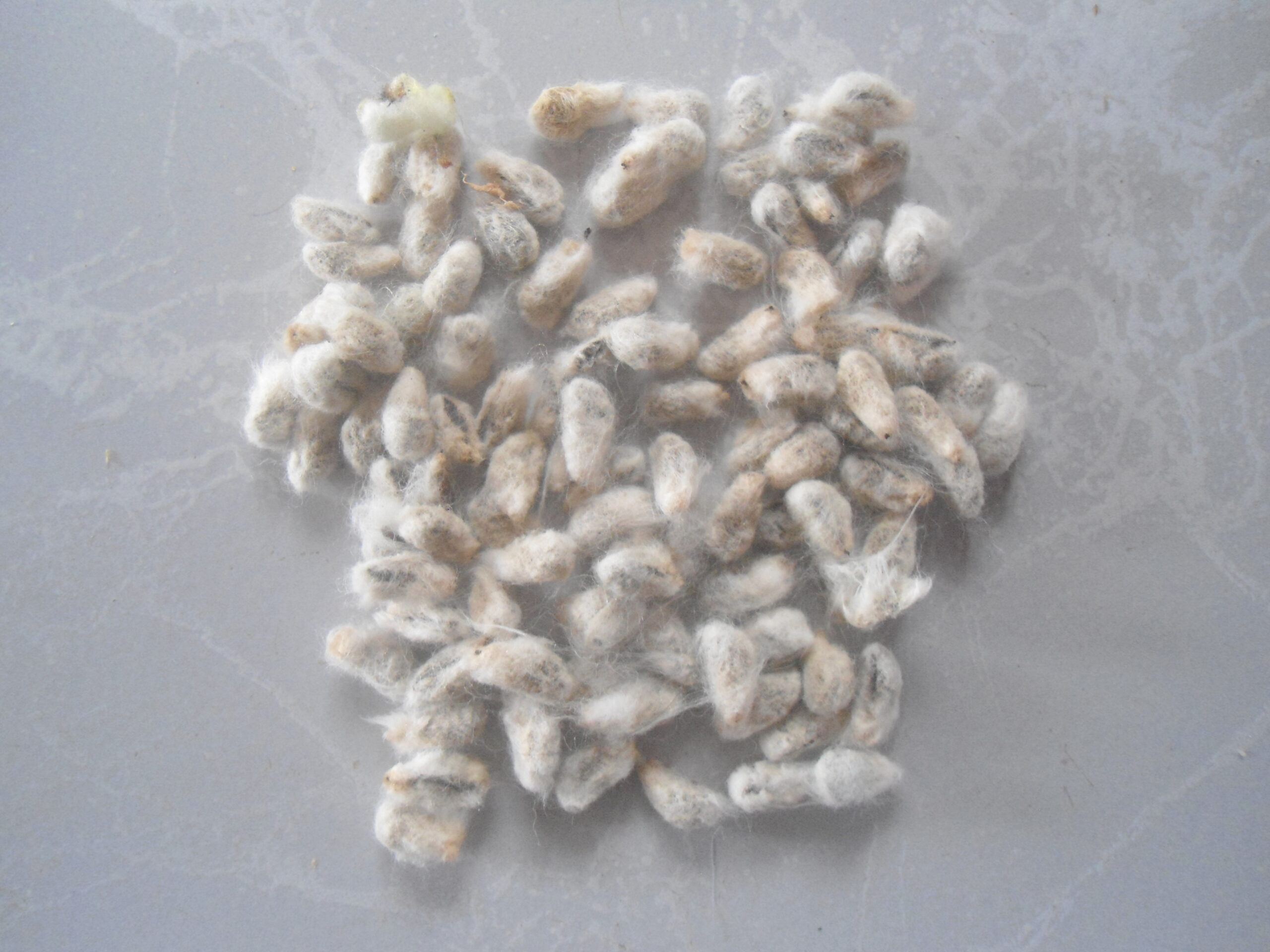
Cotton isn’t exactly ready to use right out of the field. After it’s harvested, the fiber goes to a gin, where it’s cleaned up to be turned into textiles. The puffy stuff contains seeds, most of which get removed and discarded.
But one Texas researcher has long hoped to find a use for these seeds. Keerti Rathore, a research plant biotechnologist at the Texas A&M University Department of Soil and Crop Sciences, has worked for more than 30 years to develop an edible cotton seed. Now he’s on the cusp of seeing his work help feed people on the other side of the world.
Rathore spoke to the Texas Standard about developing the seed, and challenges getting it into the marketplace. Listen to the interview above or read the transcript below.
This transcript has been edited lightly for clarity:
Texas Standard: Can you briefly explain why, generally speaking, cottonseed is not edible?
Keeri Rathore: Yes, the reason for that is the cotton plant contains a toxin called gossypol. It’s present throughout the plant, including the seed, and because it’s present in the seed, we cannot utilize the seed as food or even as feed for some of the non-ruminant animals.
Well, given that, where did this vision come from to use cottonseed as some kind of food and were you thinking more about just livestock or for human consumption?
In fact, when I first started this work here at Texas A&M, that’s when I came to know about how much protein that is present in the cottonseed. And once I saw the numbers, they’re kind of mind boggling numbers.
So amount of cottonseed produced throughout the world – which is about 40-45 million metric tons of cottonseed – and that contains about 10 million tons of protein and it can easily meet the basic requirements of even 500 million people per year. And so I thought this is a problem worth solving because of this huge amount of protein that we are not utilizing very efficiently, at least in a lot of other parts of the world.
And in the U.S., we don’t have shortage of protein, but a lot of poor people in a lot of other cotton-growing countries, they suffer from hunger, especially protein malnutrition. And I thought if we can make this protein edible from cottonseed, it’ll be of great value to, especially, poor people.
That is absolutely fascinating. Okay, well, so what would this mean as a practical matter? Would cotton processors have to change the way they gin cotton in order to harvest edible seeds, or could they be gathered without much modification of the existing infrastructure?
So this is the beauty of this technology, the farmer or the processor doesn’t have to do anything at all, anything extra, and so we don’t need any extra input in terms of cultivation or no other extra efforts required. It will be processed just the same as any other crop.
So what’s the secret? You say that cotton contains a toxin – all of it does. It can’t be consumed. How did you approach this?
So at the time when I started, we came to know about a gene that is involved in making the gossypol throughout the cotton plant. And it was not straightforward. We had a lot of failures, and it was about 10 years after starting the work that we had our first success.
So another technology came by which is called RNAi, or RNA interference. It’s a gene-silencing technology. So what we did was to specifically silence this gene only in the cottonseed so that the gossypol is eliminated in the seed, but it is maintained at the same level throughout the rest of the plant because it protects the plant from insects and certain diseases.
» GET MORE NEWS FROM AROUND THE STATE: Sign up for Texas Standard’s weekly newsletters
Wow. Is it being grown in the U.S.? Is it growing anywhere?
Unfortunately not. This was my goal, and we worked so hard over decades.
So we approached all the companies. I think there are three or four cottonseed companies. And Bayer being the biggest one, Corteva, even a small one like Americot, and BASF, and so on. They had, well, there are a couple of reasons, in my opinion, as to why they haven’t picked up this technology yet.
One is that most of our cotton is exported. So fiber is exported almost, I would say, over 80 percent. And even quite a bit of cottonseed is exported to other countries. So, we have deregulation here in the U.S. but not in these cotton-importing countries. And they don’t want to spend the money to get deregulation in those countries.
And so I think that is the primary reason. And they had not seen these large-scale cultivation of our cotton-seed. And so, you know, it all requires a lot of money and effort and obviously we are scientists and we’ve done our job.
You’re not the marketing experts, I understand, but I hear that there’s a project underway to grow this edible cottonseed in Uzbekistan. What can you tell us about that?
Yes. Now, Uzbekistan is a very… Not many people know about this, but Uzbekistan is the seventh largest producer of cotton and it also has food security issues.
And the other thing is that Cotton Incorporated and Texas A&M came to an agreement that if this technology is used on a humanitarian basis for some poor, cotton-growing countries, we should give it out for free. So that’s what we kind of agreed on.
And so Uzbekistan was very interested in this technology, which really will help them to increase the amount of protein that they can utilize, either directly or indirectly as a feed for, say, chicken and fish and so on.
Very interesting, but I would imagine that this could also be a kind of a test bed for those who are watching from the sidelines and wondering if this might be something that we could do here in the U.S. In fact, have you heard any interest from growers on this side of the world?
Oh, growers wanted it all the time. I mean, I’ve had phone calls from growers, and so they just say, “when can we have it?” And this is even before the deregulation.
So we published our first scientific paper saying that this technology works back in 2006. And even at that time, they said, “okay, when we can have it?” And we said, “Well, we have to go through USDA and FDA and it’ll take a decade or more.” And they were all kind of wondering why should it take this long?
So the farmers obviously want it badly because they can benefit, they can see the benefits and they can benefit from this technology because right now most of their income from cotton cultivation comes from selling the fiber, not from the seed.
Now if you can utilize this seed, either as food or even as feed for say chicken or fish in our country – we even give it to the swine or the pigs – and so the value of cottonseed goes up tremendously. So the farmers should be able to benefit from that.