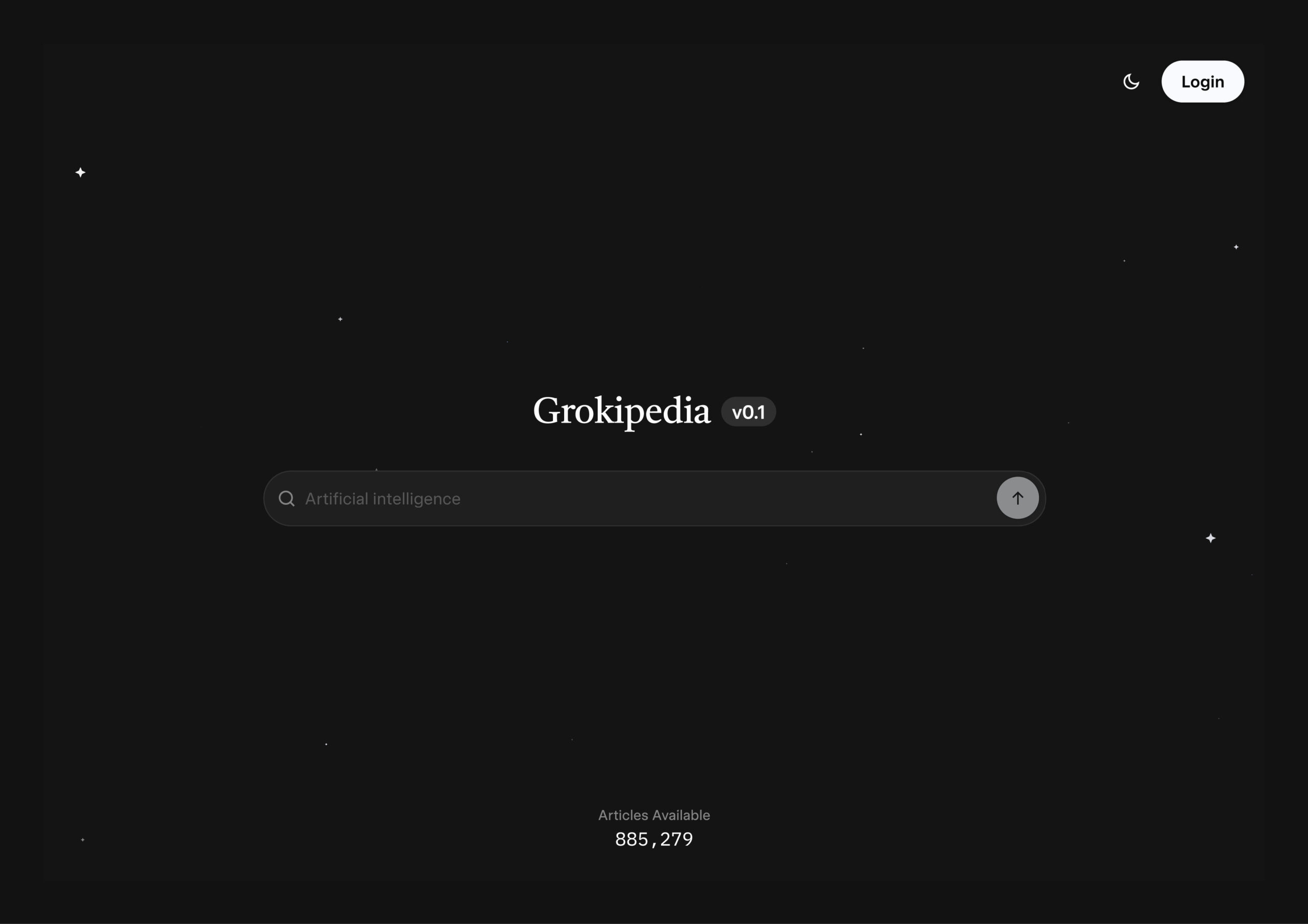
Back in 2021, Elon Musk sent out a tweet: “Happy birthday Wikipedia! So glad you exist.”
Since then he’s moved X headquarters to Texas, joined the Trump Administration, left it — and has changed his opinions on the platform, now referring to it sometimes as “Woke-ipedia.”
All of this is why he’s launched a new platform called Grokipedia, calling it “a massive improvement over Wikipedia.”
Right now, the website has a little over 800 thousand articles and John Herrman has been sifting through some of them. He’s a tech columnist with New York Magazine and he joined the Standard to discuss what he found. Listen to the interview above or read the transcript below.
This transcript has been edited lightly for clarity:
Texas Standard: I mentioned Musk feels a need to launch a Wikipedia rival. Tell us more about why he’s doing that.
John Herrman: Well, you know, Wikipedia is this widely used sort of mainstream resource. And we all remember when it was kind of controversial to use Wikipedia for research, when teachers were saying, like, “don’t start there. It’s just made up by strangers.” But it’s become this sort of infrastructural part of the internet.
And so, like anything that a lot of people read, people have started to pick up on problems. They have personal objections. They have ideological objections and Elon Musk is one of those people.
Of course, he’s not just a person who reads a Wikipedia article about the president and thinks, “well, this doesn’t sound right.” He is one of the most powerful people in the world. There are Wikipedia articles about him. And that’s kind of where it started.
He, over the years, used to share lots of Wikipedia articles about stuff he was interested in, but then would also sort of come back to the complaint over and over again that like “this page focuses on controversy too much. This page calls me an investor when really I should be a founder.”
Eventually, he started having broader complaints, you know, “Wikipedia is Woke-ipedia. Wikipedia is just parroting mainstream propaganda.”And as his political transformation continued, he eventually just sort of gave up on Wikipedia, and said “I should make my own.”
How does Grokipedia compare to Wikipedia?
On a surface level, it is a Wikipedia clone. It is very explicitly like a kind of a copy of and an alternative to Wikipedia.
And in some cases even has chunks of the same text, which makes sense. It is written by AI. The AI is trained on a lot of stuff, including probably Wikipedia, although we have no way of knowing for sure.
It is also written, again, by the model that was trained on Wikipedia, meaning the model goes out onto the internet, scrapes a bunch of stuff together and puts it into a kind of a report.
Well, you talked about accuracy and that was one of the big concerns initially with Wikipedia. Do you have a sense of how accurate is Grokipedia?
I would say that, again, on first scan, most of the articles will get you somewhere. But if you take a look at a topic that you know very well or a topic that, for example, is very controversial, you can kind of see a little bit of what’s going on here.
If you look at the entry for Jan. 6, for example it’s less about the events of the day than it is a collection of sort of objections to the coverage of what happened that day. It’s very much written as counter-programming, which kind of makes it hard to tell what you’re reading about. It’s so caught up in trying to reset the narrative and reset the story and stuff like that.
But a number of researchers have gone out and looked at this. PolitiFact noted that it has a real problem with inventing false citations, even for claims that might be true, which is again, sort of a common thing we see with AI tools in general. And yeah, there’s an accumulation of very small errors that you start to notice over time.
The difference, and this is kind of crucial, is that on Wikipedia, if you notice something that sounds off or that seems wrong, you can see where it came from. You can check the citation. You can also see who wrote it. You can see the arguments they had with other Wikipedia volunteers leading up to its publication.
And sometimes, if something is posted in the article, it will still have kind of a passive aggressive citation note saying “according to who?” You know, like from where “citation needed” is the formulation people are most familiar with.
Grokipedia has none of that. There is no insight into how it was written, except that we know it was by AI.
Who has editorial control of Grokipedia? Does Musk have a say in what people are reading?
I mean, he leads xAI, which runs the product. So yeah, and he’s weighed in plenty in public about how he kind of wants the Grokipedia to function.
It is very much an extension of Grok, which is xAI’s chatbot. It’s sort of a competitor to products like ChatGPT. And Grok itself has been the subject of a lot of sort of public… I don’t want to say “manipulation,” because again, it’s his product, but it is very much an ideological project. It is meant to be the quote, “anti-woke version” of something like chat GPT.
Well, you’ve been writing about the internet for a while now. What do you see as the effect of this platform?
I think that Grokipedia as an alternative to Wikipedia isn’t hugely important.
I’m also more open than I think a lot of people are to the critiques of Wikipedia as a biased resource. It is a big system that has attracted certain kinds of users that put a lot of time and effort into it, and I think it’s very valuable, but who do tend to sort of congregate around certain beliefs about the world and fundamental assumptions about the word.
This is an unavoidable thing if you’re creating a reference resource, or if you were writing the news, for example. Like biases are unavoidable, you just want to be as transparent as possible about them.
What’s more interesting about this to me is that we get to see what it looks like when someone completely encloses themselves in an information environment of their own design. Right now, Elon Musk can do that. He is, again, one of the wealthiest people – if not the wealthiest person – in the world, and he can say, “all right, I am remaking my favorite social network in my image. I’m creating an AI company that sort of lines up with my values and beliefs. I’m using that AI company to create an encyclopedia that is more in line with how I see the world.”
Also, it is very much something that AI tools will make possible for all of us. We’re already used to people kind of disappearing into their own media environments.
Here we have a vision of a world where you kind of interact with everything down to the encyclopedia, down to basic facts about the world through a machine that is catering to your preferences. And that is what not just companies like xAI are doing, but what more mainstream AI firms like OpenAI and Google are openly doing.