The U.S. War in Afghanistan lasted almost 20 years. Though it officially ended more than four years ago, the soldiers who served there and lived to return home still reckon constantly with their memories and the lasting impacts of that service.
While that’s not a situation unique to the War in Afghanistan, it is worth focusing on, especially as the number of service member suicides continues to rise.
A new documentary airing on PBS stations tells the stories of families and veterans after the war in Afghanistan by focusing in on a Marine from San Antonio.
“American Sons” is produced by Laura Varela and produced and reported by Andrew Gonzales. Listen to the interview in the player above or read the transcript below.
This transcript has been edited lightly for clarity:
Texas Standard: Much of your story takes place in San Antonio. Laura, that’s where you’re based, and it’s where JV Villarreal, the Marine at the heart of your story, was from. Can you tell me about finding him and deciding to center your story around him?
Laura Varela: We usually call JV the first filmmaker, because JV, upon the request of his mother, took many photos and videos so that he can share back home. He had failed to do that, like, at the beginning of his enlistment, and so when he was going to be deployed to Afghanistan, his mother, Yolanda, who is also in the film, asked him to take plenty of photos and video, and he did.
And this was before the [smart] phones, before selfies. And so we have some really great footage of him talking to the camera, showing his day to day.
So the men were deployed in May of 2010 and [when] he passed in October of 2010, the footage came back to his family, to his sister April and his mother Yolanda. And April knew that this was something very important because not only was it JV’s footage, it was also footage from the Marine brothers that served with him, as well as a set of photos from an embedded Getty photographer, Scott Olson. And there were images of the days before his death, the day of his death and the day after.
So April wanted to make sure that her brother’s memory was honored. And when she did her research, she was doing some national research looking for Latino filmmakers, Latina filmmakers, people who were proud of their culture and wanted to tell these stories. She had seen my film that I had made on Chicano Vietnam veterans. And this is when she found out that I was in the same city and brought it to me.
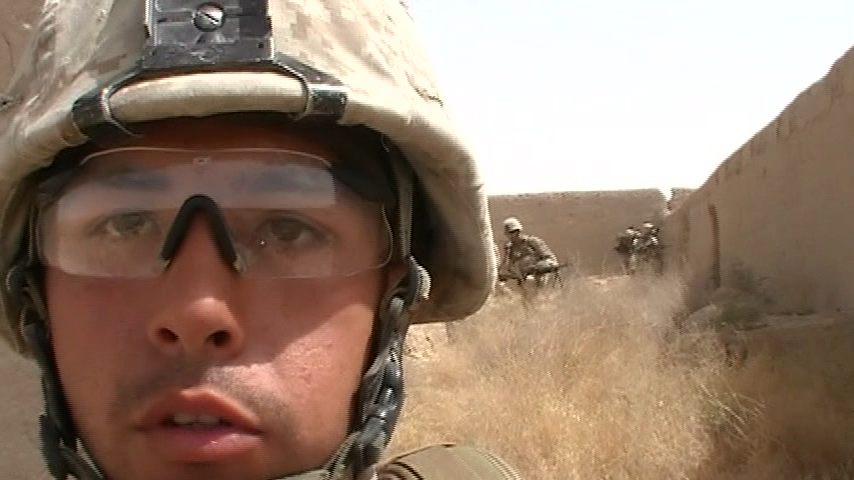
JV Villarreal narrates his journey in Helmand Province, Kajaki, Afghanistan. Credit: American Sons
This film is very beautifully titled “American Sons” – which means something more when we hear from JV’s mom who lost one son but has connections now with others. Andrew, can you talk about that title and what it means for families with loved ones who have served?
Andrew Gonzales: Yeah, so very clearly in the film, you can understand how the mother Yolanda has lost her son but gained all of these new sons, which are JV’s Marine brothers. And in just the relationships that he built with these young men in both basic training and training to go to Afghanistan and being in Afghanistan, it’s just such a tight bond that we refer to as the Marine Brotherhood. But they were so much deeper than that.
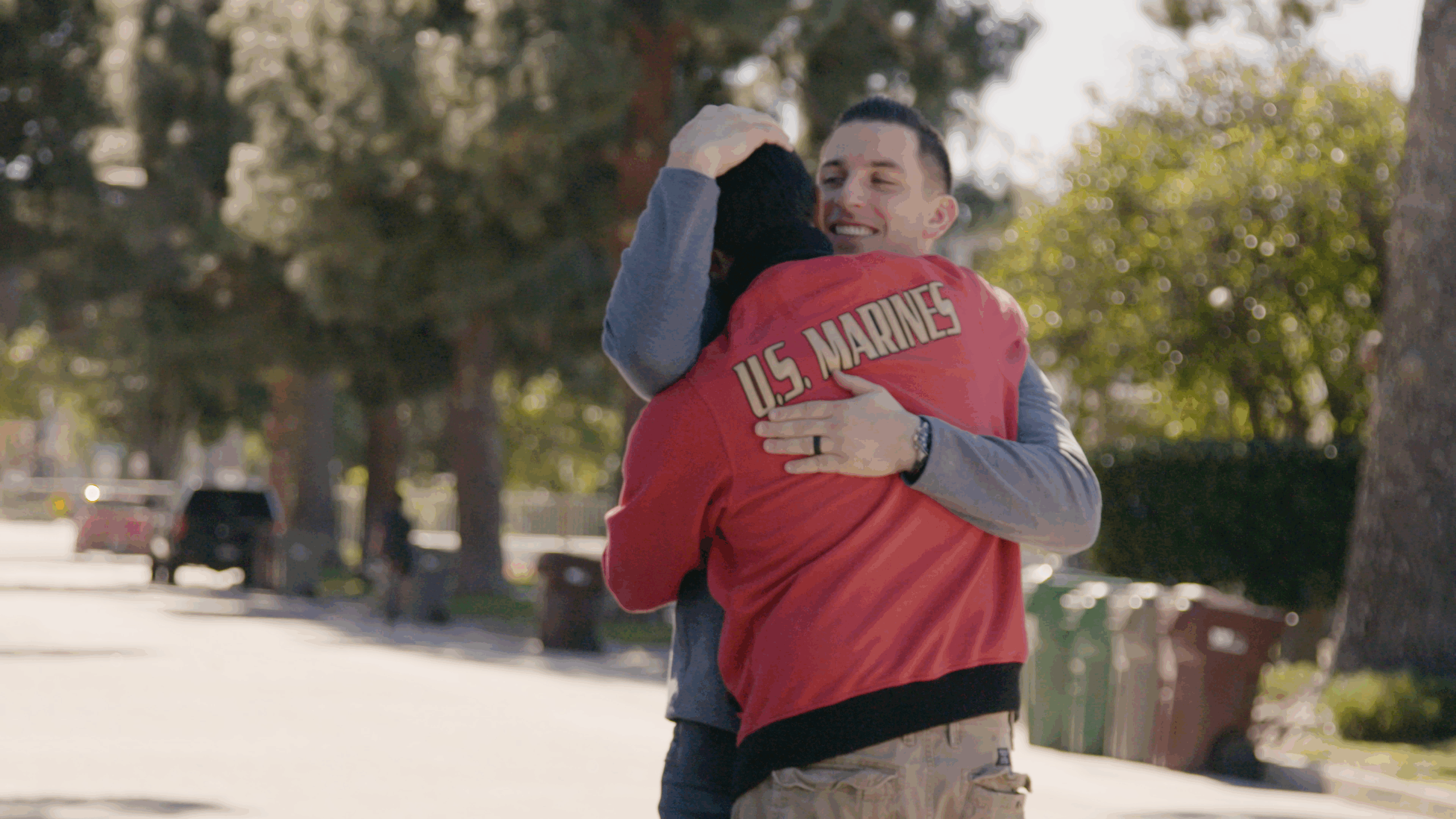
And so it’s through their relationships and the honoring of JV that they come back to San Antonio and they visit and have developed a very close relationship with the family. So it’s about that surrogacy, about keeping that memory alive, and about this community that can come together to honor that fallen brother, but just to honor all veterans that have served in this country.
And, on the other side, the American sons, what the film shows and what exists in our military is the actual people that are on the front line.
Though there are memorials and reunions, it’s not really one specific anniversary that your film centers around. It’s really the day in, day out, remembering and surviving for these Marine veterans and their families. Is that something you wanted audiences to understand?
Laura Varela: Yes, I think it was really important for us to show their humanity and show what happens to these Marines who are trained for combat and the issues that they have to deal with after combat when they come home and transition into civilian life.
And what we have found is that reconnection is very much a path to healing for them because they have suffered a lot of loss and they have a lot grief and they’re also dealing with their own physical and mental issues from their deployment.
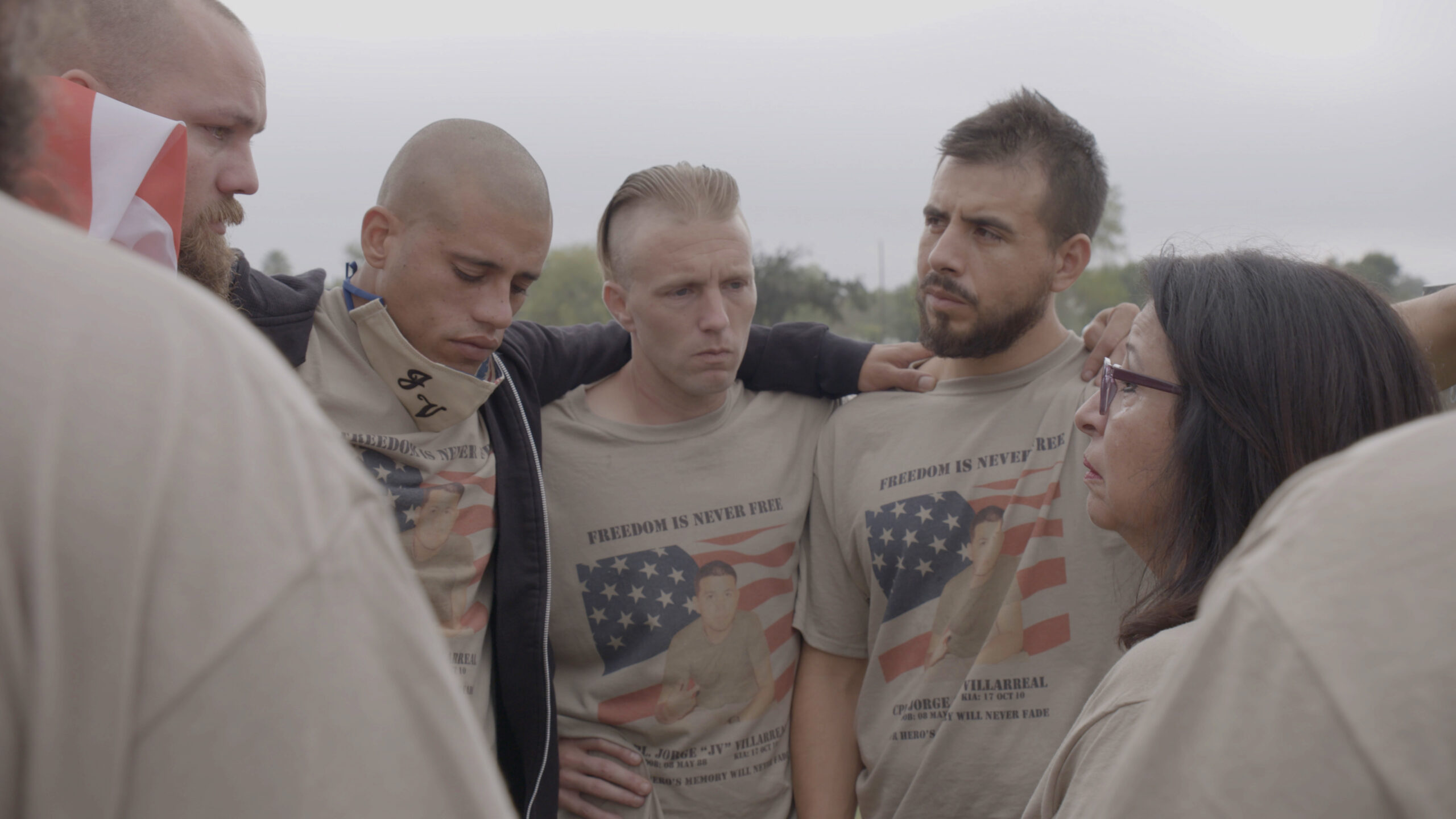
Nick Fry, Angel Rios, Raimen Horn, Gorge Serna, and Yolanda Villarreal at the San Fernando
Cemetery for JV’s 10th Memorial Anniversary.
Credit: American Sons
Laura, what do you hope to accomplish in sharing these stories?
Laura Varela: It’s important for us to show these men, and show America very much, that Latinos are also part of the American fabric. They also serve in very high numbers proportionate to their population.
And I think it’s important for us not only as civilians, but also for our politicians and leaders to really, really think hard before we send them off to these wars that just never seem to end and just be very careful what we do with them and their service and their training, and also make sure that they’re taken care of when they come home, because I think that’s one of the most important parts…
Or, for me, is to make sure that we take care of them, because it’s not just them, right? It’s them and families and their communities that feel all these ripple effects from their deployment and their service.
Andrew, what would you add to that? The number of suicides of those who served in Afghanistan continues to rise. Are you hopeful that the right help could prevent more?
Andrew Gonzales: I definitely believe that the right help will prevent more.
Now, where that help is coming from, we tend to see it in the organizations formed by veterans themselves. If we ask for our leaders, as Laura said, to be able to take action, I think we’re still waiting on that to happen. I would love to see more engagement on that end.
I know there is a concern there. It is alarming. But we’re looking for more of a wraparound opportunity where if men and women are being trained to, you now, potentially give their lives for this country in service, that they will be rewarded for those acts of service by at least getting basic mental health care when they come home.
I think that the number of suicides, there’s just no excuse for that. Definitely there’s a responsibility that needs to happen.
And whether or not I’m hopeful, it just depends on where it’s coming from. So I support all of the veterans who are coming out to help other veterans. And that is really what this film is about. It’s an awareness to show that that peer-to-peer care is so vital, so critical.
And so we just want to encourage, there’s things that are happening on a national level, there’s organizations that are plugging veterans together, but on a local level for veterans to reach out to each other or to watch this film and realize that maybe they need to reach it out, maybe they may need to reconnect, maybe they’re too isolated.
So it’s just a way to remind the folks that are watching that there’s someone out there that needs their help. There’s someone that could use a phone call right now. And that’s a very small lift to do. Just call somebody you’ve been thinking about. Don’t put it off any longer.
The PBS nationwide airing is great, but it’s not the end of the story for this film. Where are you taking it next?
Andrew Gonzales: That’s right, so this film has some real impact. It’s kind of an educational tool that shows the inner workings of what’s happening to these combat veterans when they return home.
And so what we’re doing is we have an impact campaign scheduled for this year where we’ll be traveling, screening the film in veteran-centric populations all over the country, partnering with different organizations, and bringing veterans out from isolation so that they can connect with other veterans, connect with organizations and find what services are available there in their local communities.
If you found the reporting above valuable, please consider making a donation to support it here. Your gift helps pay for everything you find on texasstandard.org and KUT.org. Thanks for donating today.