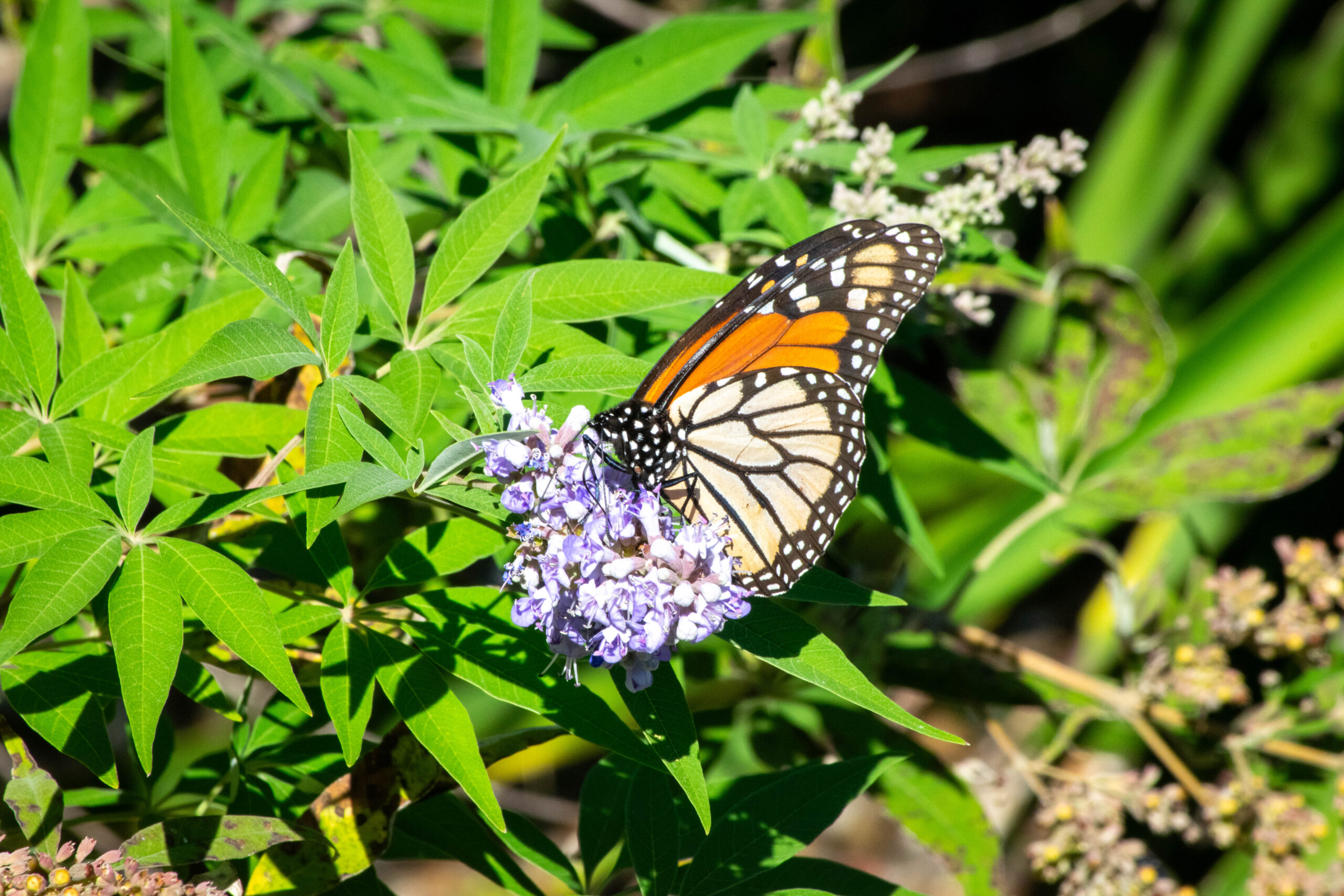
Unfortunately, Texans know all too well that our position on the path of migration for monarch butterflies means that we have often inadvertently contributed to their untimely demise. In fact, it turns out that our vehicles are one of the biggest threats to migrating monarchs.
Researchers at Texas A&M are trying to help.
Megan Stringer wrote about this for Axios. She joined the Standard for a discussion. Listen to the interview above or read the transcript below.
This transcript has been edited lightly for clarity:
Texas Standard: So what do we know about just how dangerous Texas roads are for monarchs?
Megan Stringer: As you mentioned, it’s one of the largest threats. And there are a lot of different types of threats that monarchs face on their migration. They’re looking at disease. They’re are looking at different temperatures from climate change, deforestation, all of this.
But roadkill is a pretty big one. I’m told at least 6% of deaths – and that might sound like a small percentage, but when you think about all the various issues that they are facing, that turns out to be a a pretty big one.
So how did Texas A&M researchers begin to actually quantify this, understand how many butterflies were hit by cars in Texas?
So this started back in 2016. So a while ago, really. They have been looking at this and it started kind of the old fashioned way, you know? They started just driving thousands of miles across the state, collecting butterfly remains and figuring out where they are, how many are in what areas.
And that’s how they kind of began to put together a map and really understand where this is happening the most and why. And so that’s how they were able to discover that wind patterns had a big effect on where the monarchs are migrating, where they’re being funneled.
And so they found a couple of areas in the state where that is happening most, just by doing that sort of old-fashioned footwork.
So what are they trying to do about it? It doesn’t seem like wind patterns are a thing you can control.
No, you might not be able to control the wind, but you can put up some diverters.
And that’s what they’ve done at a couple of sites here in Texas. They’re sort of mesh panels that are high in the sky and they encourage the monarchs to fly around them – so sort of above the cars. And that’s what they’re going for, really trying to get them above the cars and not in the way of our grills right there.
And so there are a couple of sites in the state that they have installed these diverters at over the last couple of years. One is in West Texas along Interstate 10 in a town called Ozona. You might be familiar with it if you’ve ever taken a road trip over to Big Bend. And the other is at the Lavaca Bay Causeway, which is along the coast near Victoria.
So what do their early data say? I mean, are they working?
Yeah, they just have early results so far, but at the Ozona site, they’re seeing that the diverters are cutting monarch deaths in half – during the fall migration in particular is what they were looking at. But we will expect some more hard data next year as their current funding comes to an end and they expect to release more data and reports on this.
» GET MORE NEWS FROM AROUND THE STATE: Sign up for Texas Standard’s weekly newsletters
So what are their hopes for the project? I mean, these are just two sites, but are they hoping to expand?
Yeah, you know, it depends on what they are able to say with the hard data next year. I think there’s waiting for that and kind of seeing what is going to happen, what they can say more concretely.
But I would say after speaking with Robert Coulson [A&M entomology professor], he’s optimistic, maybe cautiously so, about what this can do for the monarchs. If they can have a solid report next year, if it shows that the diverters are working, that there’s promise in those, then there’s the opportunity for agencies to pick that up and fund this going into the future at other sites across Texas.
Well I’m sure most listeners agree that monarchs are beautiful and we love to have them and see them, but I wonder if some are also asking, is this worth the time and money? Is this really valuable? What would they say to this?
Yeah, you know, monarchs, they’re more than just a pretty sight. They might be a very pretty sight, but they’re also very important to our ecosystem and even our food system as humans.
They are pollinators. And so, if monarchs are healthy and they’re here, that means that the rest of our ecosystem, and plants and animals, can have good food sources. And it just keeps our environment sort of functioning.
And, so, that’s why important is as pollinators, that they serve a function sort of beyond their beautiful migration that we might see in the fall and spring.
Well, and they’ve already been under such threat. As you said, we don’t have as many as we used to.
Correct, yes. The U.S. Fish and Wildlife Service is considering listing monarchs as a threatened species. It was about a year ago that they opened that up for consideration and they’ve had some public comment on that and we are still awaiting a decision.
But the Eastern migratory population, that’s the population that migrates through Texas, has declined by as much as 80% since the mid-1990s, is what that U. S. Fish& Wildlife Service estimates.