From The Texas Observer:
Alonso Montañez killed the outboard, and the boat swung against the scum and trash that had accumulated in the stagnant water on the high side of the dam.
“Escucha,” he said, gesturing at the surface of the lake.
In the quiet, we heard water slapping the hull, a life jacket buckle pinging on a metal pole. “Listen,” he said again. “You can hear the force of it, no?”
The sound was imperceptible at first. But soon enough it emerged, swelling upward from the murky emerald depths beneath our little boat. The sound was like an enormous rainstick held underwater.
Montañez, muscle-bound in a tight blue t-shirt, explained we were hearing the sediment-infused water of La Boquilla Reservoir sluicing into the dam’s gigantic outlets. “That’s not something you want to hear,” he said.
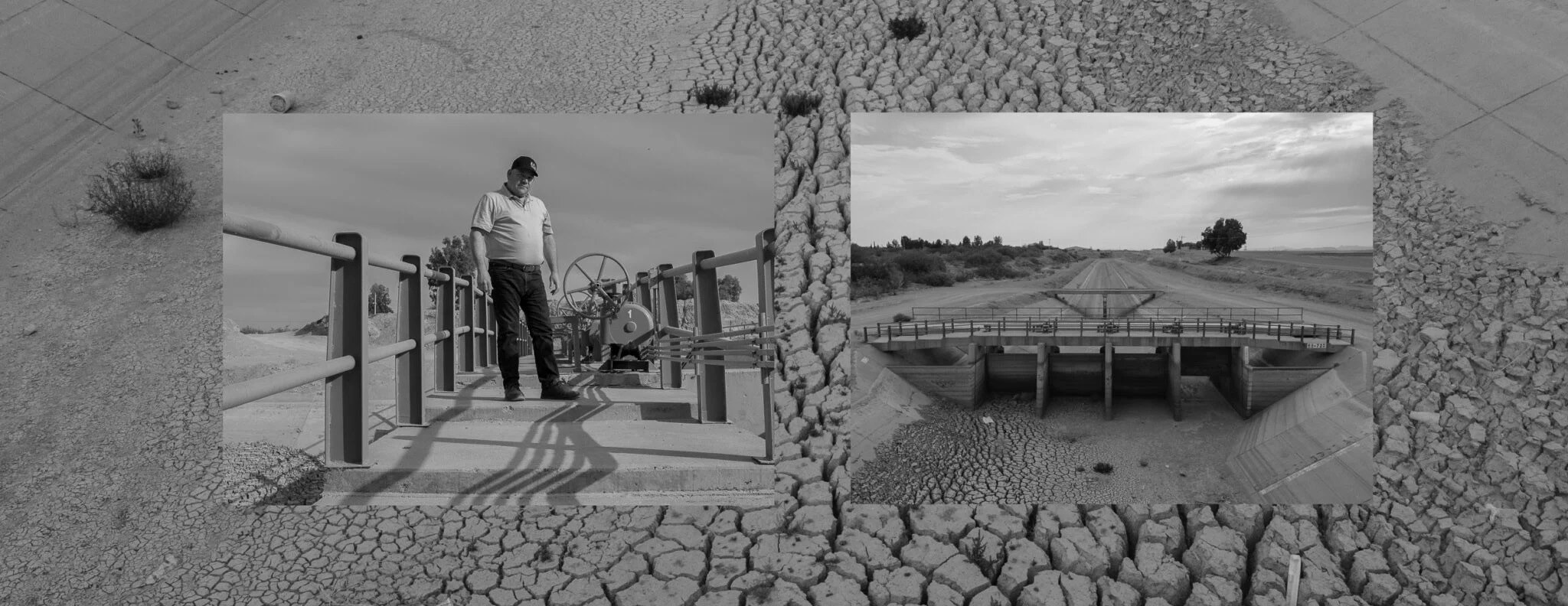
Our boat drifted closer to the dam’s wall, a mighty concrete curtain pressed between two desert peaks. Montañez pointed out six gates, each about 12 feet wide, the tops poking out just above the water’s surface. These were the reservoir’s outlets. Under normal conditions, Montañez told me, they would be far below the lake’s surface. “You should never be able to see these,” he said. “This dam was not designed for the water to get this low.”
Montañez is a tour boat operator and fisherman on La Boquilla Reservoir, the largest reservoir in the northern Mexican state of Chihuahua and a body of water whose drastically dwindling supply portends ever-more hardship for the drought-stricken Rio Grande. Never in the history of Mexican National Water Commission records has La Boquilla plunged to its present levels. The day we motored up to the dam—September 21, 2024—the reservoir had sunk to 16.1 percent of its capacity. This May, the reservoir sat at 14.7 percent.
La Boquilla impounds the water of the Rio Conchos, the largest tributary of the Rio Grande. With a capacity of more than 2.35 million acre-feet—enough, in other words, to submerge 2.35 million acres of land in a foot of water—La Boquilla can be thought of as a gigantic storage tank perched at a high point in a complex binational river system.
If the lake lacks water, the river below it dries. And a dried-up Rio Conchos signals distress and political tensions extending throughout northern Chihuahua and all along Mexico’s border with Texas.
•
Historically, the Rio Conchos served as Mexico’s most reliable workhorse for delivering water to Texas in accordance with a treaty negotiated by the United States and Mexico in 1944. But it’s become increasingly apparent that decades of megadrought and overexploitation have ridden the old river nearly to death.
The desiccation of the Rio Conchos is partly to blame for unprecedented water shortages experienced by Rio Grande Valley farmers in South Texas that threaten an annual agricultural economy estimated at $887 million. In February 2024, South Texas’ last sugar mill shuttered, heralding the death of an industry—the blame for which many have laid at the feet of Mexico for failing to meet its 1944 treaty obligations.
But the Rio Conchos also flows as the lifeblood for hundreds of thousands of northern Chihuahua residents. They tap the river and its associated groundwater for domestic use. They turn to the Rio Conchos as a ribbon of wildlife habitat in an otherwise parched desert. And they depend upon the river for a regional economy propped precariously atop irrigated agriculture.