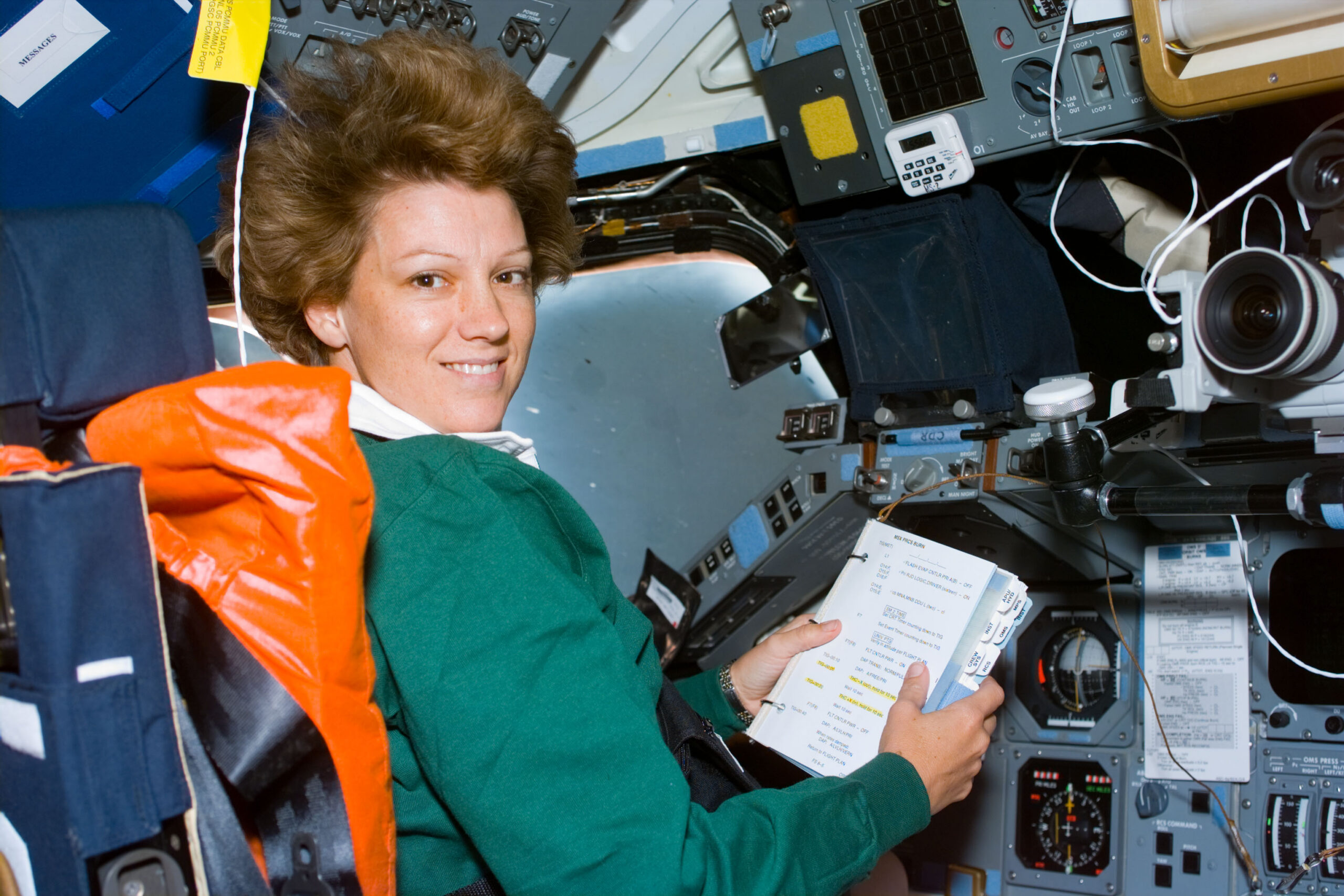
Little girls all over the country don’t often get shushed or dismissed anymore when they say they want to grow up to be astronauts. They can also say they want to pilot a spacecraft or command one.
That’s because Eileen Collins did it first, decades ago.
A new documentary celebrates her level-head, natural talent and glass-shattering determination. “Spacewoman” is coming in limited release to theaters in Texas’ biggest cities. It’s based on Collins’ book “Through the Glass Ceiling to the Stars” and is directed by Hannah Berryman.
Listen to the conversation with Collins and Berryman via the audio player above or read the transcript below.
This transcript has been edited lightly for clarity:
Texas Standard: You were based at Johnson Space Center in Houston for a long time. And am I right that you’ve continued to make Texas your home?
Eileen Collins: Oh, that’s right, I was at 20 years at Johnson Space Center in the years I was a space shuttle astronaut. I married a man from San Antonio and love the city. That’s where I live now and love Texas. It’s a great place.
» RELATED: Highway to the Moon: How Texas paved the way for Apollo
You’re from New York and, even as a young person, dreamed of being not just an astronaut, but piloting a spacecraft?
Eileen Collins: That’s right, so I grew up in upstate New York, a very rural area — you know, people grew corn crops, there were cows and dairy everywhere, so I’m kind of a rural person.
I got interested in flying really two ways. The first was through reading books, and I encourage young people to read books about people that do things that you would like to do someday. But the other thing is we had the National Soaring Museum in my hometown of Elmira, where I was able to watch gliders fly overhead.
I did kind of dream of what it would be like to fly myself. Of course, my parents didn’t have the money to give me flying lessons. That would have been totally ridiculous to ask them for that.
So I ended up joining the military. The Air Force taught me how to fly, and that, I think, is what led me, eventually, into the astronaut program.
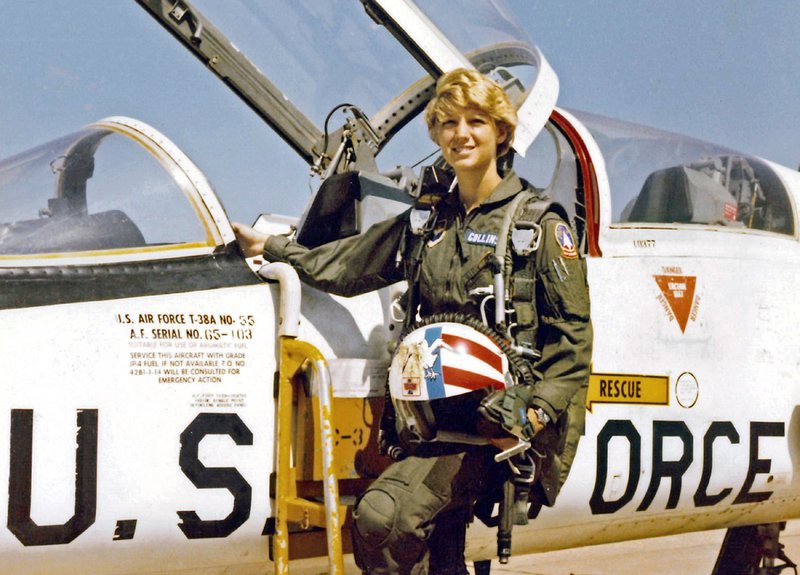
Collins poses with her T-38 when she graduated from flight school in 1979.
Hannah, you’re from the UK. When do you remember first encountering Eileen’s story?
Hannah Berryman: I’m ashamed to say I didn’t know Eileen’s story and that was one of the reasons I really wanted to make the film. Because when I read her book, I thought what an absolutely incredible story.
So her quite tough upbringing combined with being the first woman to pilot and command shuttle, which was incredible and then being part of some really jeopardous missions.
It was really obviously going to be a great film and people would know her name if they didn’t already because I’m from London and I just don’t think many people do.
Eileen speaks matter-of-factly about all of these barriers that she just barreled down. Toot her horn for her here. I mean, this was shortly after the first women, like Sally Ride, were accepted at NASA.
How huge was it when Eileen made that move to NASA and then was on this path to being a pilot?
Hannah Berryman: If they hadn’t allowed women to fly the jets in the Air Force, then you wouldn’t have been able to make it through to the shuttle program as a pilot.
Sally Ride, obviously, it was a great achievement to go to space, but she didn’t fly the spaceship. That’s why it was so huge when Eileen came along. You see her in a room full of these male pilots and it’s really that kind of “right stuff” world still at that stage. It’s tough and she had to prove herself.
» RELATED: Filmmaker celebrates bravery in documentary about Sally Ride
Eileen, you became the first woman not just to pilot a spacecraft, but also to command one. Why would you want the weight of a mission on your shoulders?
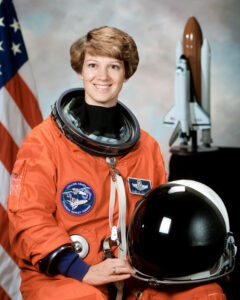 Eileen Collins: Well, you know, I love a challenge.
I found that once I really learned as much as I could about the space shuttle, of course I was always continuing learning and learning, getting to know the people. I loved the mission so much.
And I think that I feel confident in myself as far as being a decision-maker, being a person who likes to encourage communication. I like to be a good listener. I like to ask people questions. I want to encourage creativity.
So I think in that respect, that was the type of leader that I was – not really a yelling orders at people, but being a collaborative type of a leader.
And when you’re in a a mission like flying in space where everyone is very educated and already dedicated to the mission, they love the mission – you need a different type of leader for that. So I was kind of a collaborative leader.
And especially at the time when we had the terrible accident, and this will come out in the film when we lost the Space Shuttle Columbia in 2003, people needed someone to talk to. People felt horrible about the accident. And I found myself in a leadership role of going around and being a listener and trying to bring people together.
So I felt like I was very well-prepared. I wanted to be the commander of the flight after the accident. And I was happy that NASA had the confidence in me to keep me on and fly that mission that was called Return to Flight. It was a huge challenge, but what an honor.
I’m not going to say I was better than anybody else. I think it was just that the places I had been made me very well-prepared.
There’s a moment in the film that highlights some advice you gave to another female astronaut. What, in general, is your lesson for women in leadership or women who want to be in leadership?
Eileen Collins: There’s so much I could say about that.
My first thing is you need to know as much as possible about your job, be as good as you can in your job. But also learn about your industry. So read the history of your industry, read case studies of where people made mistakes, what was done to correct for those.
And then secondly, be a good communicator, which means being a good listener. And I find that some people tend to intimidate. I didn’t want to be that kind of person. So I think it’s the way we approach people and looking them in the eye and saying, hey, I value you and I want to know what you’re thinking. So don’t ever be afraid to speak up.
And then the last thing I’d say is it falls on integrity, you know, being honest with people and having that trust factor that you can trust people to be honest in the future.
And so I always try to come back to those three things: knowing your job, communicating and maintaining a sense of integrity. So that’s the same type of advice. I’d give that to women, but also to men, and always stay focused on the mission.
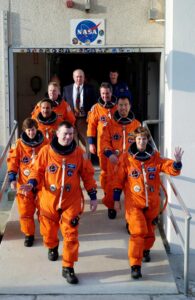 Collins: What Hannah really brought in that I thought she did such a great job on that I hadn’t really thought about as much was my family.