It’s officially that time of year when people start making resolutions and setting goals for self-improvement. But whether it’s doing more reading, getting in shape, or learning a new skill, following through can be a challenge.
One of the biggest issues is distraction. It’s easier than ever to fall down a rabbit hole – scrolling social media, gaming, or streaming TV shows.
So what to do if your goal is to focus more on other things?
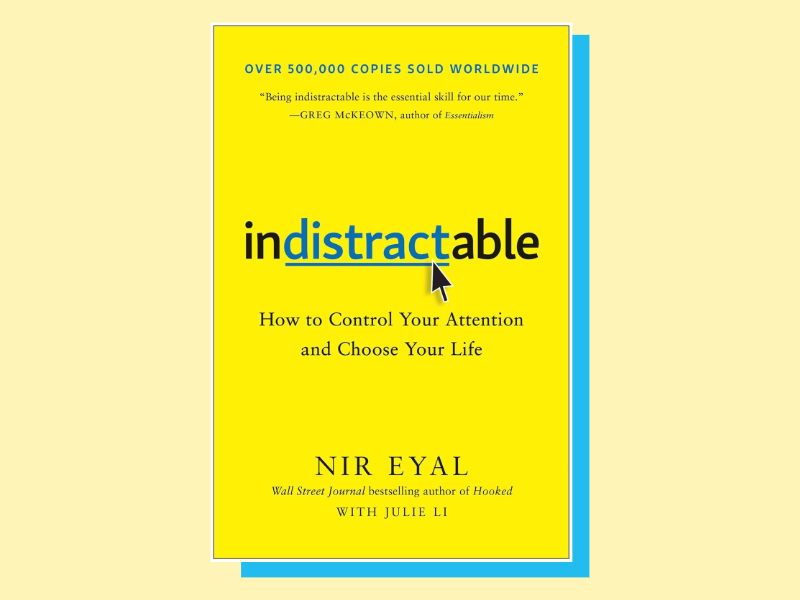
Nir Eyal, author of “Indistractable: How to Control Your Attention and Choose Your Life,” joined the Standard to share some tips as we head into 2026. Listen to the interview above or read the transcript below.
This transcript has been edited lightly for clarity:
Texas Standard: Your book lays out several techniques for staying focused and productive, and you start with making the claim that the root cause of all distraction is the desire to escape discomfort. Explain what you mean and how that is relevant to the broader goal of productivity.
Nir Eyal: So we tend to blame the pings, dings, and rings… Our phone, our kids, the boss, the news – all the things in our outside environment. But in actuality, studies have found that those external triggers, those things that are out in our environment, they only account for about 10% of our distractions.
So the question then is, what’s the other 90%?
It turns out that 90% of distractions begin from within. These are called internal triggers and they are uncomfortable emotional states that we seek to escape. So boredom, loneliness, fatigue, uncertainty, anxiety – that is the source of 90% of our distractions.
So if you’re fighting distraction, it doesn’t matter if the distraction is too much news, too much booze, too much football, too much Facebook, you are always going to get distraction unless you understand that most distraction begins from within.
Oh, that’s fascinating and surprising that the dings and pings are just a small percentage. Well, in the book, you talk about something you call the 10 minute rule. Tell us about that.
Yeah, so I use this every single day and it’s really helped me as an author. I’ve been a professional author now for over two decades and all I wanna do every time I write is to do something else. I want to check the news, I wanna look at stock prices, I wanna to look at sports scores, I wanna do everything but the writing. It’s really hard.
So this rule that I’ve come across is called the 10-minute rule. Now the idea behind the 10-minute rule is that you’re allowing yourself to give into that distraction. You can do anything you want. You’re an adult, you can do what you want, But you want to do it in 10 minutes and if 10 minutes is too long, make it the two-minute rule, make it five-minute rule.
The idea here is that you’re teaching your brain that you are not a slave, you’re not addicted to these distractions, you’re just simply doing something with your mind at that moment. So the idea here, is that you’re gonna restrict yourself, you’re going to tell yourself to not do something because in fact that can backfire and make you want it more. Instead you’re saying, I choose to give in to that distraction in 10 minutes.
So many times while I’m writing, I’ll just set an alarm and I’ll say “okay, for 10 minutes” and then I can continue that task for just 10 more minutes and then what I’m doing is I’m showing myself that I have the agency, I have self-efficacy to then change the 10-minute rule to the 12-minute rule to the 15-minute rule, to the 20-minute rule and that’s how you’re teaching your brain to expect that you can actually delay that distraction for a little bit longer.
» GET MORE NEWS FROM AROUND THE STATE: Sign up for Texas Standard’s weekly newsletters
Well, you’re a big advocate of time-boxing, setting aside specific chunks of time to accomplish tasks. How do you do that in your own schedule?
So this has absolutely changed my life because of this principle that I oftentimes repeat, which is you cannot call something a distraction unless you know what it distracted you from.
I’ll say it again: You can’t call something a distraction unless you knew what it distracts you from. So people complain all the time, and I used to complain all of the time, about how I was distracted because of my daughter, I was distracted because of the news, I was distracted because of what my job required of me, that I was constantly distracted. But then when you looked at my calendar, like a lot of people, it was blank. There’s nothing on my schedule.
So you can’t say you got distracted unless you know what it distracted you from. So you’ve got to put down in your calendar how you want to spend your time because we tend to vilify the distraction itself – the phone, the television, the whatever it might be that might be taking us off track.
But none of those things are inherently bad. What’s bad about those things is that when we use them without intent. And so the antidote for this impulsiveness… Because at the end of the day, distraction is simply a dysfunction of impulsivity, because we haven’t learned how to deal with those impulses. So if you plan ahead, there is no distraction you can’t overcome.
Well, putting away our phones is common advice for staying productive, but it’s not always feasible. What are some ways we can use technology to help us stay on track?
So one of the best things you can do is actually schedule it. I see this a lot of times with parents and I give them what they think is the most unconventional advice – that if you want to get your kids to use their phones less, make time for it.
And so this goes back to the idea of time boxing because what happens with a lot of us, not just kids, is that we ruminate. We think, “when can I check?” Especially with kids: “When can play that game? When can contact my friends? When can use these technologies?”
And so one of best things you could do is to simply. Plan time for it, not just for the productive time, not just the homework time or clean-up-the-house time, but time to play games. If that’s important to you, if that’s part of your value system, part of the person you want to become, is spending time online, there’s nothing wrong with it, but do it on your schedule and according to your values, not the tech companies.
And as you said, schedule it. So at this point, the internet and digital devices are not new. Do you think we’ve gotten better at managing all the push notifications and digital distractions?
I think we have, actually. If you compare from when I first started doing this research and publishing this work, I had to convince people that this was a problem. Today, we all know it’s a problem, and so part of what the companies who make these products, as much as we want to paint them as the bad guys and they certainly have special responsibilities, they’ve actually put in tools into the very products to help us use them less.
I mean, I can’t name any other products that do this that actually help the people who use them use them less, right? The casinos don’t tell you, “hey, you’ve had enough, you should go away.” They don’t do that, but yet these tech companies, every product these days, whether you have an iPhone, whether you an Android device, it comes with tools built right into them. Apple Screen Time, Google Wellbeing, it’s built into the device to help us use them less.
And so we need to frankly stop complaining and use these tools that come on our phones for free to help control all of these devices so that we use them as opposed to them using us.
Well, you have a new book coming out soon called “Beyond Belief.” What’s that book about?
Yeah, so thanks for asking. So this book tackles this challenge that I found. You know, I wrote “Indistractable” a few years ago and I do these office hours where anybody can call me and ask me anything they like about the book and it’s a great way to kind of get feedback from my readers.
And every once in a while I would get this call that someone would say, “hey, I read your book, ‘Indistractable.’ I really enjoyed it, but it didn’t work.” I’d say, “oh, wow, it didn’t work. Tell me more.” You know, what was happening here? I spent five years on it. I did tons of research. There’s 30 pages of citations to peer-reviewed studies.
“Tell me, how did step one go for you?”
“Well, you know, I didn’t do step one.”
And so what I realized is that, you now, I thought, well, what’s wrong with these people? And then I realized, wait a minute, I’m one of these people. I have tons of books with gurus telling me advice that I haven’t followed and haven’t listened to and haven’t implemented. And the real question is why?
And what I realized when I dug deeper into the research is that it’s not good enough to just know what to do. Why? Because we’re missing the belief. Motivation is not a straight line between doing the behavior and getting the reward, it’s actually a triangle. That you have the behavior, you have benefit, and then you have belief. And the belief is what holds it all together.
And so that’s what “Beyond Belief” is all about.