Texas declared independence 190 years ago. This town northwest of Houston is celebrating

Almost two centuries ago, dozens of Texans gathered in the town of Washington-on-the-Brazos to sign Texas’ Declaration of Independence from Mexico. Today, the site is investing in becoming a historical destination.

By Michael Adkison, Houston Public MediaFebruary 27, 2026 10:15 am, ,

From Houston Public Media:

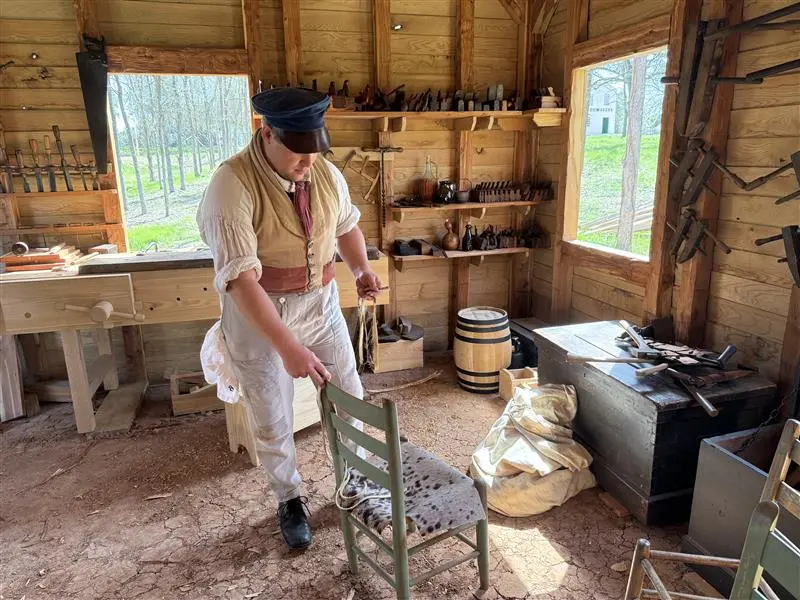
Ben Baumgartner held in his hands a strip of raw cow leather, white with black spots, still with its coarse hair on one side. Standing inside a wooded workshop, he was building a wooden chair with a leather seat.

He’d already completed one chair, its leather seat as tight as a drumhead. He’d rolled his sleeves up to his elbows as sweat beaded on his temples.

His goal: to prepare for the coming of 59 delegates to the town of Washington-on-the-Brazos to declare Texas’ independence from Mexico.
Michael Adkison / Houston Public Media

Ben Baumgartner, an interpreter at Washington-on-the-Brazos, builds a raw hide chair on Feb. 21, 2026.

“If you’re going to meet somewhere, you need somewhere to sit,” Baumgartner said.

Of course, Baumgartner is nearly two centuries removed from the signing of Texas’ Declaration of Independence in 1836. He’s an interpreter at modern-day Washington-on-the-Brazos, an unincorporated community about 65 miles northwest of Houston.

Interpreters are like historical reenactors, though more focused on education — bridging the gap between the past and the present. This week, the historic site is celebrating Texas’ independence, which was declared 190 years ago on March 2.

This Saturday, Feb. 28, Washington-on-the-Brazos, which is part of the Texas Historical Commission, will celebrate the anniversary with an opening ceremony, parade and performances. The event is free and open to the public.

“The Washington townsite experience is one of the most amazing things that I’ve ever been a part of,” said Tynan Shadle, an assistant manager at the historic site. “We’re able to preserve history through bringing the past to life before people’s eyes.”

Michael Adkison / Houston Public Media

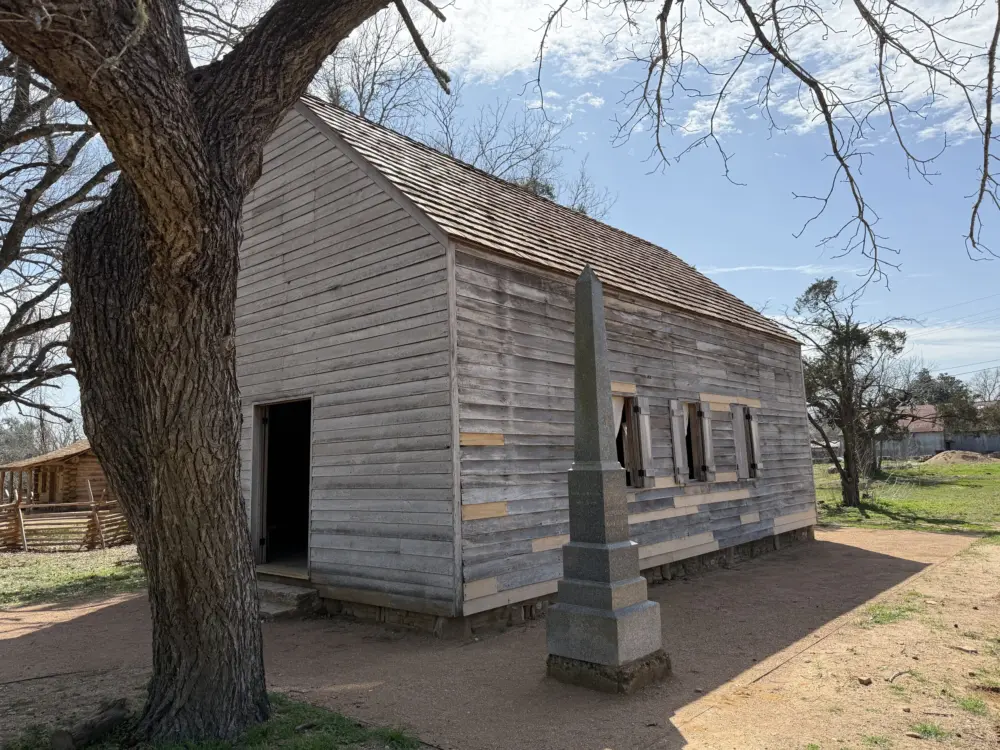
Independence Hall at Washington-on-the-Brazos, a recreated depiction of the building where Texans signed their Declaration of Independence in 1863. Photo taken on Feb. 21, 2026.

Washington-on-the-Brazos includes Independence Hall, a replica of the building where the Texas Declaration of Independence was signed. On Feb. 1, 1836, Texans held elections across the state to select delegates for the 1836 Convention.

“When they arrive here at Washington on March 1st [1836], they actually put together a committee the first day to write a Declaration of Independence,” Shadle said. “There is no debate about it. They know why they’re here.”

The declaration is believed to have been written mostly by George Childress, a lawyer and newspaper editor. When the declaration was brought before the full convention, it was read once and adopted unanimously an hour later, Shadle said.

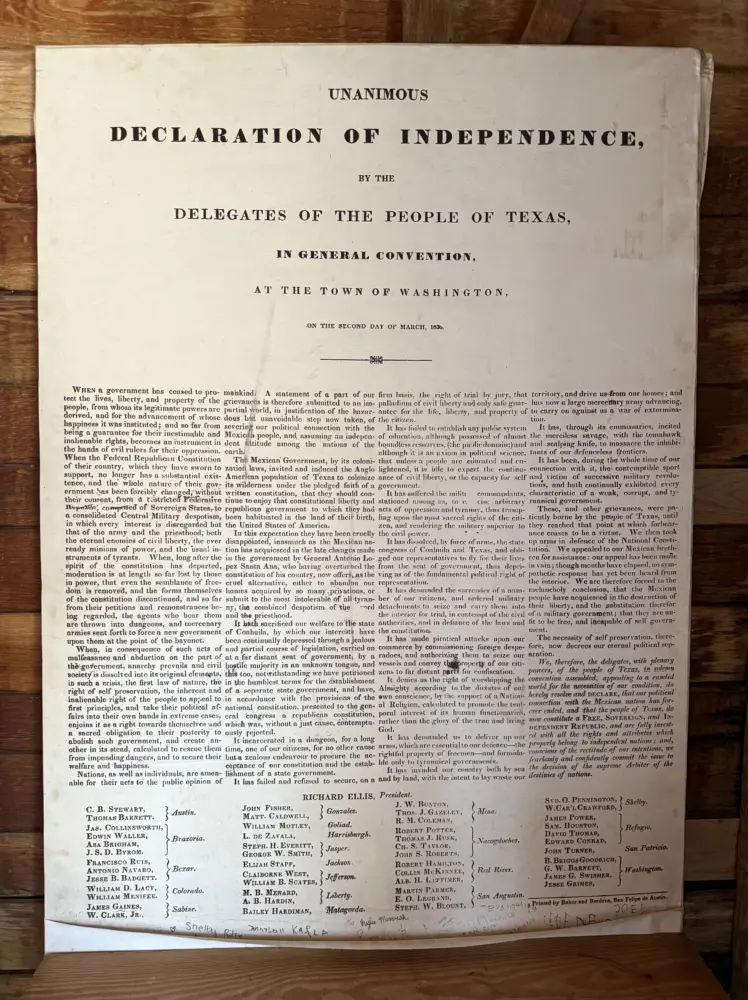
A recreated depiction of the Texas Declaration of Independence at Washington-on-the-Brazos on Feb. 21, 2026. Michael Adkison / Houston Public Media

At about 1,400 words long, the declaration lists a series of grievances against the Mexican government before declaring “The necessity of self-preservation, therefore, now decrees our eternal political separation.” Texas accused Mexico of violating the state’s safety, Texans’ rights to due process, to bear arms and to the freedom of religion.

As such, the Texas Declaration of Independence has a clear and direct influence: the United States, which signed its own Declaration of Independence in 1776 — 250 years ago this July.

“Throughout the 1820s and the 1830s, the memory of the American Revolution had been something of a mania for Americans,” said Sam Haynes, a history professor at the University of Texas at Arlington. “It shouldn’t come as much of a surprise that Anglo Americans in Texas, just like Anglo Americans elsewhere, saw [Mexico] as tyrannical and, therefore, a cause for revolt.”

It’s possible that even meeting in the town of Washington-on-the-Brazos may have been an homage to the United States by design.

“They’re expressing their American ideals at a town called Washington, right?” Shadle said. “Most of the other towns in Texas — San Felipe de Austin, Gonzales, Goliad — these are Spanish names. Washington, whether intended or not, there is some symbolism involved with many of these Americans and we had more than just Americans here, but they’re all expressing the same kind of American ideals and principles here in Texas.”

After the declaration was unanimously passed, five copies of it were made and sent to Texas towns across the state. Also, 1,000 copies were ordered printed in handbill form.

Though the Texas Revolution had begun months before, beginning with the Battle of Gonzales in October 1835, the passage of a Declaration of Independence is a major turning point in the war. Four days afterward, on March 6, 1836, Mexican troops descended on the Alamo mission, killing each of the Texas soldiers defending it in the span of about 90 minutes.

Since then, the Alamo in downtown San Antonio has become the defining image of the Texas Revolution. But the Texas Historical Commission, the state agency tasked with historic preservation, wants to work on making each major revolutionary site, including Washington-on-the-Brazos, a historic destination.

Michael Adkison / Houston Public Media

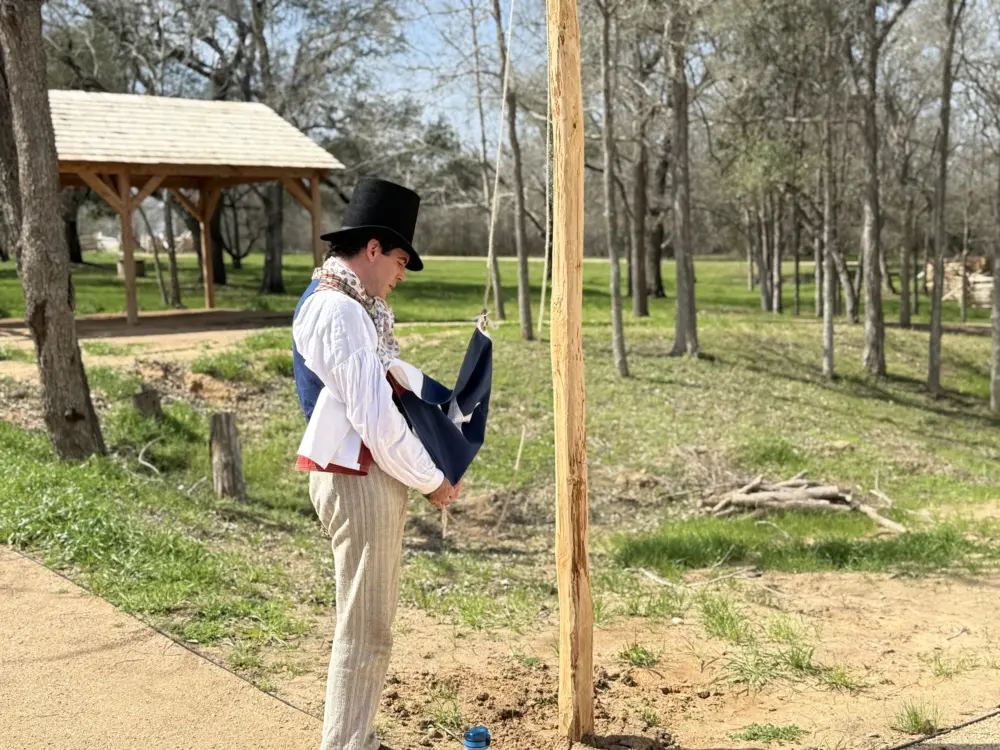
Adam Arnold, an interpreter at Washington-on-the-Brazos, raises the Texas flag on Feb. 21, 2026.

In November, the Texas Historical Commission held a grand reopening for the Washington-on-the-Brazos historical site, after a $54 million renovation, which the commission called the most expansive project in the agency’s history.

The expansion included a renovated visitor’s center and Star of the Republic Museum, as well as a more fleshed-out Washington townsite. Prior to the renovations, Independence Hall, the recreated building where the declaration was signed, had always stood alone.

Now, the town includes recreations of Sam Houston’s presidential office, which once stood in Washington-on-the-Brazos; Hatfield’s Exchange, where lawmakers met during the 8th and 9th Congresses of the Texas Republic; and a carpentry shop, where Baumgartner built his chairs.

Just outside Hatfield’s Exchange, Adam Arnold, another interpreter, was raising the Texas flag on a newly built flagpole.

“You have to know where you come from,” he said. “If you don’t know where you come from, you can’t make good decisions about where you’re going.”

If you found the reporting above valuable, please consider making a donation to support it here. Your gift helps pay for everything you find on texasstandard.org and houstonpublicmedia.org. Thanks for donating today.