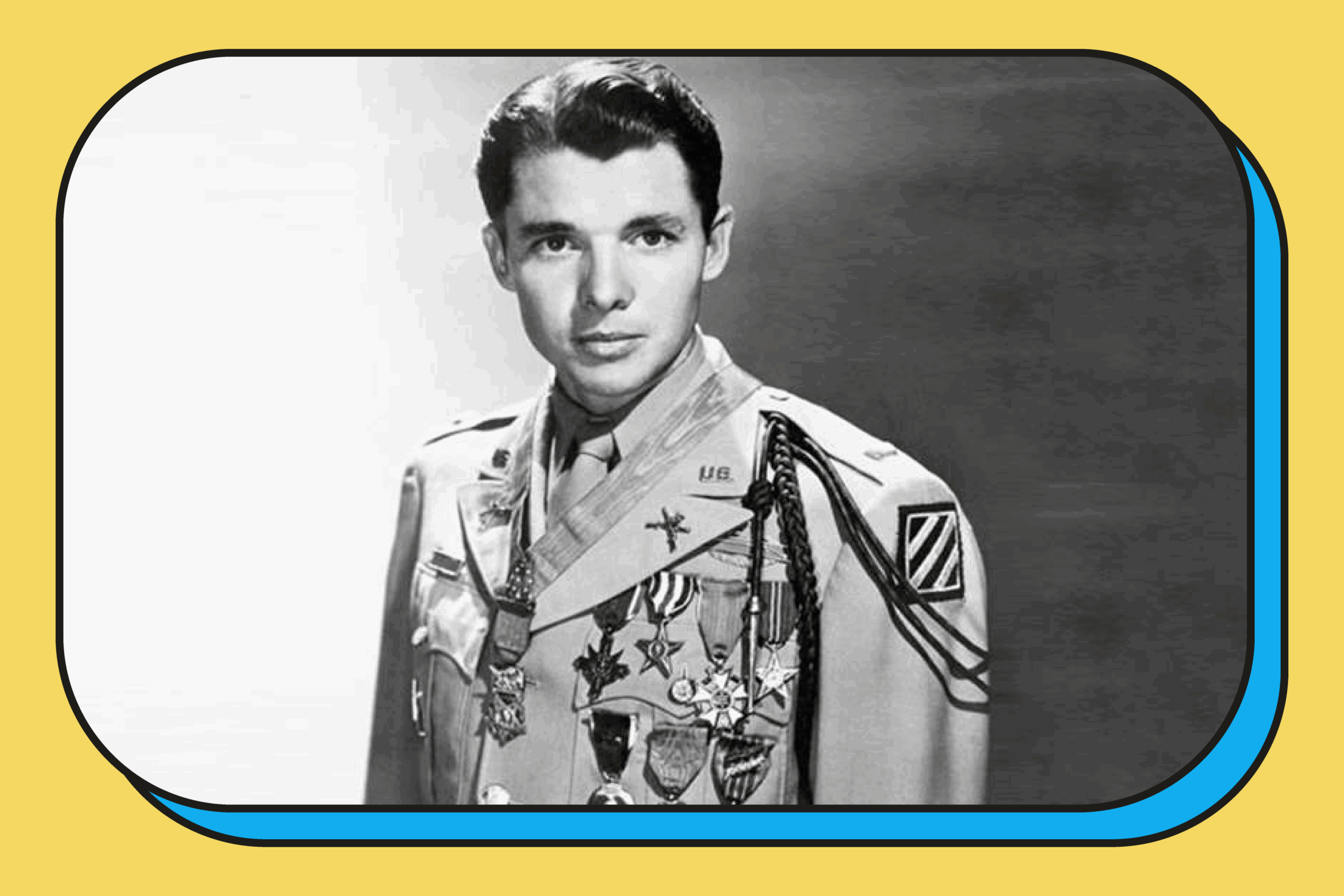
On Jan. 26, 1945, 19-year-old East Texan Audie Murphy almost single-handedly held off a German counteroffensive in occupied France.
Murphy manned the machine gun of a burning tank destroyer, alone, in an open field, taking out dozens of Nazis after ordering the rest of his company to retreat to the woods.
This was but one act of bravery in Murphy’s distinguished Army service during WWII, making him the most decorated American soldier in the conflict and a recipient of the Medal of Honor.
So, how’s this a music history story?
Well, Murphy’s high media profile at war’s end inspired him to use his record of service to promote the memory, legacy, and sacrifice of Allied troops. He appeared on the cover of Life magazine and wrote a memoir, “To Hell and Back,” with David McClure.
He starred in the book’s film adaptation, as well as dozens of war films and Westerns, becoming a top box office draw by the mid-1950s.
And, yes, like many of the era’s screen cowboys from the Lone Star State – from Gene Autry to Tex Ritter – Murphy, too, turned his attention to the country music industry, co-writing over a dozen songs with Canadian composer Scott Turner.
Two, Eddy Arnold’s recording of “When the Wind Blows in Chicago” and Dean Martin’s of “Shutters and Boards,” broke the top ten. Porter Wagonner, Roy Clark, Jimmy Bryant, and Charley Pride all covered Audie Murphy songs, as well, rounding out this more peaceful chapter of Murphy’s career.
In his home region of northeast Texas, in Greenville, the Audie Murphy American Cotton Museum now houses the war hero’s archives, a fitting tribute to this son of a sharecropper who answered his country’s call in WWII.
Sources
Harold B. Simpson in Laurie E. Jasinski, Gary Hartman, Casey Monahan, and Ann T. Smith, eds. The Handbook of Texas Music. Second Edition. Denton, TX: Texas State Historical Association, 2012.