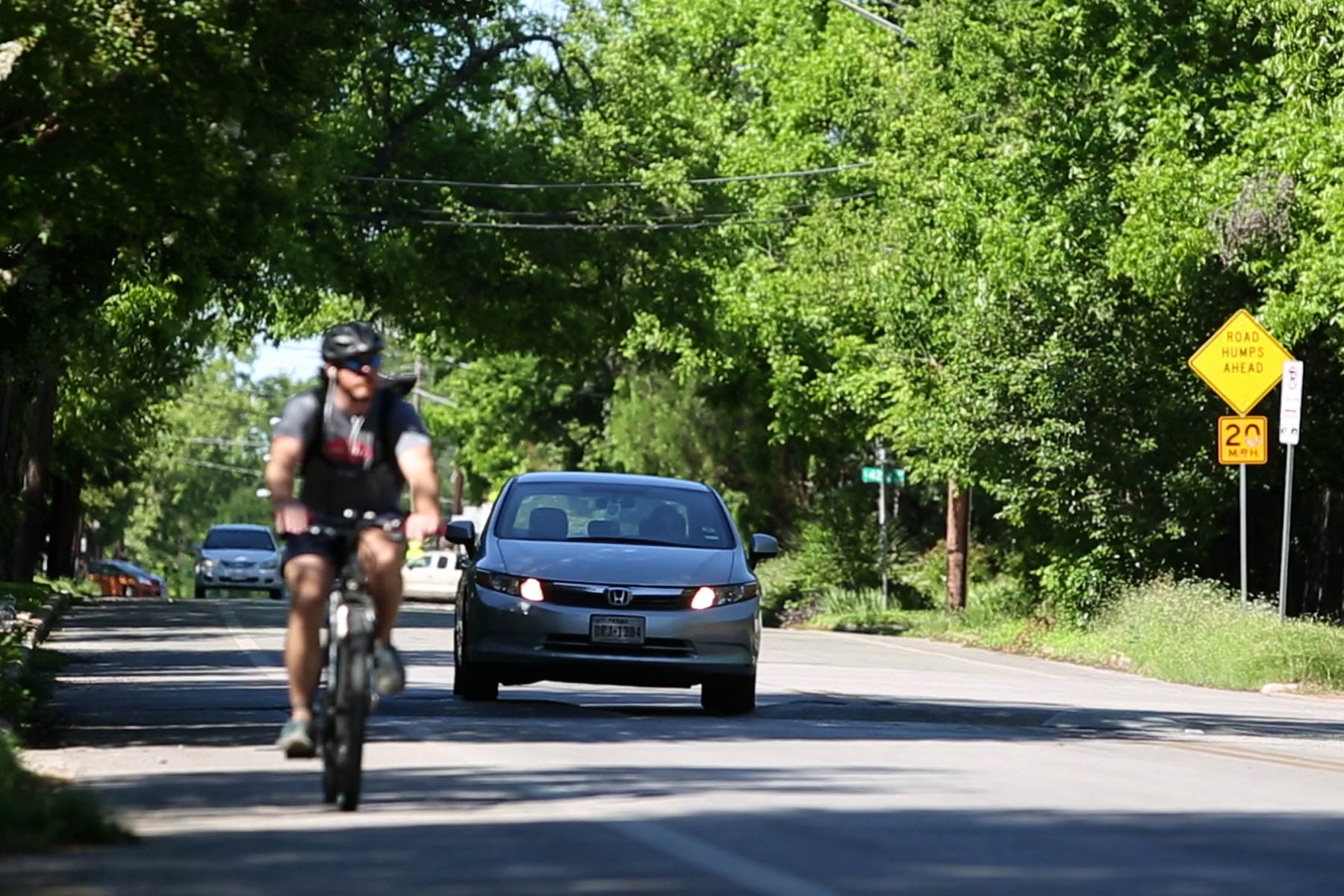
More people are riding bicycles in traffic. Unfortunately, fatalities among riders are on the rise. New research says that could change if drivers and bike riders could agree about the signals they use.
Christine Petersen conducted this research during her time as a graduate student in the Department of Psychological Sciences at Rice University. Listen to the interview above or read the transcript below.
This transcript has been edited lightly for clarity:
Texas Standard: Tell us a little bit more about what this one area is that could bring about a dramatic improvement in the numbers here.
Christine Petersen: Yeah, so it’d definitely be communication between drivers and cyclists. So today, it’s written into Texas transportation laws and other states as well on how cyclists should communicate. And that is arm signals. So using either straight arm signals turning left or turning right, or bent arm signals for communicating stopping or slowing.
And what I found is that arm signals are not perfectly understood by drivers. And so it’s really important to understand how we can improve this communication between cyclists and drivers when they have to use signals that are not perfectly understood.
Boy, you are making an important point here, because as you were talking, you were describing those arm signals, I thought, OK, look, I ride a motorcycle and often supplement my turn signals with hand signals. And now when I think of these signals, and I think an arm outstretched directly means turning left, an arm in a sort of an upwards L position means turning right, and an arm sort of diagonally downward means coming to a stop.
Now what are the real arm signals and am I doing it right or wrong?
Yeah, so you did touch on three of them, but you can also use a straight arm right out signal to also communicate turning right.
And what we found is using those straight arm signals is 100% understood by the drivers we researched, while using that bent turn right arm signal is not as widely understood. It actually leads to confusion and makes drivers less likely to actually understand what the cyclist is gonna do.
So let me make sure I’ve got this straight. If I hold my right arm out straight, that’s understood by drivers to be I’m turning right, do I have that right?
Correct, yes.
What’s led to this gap in understanding over these signals? Because I guess I feel like I grew up thinking everything had to be done with your left arm.
Especially in the uptake since COVID, there’s just more people riding bikes. And so there’s people on the roadway who may have not focused as much on the proper arm signals and are just going with the innate, “I wanna go left, so I’m gonna point left and I’m going to go right, I’m gonna point right.”
And so it’s leading to this confusion with drivers – like you, you know only to signal with your left hand, but to others who may not be familiar, they get confused because it doesn’t go with the direction you’re actually intending to do.
So is this all on the cyclist to know how best to signal for drivers or isn’t some of this responsibility on drivers to know what the accepted signals are?
I would say I wouldn’t put the responsibility on either party. I think it’s the responsibility of those that are creating these laws to not only make sure the laws make sense and are kind of backed by behavior of what a cyclist would do and what a driver would understand, but also just on everyone as a whole to be on the same page.
Because research in other areas shows that the best form of communication is sticking to the laws because that means everyone is on this shared path of communication. When it doesn’t actually match what we just innately believe, that’s where this kind of confusion can occur.
Of course, you’ve got to assume, though, for this to work, that there are as few brakes in that communication chain as possible. And I’m thinking that a lot of drivers are looking more at their smartphones, perhaps, than at the road ahead. How much is attributable to driver distraction?
Yeah, it’s great you asked that because I did have a follow-up looking at distracted driving – so looking at drivers partaking in a simulated cell phone conversation.
And we do know from research that, you know, you don’t actually have to have your eyes off the road. Even looking at the road and talking on a cell phone dramatically impacts a driver’s ability to be aware of what is happening.
And so what I saw is, while arm signals are still the significant predictor of what a driver would use to accurately predict what a cyclist is going to communicate, it limits the likelihood of them accurately predicting. So while they still use these arm signals, you’re not as accurate in judging the communication of what the cyclist is communicating to the driver.