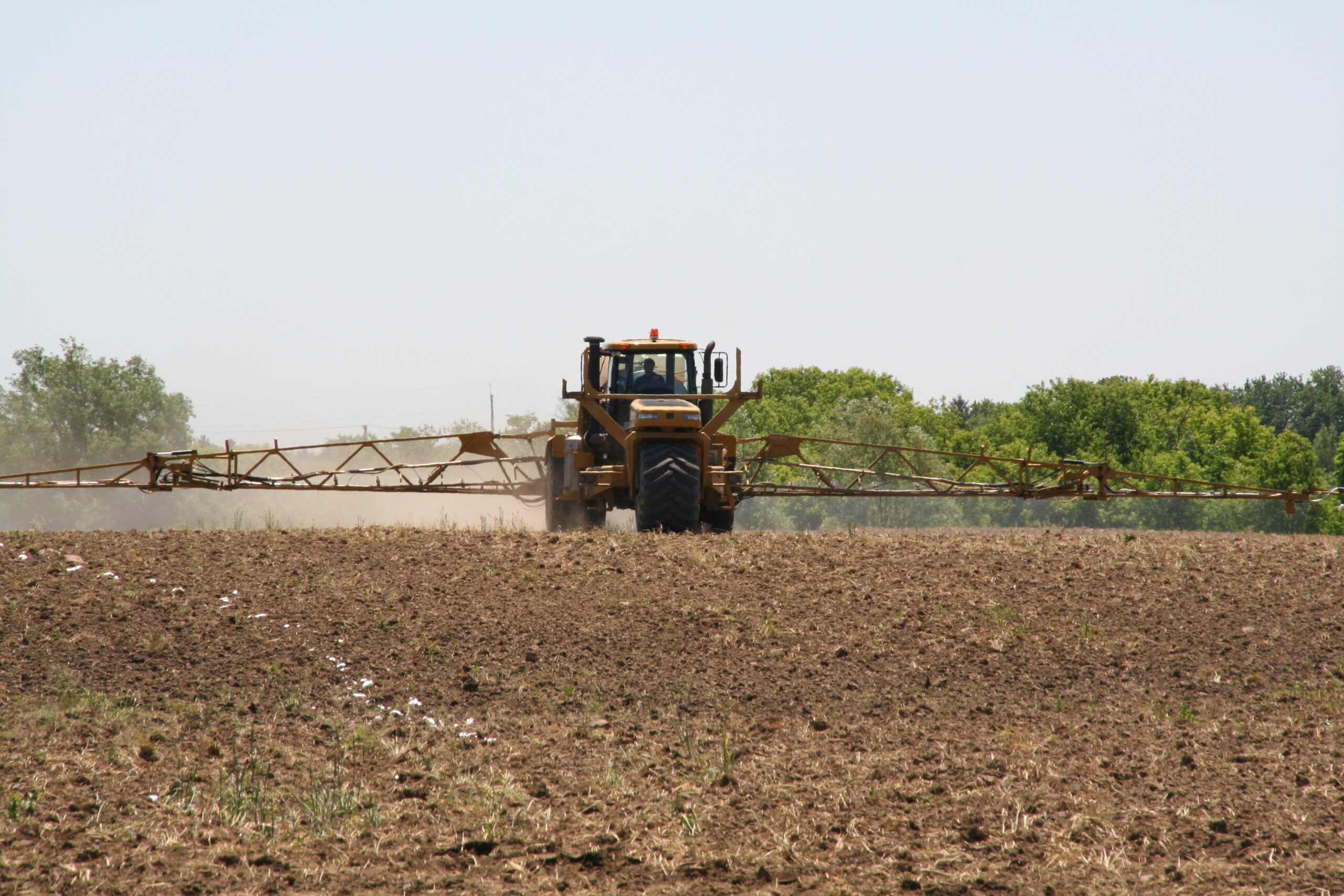
President Donald Trump signed an executive order last week to protect production of glyphosate, a common chemical used in the weedkiller Roundup.
The order comes at a tumultuous time for Roundup and its manufacturer, Bayer. The company recently agreed to pay out $7.25 billion to people who claimed that the herbicide helped cause their cancer.
Carey Gillam, editor in chief of The New Lede and author of two books on industrial agriculture, spoke to the Texas Standard about what the president’s order will mean for the chemical. Listen to the interview in the player above or read the transcript below.
This transcript has been edited lightly for clarity:
Texas Standard: Can you explain what this executive order will do to protect glyphosate production will do exactly?
Carey Gillam: That’s a good question. I’m not sure many people really know the answer to that.
It’s a very odd way to go about this. Most of the people I’ve talked to, legal experts and others, really feel that this is just more messaging and positioning as the U.S. Supreme Court gets ready to take up a case brought by Bayer trying to get federal preemption in place, essentially to shut down the litigation.
So this executive order comes in under the Defense Production Act and essentially is saying glyphosate is essential — we need it, farmers need it to grow the food or food supply would be in danger if we don’t have adequate production of glyphosate. It’s a declaration, but absent of any new rules or regulations or policies put in place through USDA or EPA, it really would not have much of an effect.
But certainly the messaging coming from the Trump White House, when Bayer is hoping the U.S. Supreme Court will give it an off route for the litigation, is very important.
And food production, I guess, killing the things that affect crops is really the only thing that glyphosate is used for.
Glyphosate is the world’s most widely used weed killer. It’s the key active ingredient in Roundup and other herbicide brands.
It’s no longer sold to residential users in the U.S. because of the litigation, but for farmers, it remains a very important and widely used way to kill weeds in their fields.
» GET MORE NEWS FROM AROUND THE STATE: Sign up for Texas Standard’s weekly newsletters
Are there good alternatives to products like Roundup?
You know, it depends on who you talk to. Again, I mean, the movement currently in the U.S. and really in many countries around the world is for regenerative agriculture — using fewer pesticides, more natural methods to control weeds and insects and other things that can affect crop yields.
Because we’ve gotten to a place, particularly in the U.S., where glyphosate and other weed-killers and other pesticides… The use has just gotten so extraordinary. And these things are designed to kill living creatures.
And so they have been connected to diseases, cancers, reproductive health problems, as well as environmental health problems. So there is a real push to reduce our use of these things. But of course, many farmers still say, gosh, I need them, and I want them.
Well, are there warning labels on the labels of these products containing glyphosate, that they could be carcinogenic? Or is that still kind of up for debate, too, certainly as far as Bayer’s concerned? They deny that, right?
So none of the labels that are currently on these glyphosate products are required to carry a cancer-risk warning. Bayer has steadfastly refused to do that. The EPA does not require a cancer warning.
The International Agency for Research on Cancer in 2015 classified it as a probable human carcinogen, but the company and the EPA so far have said there’s no reason to put that on a label.
We mentioned these ongoing court cases and the Trump administration now issuing this order. How do you think that could affect future claims of people who believe that glyphosate exposure helped cause their cancer?
Bayer has very craftily put together a three-legged stool or walls, if you will, around this class action litigation. There were close to 200,000 claims that were brought against Monsanto and Bayer by people saying they developed non-Hodgkin lymphoma because of their use of these Roundup glyphosate products.
Bayer has gone to the U.S. Supreme Court — there’s a hearing slated for April 27 — and said that basically all of these lawsuits that are claiming that we didn’t warn people about cancer should go away. People should not be able to sue us over that because federal law, the EPA doesn’t require us to label for cancer. So people shouldn’t be able sue us.
So that’s one leg. They also are passing state laws and are trying to get laws passed at the federal level that would say the same thing. If the EPA doesn’t make us say it could cause cancer, nobody can sue us for getting cancer.
So that’s where they are now. They’re trying to get this giant settlement put in place to make the litigation go away. There’s a lot happening right now around Bayer and glyphosate and Monsanto.