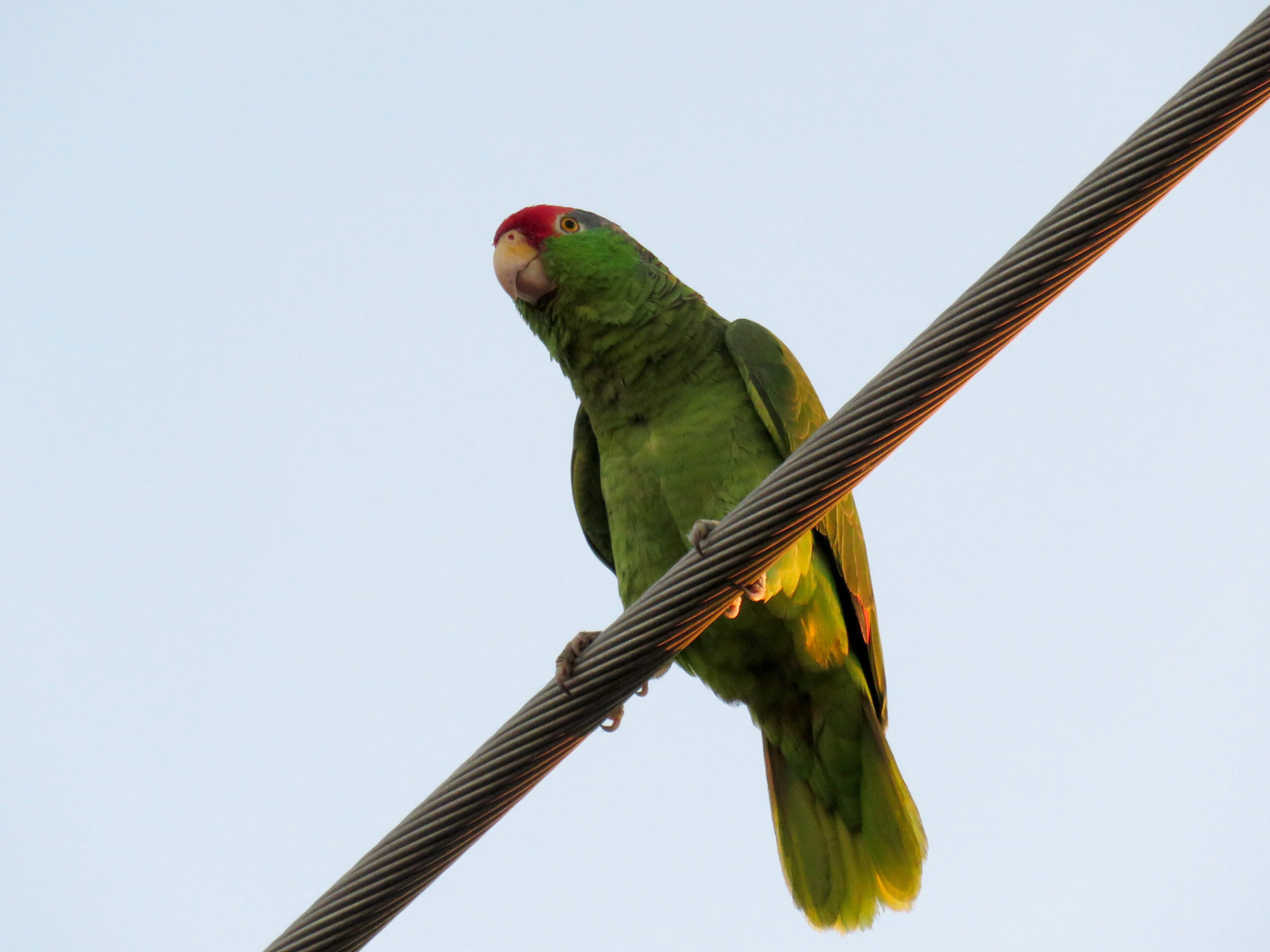
If you were to head out to Brownsville’s Joe & Tony Oliveira Park in the evening around this time of year, you might hear a chorus of squawking from birds known as red-crowned amazons or Mexican red-headed parrots.
According to Texas A&M researchers, there are around 675 of these birds in Hidalgo and Cameron counties in the Rio Grande Valley.
The red-crowed amazon has also been the official bird of Brownsville since 1992, and how it ended up with this special honor is the subject of a new story from Texas Monthly.
Joseph Palmer took a trip to the RGV to learn more about the birds and joined the Texas Standard to discuss what he saw. Listen to the interview above or read the transcript below.
This transcript has been edited lightly for clarity:
Texas Standard: For people who are not familiar, what do these red-crowned amazons look like?
Joseph Palmer: What they look like is basically what it says on the tin.
They are green parrots, sort of think of an emerald color, with a bright red top to their head, probably from where the beak goes to the top of the head, with yellow irises and little black eyes. And they sort of look like what you might imagine a green parrot to look like.
So how exactly did these birds end up in Brownsville and how did they end up as the official bird of the city?
For the first part of that question, there’s two competing theories, and for better or worse, the likely answer is that both are partially true.
Some people say that red-crowned amazons are the descendants of released pet parrots in South Texas, and there’s probably an element of truth to that.
However, uniquely among kind of feral parrots within the United States, the native range of the red-crowed amazon is also within Mexico, relatively near to the Rio Grande Valley. So there’s also a chance that their native range expanded naturally.
Owing to some testing that ecologists have done, they said at least some of these birds are definitely descendants of native red-crowned amazons from Mexico, who during an extreme weather event extended their range into the Rio Grande Valley.
They probably mixed with other released feral birds, but what you can say is at least some of the population of the Rio Grande Valley’s red-crowed amazons are, quote, “native” and others are feral and now they’re all mixed and who can tell the difference?
Well, I grew up in the valley and we had a pet parrot named Lorenzo and we did not release him, but yeah, there were always thoughts that people had these pets and they maybe got were freed or escaped.
Well, again, let’s get back to how did they become the official bird of Brownsville?
The”how” can be a little bit difficult to track down. I wasn’t able to quite figure out the exact answer to that.
I can’t tell you exactly how, but I do know that it is. As is often the case in these official mascot titles, it was probably the effort of one particular ornithologist in the area who took a particular shine to the bird, realized that a lot of his compatriots within Brownsville also really loved the bird and pushed for it to become the official bird in 1992.
» GET MORE NEWS FROM AROUND THE STATE: Sign up for Texas Standard’s weekly newsletters
Well, for this story, you actually went to Oliveira Park, a popular place in Brownsville where these birds gather. What did you see? Describe it for us.
Somebody told me to go there right around sunset. And so trying to be diligent, I showed up well before sunset and saw nothing. Everybody said they’re hard to miss, but I’ve noticed when you’re tracing down these things that everybody says are hard to miss, they’re easy to miss when you are actually looking for them.
But then two, three, dozens, 20s, hundreds of parrots began descending on the west side of the park, right as the sun was set, but still quite bright in the sky. And they are, I think best described as a bumbling, arguing family that ultimately loves each other.
They are constantly talking, but it’s not a particularly lovely bird song, but it is charismatic and attractive. And because it’s constant and it’s at each other and it is changing in tunes and they’re playing musical chairs about who sits on what tree and who sits on what wire – it’s quite hard to look away.
So lots of people are attracted to birdwatching because of, say, wanting to identify the greater number of birds. Whereas in this context, you’re watching one species of bird. But because of the hive of activity and noise that they are across a handful of eucalyptus trees in a park, it’s quite hard to turn your attention away from them.
Yeah, I’ve heard that squawking. I know it well, and your story mentions that there are hundreds of these birds in South Texas, but they’re found elsewhere. I live in El Paso, and I have a flock in my neighborhood, and right now, this time of year, they stop by to snack on ripe figs growing here, and there’s a lot of that squawk.
What is the range of the red-crowned amazon?
The, quote, “native” range is in northern Mexico and that has been extended to include the Rio Grande Valley, at least the Lower Rio Grande Valley. There are other populations that can be found in places like Colorado, Florida, and indeed in West Texas, but those populations are almost certainly descended from escaped parrots.
So where one can find native red-crowned amazons is in Northern Mexico and the very edge of the Lower Rio Grande Valley – around Harlingen, in Weslaco, and in deep Brownsville.