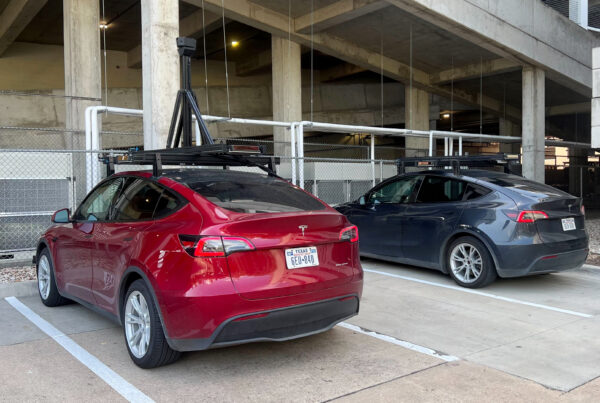
If you’ve looked around your neighborhood these days, you might have noticed some eyes in the sky.
These are called Flock cameras, also known as license plate readers. These cameras have become popular with police departments around the state to track suspects and use footage as evidence.
Flock Safety, which is the company behind the software, claims that the 24/7 footage will help eliminate crime as officers can make unique searches – like the make and model of a car. But many have concerns about privacy and the unregulated use of this system.
The Houston Chronicle led an investigation into the Houston Police Department’s use of the Flock camera database and they found that many officers do not include a purpose for their searches.
Caroline Ghisolfi is the deputy data editor at the Houston Chronicle and part of the team behind this investigation. She joined Texas Standard to discuss. Listen to the interview above or read the transcript below.
This transcript has been edited lightly for clarity:
Texas Standard: I seem to recall that the Legislature outlawed those red light cameras, if I’m not mistaken, not that long ago. Yet I kept seeing these cameras popping up around the city and I wondered what they were being used for.
That’s what these cameras are. It’s part of this Flock system?
Caroline Ghisolfi: Yes, it’s a national surveillance network that uses these license plate-reading cameras. And we can see that more and more are popping up.
In Houston, police can access as many as 88,000 cameras from agencies across the country.
Why are cities signing on to this? Do they get a cut of the proceeds somehow or another? Are they subscribers to the Flock network or what’s the arrangement behind the scenes?
In most cases, these are installed on private property by private individuals or HOAs. They share the data with police because they hope that that’s gonna make their neighborhoods or their workplaces safer. They’re hoping police will use them to solve crime.
Now in your report, you analyzed the search industry that Houston police made with the Flock system. Tell us about what you and your team found.
Well, we found that HPD is using these cameras more and more. They logged hundreds of thousands of calls just last year. And although the agency has reassured the public repeatedly that it would only use the technology for legitimate law enforcement purposes, we found that HPD officers are routinely failing to justify their work.
In other words, they’re mostly using the technology like a search engine, like Google, than an official law enforcement tool.
So in a lot of the searches that we reviewed, we had about 500,000 to take a look at. We found the word “investigation” – or variations of the word “investigation” – or “suspect” a lot with really no details about what the investigation pertained to or what the suspect may have done.
A lot of searches also just listed gibberish, like “ASDF” – that’s the sequence of letters in the center row of your computer keyboard. Or just said that they were there for random checks. We even found a search that just said “donut” or that didn’t say anything at all.
» GET MORE NEWS FROM AROUND THE STATE: Sign up for Texas Standard’s weekly newsletters
Is this tool an official tool for the official use of the police department? Or is this an unofficial tool that police are just kind of going to a third party that they are permitted to go to, but is not considered to be an official law enforcement tool?
This is considered an official law enforcement tool. HPD has general orders that dictate how this tool should be used. And those general orders say that it should only be used for legitimate police investigations.
How many of these cameras are being utilized throughout Houston and is there any indication that it’s helping to lower crime?
In the Houston area, we have several thousand, but we don’t know the exact number. That is not information that HPD or Flock will make available to us at this time.
We do know that several thousands – tens of thousands – of searches are done to look mostly for stolen vehicles. We don’t know what the success rate for those searches might be.
But if police are putting an “ASDF” or “donut” in the search rationale for this, what’s the likelihood of abuse and what do police have to say about that?
Police say that they’re using the system legitimately and that no regulation states that they have to justify those reasons on paper. And that’s true.
One of the main issues that we’re facing right now is that the policy that governs this technology is very old. It was put in place in 2015. And although it says that when it’s used, it should be used for legitimate law enforcement purposes, nowhere does it state that officers need to write down those purposes.
We need to update that policy so that it can actually reflect the new technology that’s come out in the last couple of years.