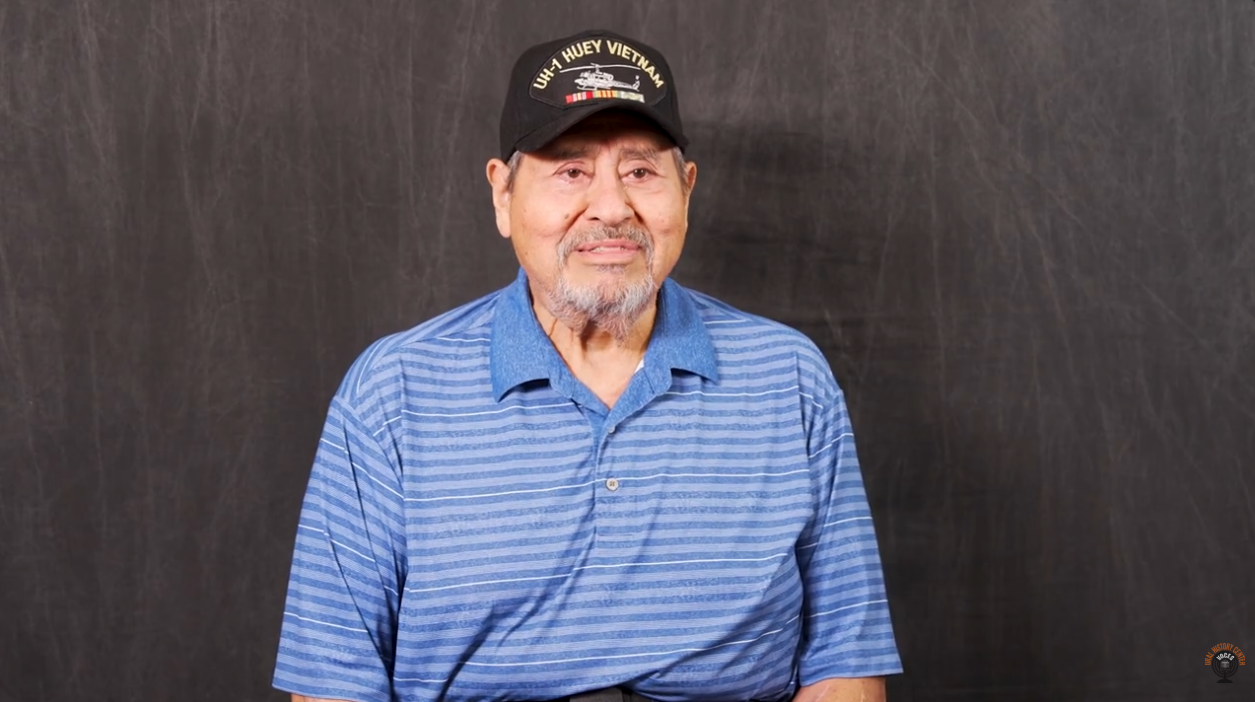
After Vietnam, Texas veteran found new ways to give back

The son of Mexican immigrants, Frank Maldonado carried their lessons of sacrifice into his later work of helping undocumented and low-wage workers navigate the legal system.

By Carlos Morales, Voces Oral History CenterNovember 11, 2025 10:47 am, ,

Frank Maldonado started working at a young age in his hometown of Caldwell. In the summer heat, he’d pick cotton and chop wood – all to help his family.

It’s just what you had to do. But Maldonado said his parents encouraged their ten children to strive for more.

“My dad and my mom were both from Mexico,” he said. “Mom and dad didn’t have any education, but they made sure that we did… And all ten of us graduated from high school.”

After graduating, Maldonado moved to Austin and started working. Soon, he enlisted in the Army.

“Mom was real upset – real upset. My dad was honored and also cautious about it,” Maldonado said.

The elder Maldonado saw his son’s military service as a way of proving his commitment to his new country.

“He was a U.S. citizen, but he always felt that he was still Mexican until I went to Vietnam. Then he felt that he had given one of his sons to his new country,” Maldonado said. “That made him a full-fledged citizen.”

Maldonado went through training at Fort Knox in Kentucky and at bases in Texas and Alabama. He had started out as a paratrooper but soon moved on to working as a helicopter mechanic and then was encouraged to become a pilot.

Maldonado landed in Vietnam in 1968. The helicopter he flew was the UH-1, known as the “Huey.”

“It was the most common helicopter in Vietnam,” Maldonado said. “Everybody depended on the UH-1. That’s the only way that we get in and out of there.”

By one estimate, there were some 40,000 U.S. helicopter pilots during the Vietnam War. It was considered one of the most dangerous jobs.

Pilots, Maldonado said, would fly soldiers in and out of the battlefield. They’d take supplies to troops, protect helicopters that were shot down, and rescue injured soldiers.
Maldonado later left the Army, but he served in the Texas National Guard. He used the G.I. Bill to get a degree in math and later taught middle school and high school in Austin.

He later worked at Austin’s old Bergstrom airport and helped plan a new airport.

I attribute it all to Vietnam,” Maldonado said. “If I hadn’t been a pilot, if I hadn’t got an education, there’s no telling what I’d be doing.”

When it comes to the war, Maldonado’s views are complicated. He appreciates the life the military made for him. But he also feels a deep sympathy for the Vietnamese people

“But now as an old man with family, with kids and grandkids and great-grandkids, you just realize, we shouldn’t have been that way. We messed up that country,” Maldonado said.

Before he left for Vietnam, Maldonado’s mother gave him a prayer card for San Martín de Porres, a Catholic saint known for helping the underprivileged. Maldonado says it was San Martín that brought him home.

And in some ways, the saint charted the path Maldondo would take after his retirement.

“I went back to school and got certified as a paralegal. And I volunteered for the Equal Justice Center and I did that for 10 more years,” Maldonado said.

Maldonado worked some 20 to 30 hours a week, speaking with undocumented people and low-wage workers before meeting with lawyers to determine how they could help.

“If I could get around, I’d even do it again. And I attribute that to my mom and dad. When they didn’t have nothing, they still gave,” Maldonado said.

And that, Maldonado says, is what made him who is today: a man who gives.

It’s what he did for his family, his community, and his country.

If you found the reporting above valuable, please consider making a donation to support it here. Your gift helps pay for everything you find on texasstandard.org and KUT.org. Thanks for donating today.