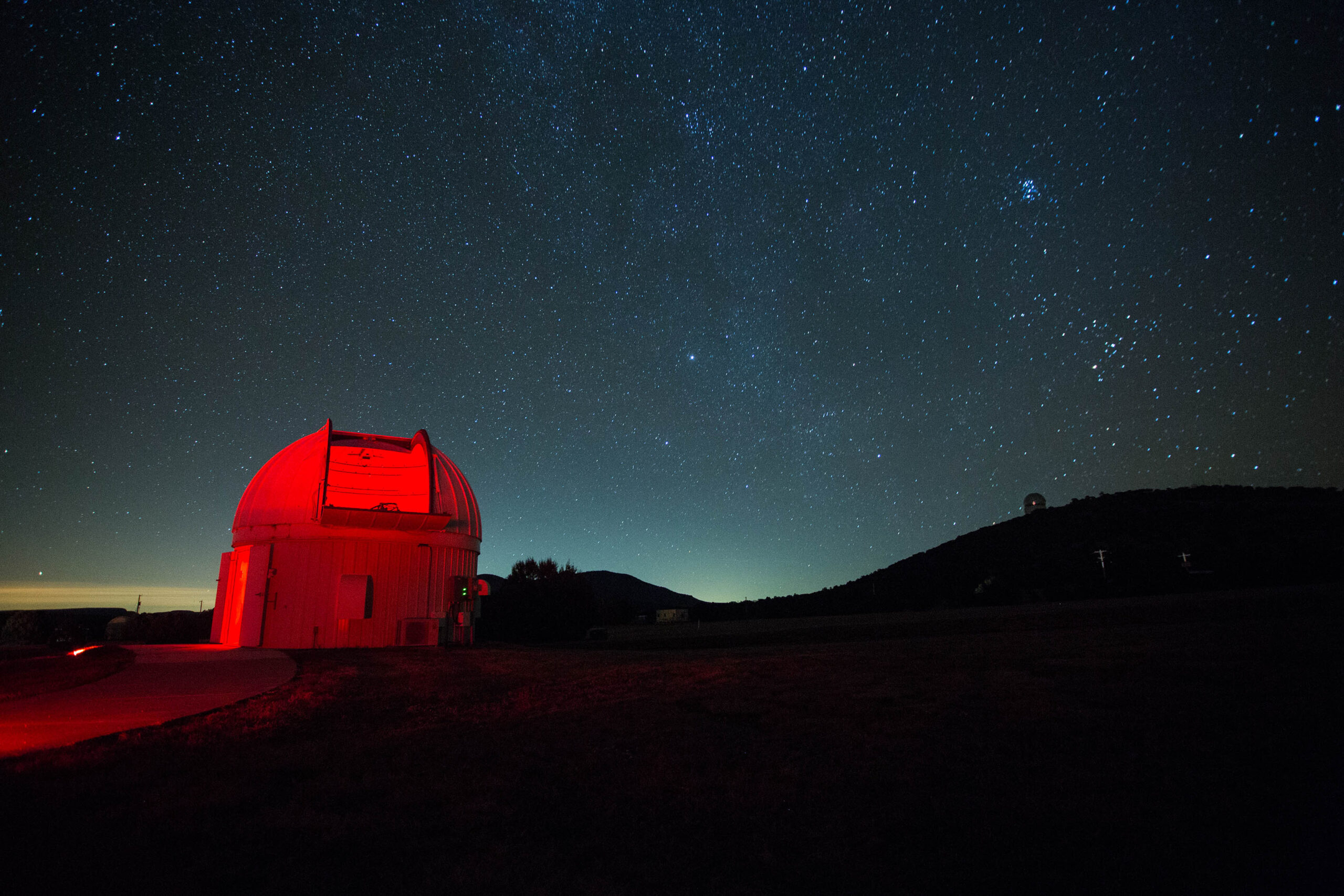
The McDonald Observatory is on the top of two mountains donated generations ago to the University of Texas for the purpose of helping UT become a leader in the fields of astronomy and beyond.
It’s also the perfect place to learn about the Geminid meteor shower, which peaks this weekend.
Texas Standard hit the road for a live broadcast from the observatory and checked in with Director Taft Armandroff and public program manager Rachel Fuechsl for tips on viewing the Geminids.
This transcript has been edited lightly for clarity:
Texas Standard: There’s a reason we are here at the McDonald Observatory today. Rachel, could you tell us what’s happening right now in the night sky?
Rachel Fuechsl: Well, kind of the big story is the Geminid meteor shower, which is peaking tomorrow night. And it’s a really good, reliable display.
And I learned something already. Why are they called the Geminids?
Rachel Fuechsl: They will appear to emanate from the constellation Gemini.
Taft, I don’t want to get too technical here, but give me the basics: What is a meteor exactly, and why do we see the Geminids around this time each year?
Taft Armandroff: So there’s comets that orbit the sun, and they have orbits where they spend most of their time in the very outer portions of the solar system.
When they come in closer to the sun, the sun heats them up, and it drives particles of dust and water just into interplanetary space.
So when the earth passes through that debris left behind from the comet, those pieces enter in our atmosphere, they burn up, and we see the light from them with our eyes. And it’s really spectacular. And you really want to do it in dark skies. And that we have that in abundance.
I always think they’re coming to us, but we’re coming to them is really what’s happening.
So an observatory, as you were alluding here, Taft, is a pretty fabulous place to see a meteor shower. But I don’t want to make all the other Texans all across the state too jealous. Rachel, what do what do Texans need to know if they want to try to see them close to where they are at?
Rachel Fuechsl: If you have a dark location near you, that’s great. You’ll see more that way. But there are some brighter meteors that will show up well under almost any conditions.
We’re really fortunate for this meteor shower that the moon is not really gonna interfere; it often does. And you can start seeing them as early as nine or 10 in the evening.
And they should look toward which direction?
Rachel Fuechsl: So at that time early in the evening, Gemini is gonna be just kind of coming up on the eastern horizon. So east would be good. But you can really see them anywhere in the sky. It’s one of those things where if you just go out and lay on a blanket and look up, that’s your best opportunity.
» MORE: A special Texas Standard broadcast from the McDonald Observatory
And give it a little time, have a little patience, ’cause some of it is just your eyes adjusting to the dark, is that right?
Rachel Fuechsl: Yeah, you want to give your eyes about a half an hour to do that. So if you go outside and just look up.
And don’t pull out your phone, ’cause then you’re gonna mess it up.
Rachel Fuechsl: Gosh no. Yeah, give yourself a a phone break for a little while and enjoy the natural sky.
I’m gonna get to stay and go to a star party tonight, and I’m so excited. It’s gonna be extra special with the Geminids going on. But what’s the typical star party experience for those who visit any time of the year?
Rachel Fuechsl: Well, we hope for clear skies, and I think you’ll have that tonight. And we start off bringing everybody into our amphitheater where we’re giving folks a chance for their eyes to adjust to the darkness. We will do a constellation tour where we show off the things you can see in the sky without the aid of a telescope or binoculars.
And then we have telescopes set up, and you go from telescope to telescope. I often call it trick-or-treating for astronomy because you can, you know, get a treat at each station.
» MORE: Homeschool day at the McDonald Observatory: ‘Kids ask the best questions’
I learned that astronomers have a different relationship with the moon than the rest of us, right? It’s, I don’t wanna say love-hate, but it’s “moon, stop shining so bright right now. I’m trying to see something.” Is that right, Taft?
Taft Armandroff: Absolutely. We take proposals to do research on the telescopes and you have to put in your proposal how much moon you can tolerate. And for the faintest, most demanding observations, the moon needs to be below the horizon. And fortunately tonight while you all are visiting, we will have no moon.
We’ve been talking about science, research and education. But I wanna ask you each this, real briefly: What do you think of when you look at the night sky?
Rachel Fuechsl: I kinda really feel at home. I look up, and a particular constellation is kinda like an old friend. And when it rises in the east early in the evening, it’s like, “oh, you’ve been gone for a few months and now you’re back.”
I think of various objects I’ve spotted, you know, and it just really is like kind of being among a group of old friends.
Taft Armandroff: You know, I think about the stars that we see – many of them that aren’t really that far from us – and whether they might have habitable planets orbiting them.
And whether there could be someone on a habitable planet, an astronomer there, looking back at our star and seeing if they could detect Jupiter, Saturn and more demandingly, the Earth and Venus and Mars.
Listen to an extended interview and learn more about the McDonald Observatory’s research and work in the audio player at the top of this story.