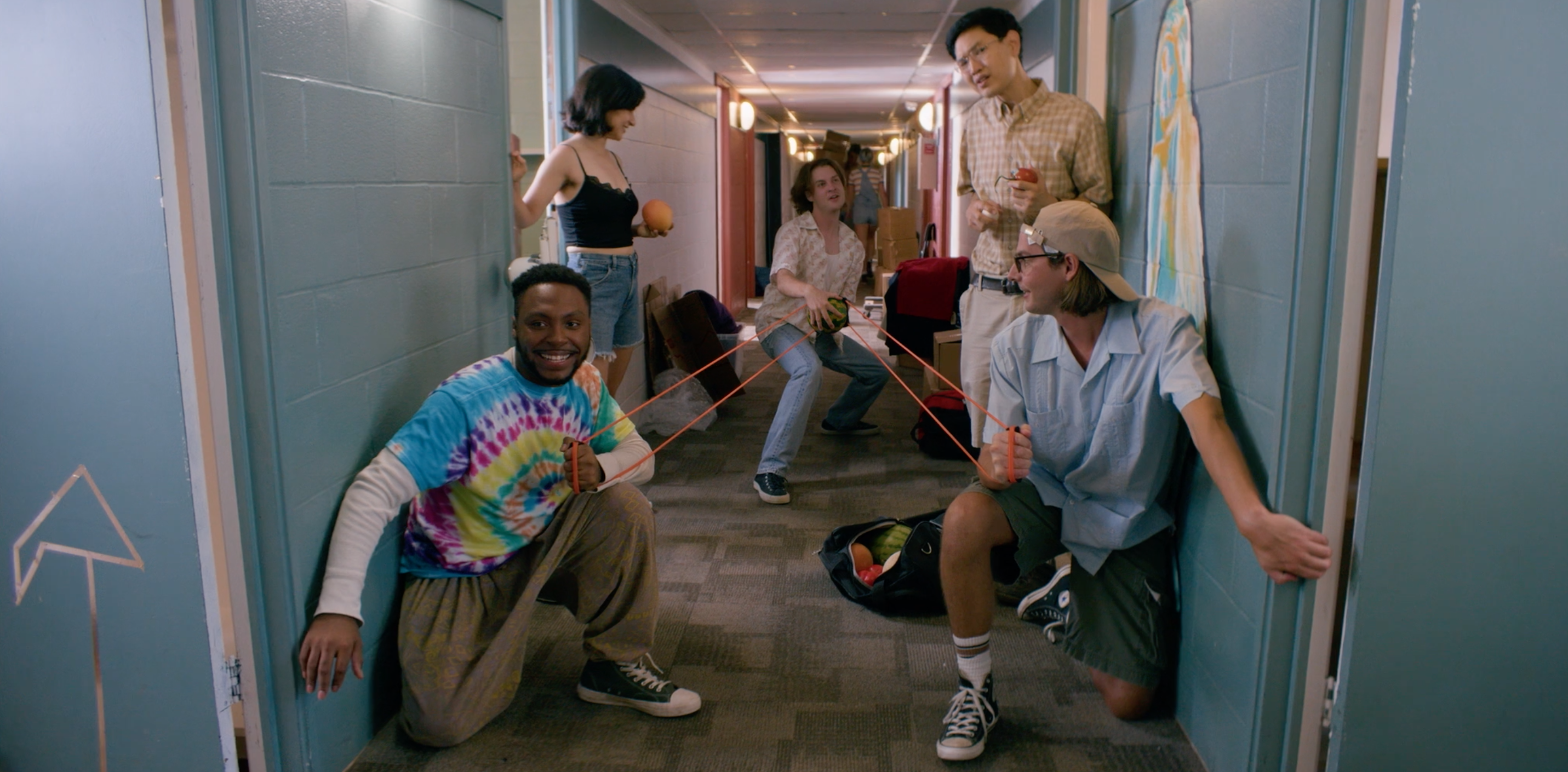
The freshest film content isn’t always very widely available. Often, the movies debuting at Texas film festivals take months, even years, to secure wider distribution deals – if ever.
“Home Free” made its Texas premiere at the 2023 Austin Film Festival. It’s now available on Apple TV, Prime and YouTube.
Texas Standard talked with New York-based writer Lenny Barszap and Austin-based director Aaron Brown in 2023. Here are some highlights.
Transcriptions have been edited lightly for clarity.
“Home Free” is about their experiences at UT in the 1990s:
Lenny Barszap: Aaron and I got together and we made like a huge list of just like every memory, like all the stories that we like to tell, anything that stands out, anything that kind of defined what it felt like at that time or in the late ’90s.
And it was great because then I had this huge menu of things that I could draw from. And, you know, when I’m putting the story together, like, you kind of put these bits and pieces together. So it is like a lot of the dumb stuff that’s in the movie is dumb stuff that we actually did.
Aaron Brown: When you see a crew of like 40 people on a movie set and a bunch of actors so focused and deliberate to recreate the most ridiculous stuff that happened to you in college, that’s an experience that I’ll never forget.
“Home Free” was very inspired by the films they watched in college:
Brown: We could have made a documentary, we could have made a drama, but the truth of it was like, we really looked at our experience in college. I mean, we were watching, we were being influenced by our filmmaker heroes at the time.
You’re talking about “Dazed and Confused,” Linklater. You’re talking about Kevin Smith, “Clerks,” “Chasing Amy.” We were inundated with comedy. It was a hilarious, fun time.
It was really an experiment, I think. Can we tell this story as a comedy? And can we also prove that you can make a comedy and, almost in a Trojan-horse fashion, put a message in that actually is connected to a real social issue that this country’s dealing with and make it work?
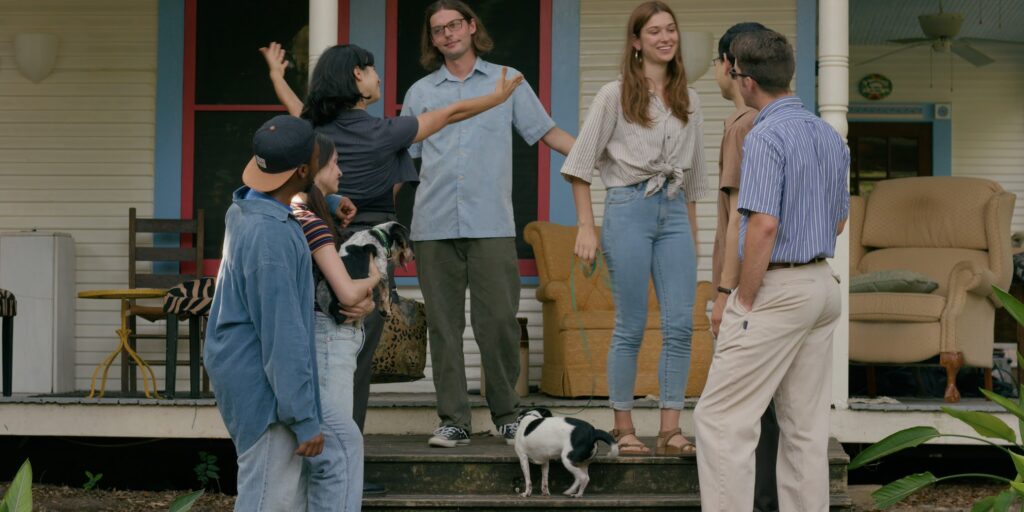
A still from the film “Home Free.”
That social issue is homelessness. At the center of “Home Free” is the true story of the unhoused former professor that began to sleep on their front porch:
Barszap: We met this man who lived in the park who was a former professor. And the story we heard was that he was a former UT philosophy professor and he chose to give that all up to live a simple life on the street. And at 19 years old, we were like, “Hell yeah. Like that’s like Jack Kerouac.” We romanticized it and really never dug any deeper than that.
But now, 25 years later, we’ve had so much time to kind of reflect on this as we were kind of developing the story. And what we realized is that nobody really chooses this, right? If it seems that they chose it, they probably had something else traumatic that they’re running away from, or something that led them there. And there’s thousands of reasons why people end up in that situation.
And this story was one that was really important to us and it definitely impacted our lives and we have taken a lot from it and it defined who we were coming out of that experience.
Brown: It just goes to show that a lot of the decisions and things that you do as a young adult or somebody in their late teens, college age, they can have profound impacts on kind of who you become as an adult. And this is definitely one of those cases.
So the fact that we made the decision to offer a piece of our house to this gentleman experiencing homelessness, which led to his community kind of living with us as well. And it wasn’t just a night or two, it was almost a year. So we had an up-close, front-row seat to their situation and their challenges. It’s just seeing intimately what they were really dealing with.
We were 19 years old. I mean, we knew we were doing the right thing. Like everyone talks about helping people, being a good person, looking out for the less fortunate. But when you actually make decisions that impact your life and your house and you’re living with it, it does kind of reveal a lot of the things that prevent this from maybe being such an easy problem to fix.

A still from the film “Home Free.”
The filmmakers paired up with nonprofits to make the film and are dedicating 10% of the profits from the film to help the unhoused.
Brown: We’re partnered with The Other Ones Foundation. And these guys, you know, they’re on the front lines of actually doing the work in our city, in East Austin, over at the Esperanza Community. And man, they are just, it’s so impressive what they’re actually doing.
And I told Chris Baker, the guy who started it, I said, “It’s almost intimidating to see how much you guys do because what can we do, right? Like you guys are actually building a community. You’re actually out there with hundreds of people transitioning them off the streets and into a more settled permanent housing situation. Like that’s hard work.”
You know, and he kind of just reiterated what I think I feel, which is it all counts.
Barszap: We really see this as the next social issue that this country has to reckon with.
Everything we’re doing right now is like trying to show that you can do social impact and have fun doing it, right? Like it doesn’t have to be sad and depressing. Like people don’t… There’s so much that’s sad in the world. And so like, how can we make this fun, right? We can work together and use creativity and just make it something that people want to participate in because it’s just a fun time.
Brown: I’m really proud of this movie. And especially with what’s happening in the world, let’s be honest, we made a dumb comedy and there’s some real heavy stuff happening in world right now. But I look at it and I said, you know what? At least it’s got a message and it counts, absolutely.
The fact that people are experiencing homelessness in every major city, everyone sees it, everyone can agree it’s something that has to be addressed. No one likes it. The way it gets dealt with seems to be the debate. But the fact that Lenny and I made a movie that is at least putting a spotlight and starting a conversation…
And I think that’s really the message that we wanted to say, as well, is the fact that like, look, it’s easy to put all of the people experiencing homelessness in a group and make these broad claims or preconceptions about how they got there, why they’re there, or maybe they wanna be there. The fact of the matter is, when you actually talk to these people, you start to realize real fast that like, there are a million different reasons they got to where they’re at. And they are people and they are individuals and they need help. And if we are good people, you know, be on the right side of things.
It never hurts to help someone else and just doesn’t ever hurt. And that’s how we feel.
If you found the reporting above valuable, please consider making a donation to support it here. Your gift helps pay for everything you find on texasstandard.org and KUT.org. Thanks for donating today.