This story was produced by the American Homefront Project, a public media collaboration that reports on American military life and veterans.
From the American Homefront Project:
When Defense Secretary Pete Hegseth brought hundreds of generals, admirals, and senior enlisted troops together at Marine Corps Base Quantico in September, his message was simple: get fit or get out.
“It’s tiring to look out at combat formations — or really any formation — and see fat troops,” he said. “Likewise, it’s completely unacceptable to see fat generals and admirals in the halls of the Pentagon… It’s a bad look. It is bad, and it’s not who we are.”
Much of what Hegseth proposed are things the military branches already are doing. Troops already must take fitness tests and meet body composition rules. But his overhaul would harden those expectations by requiring daily workouts and adding more tests. For combat jobs, it would scrap male and female minimums in favor of one standard based on today’s male requirements.
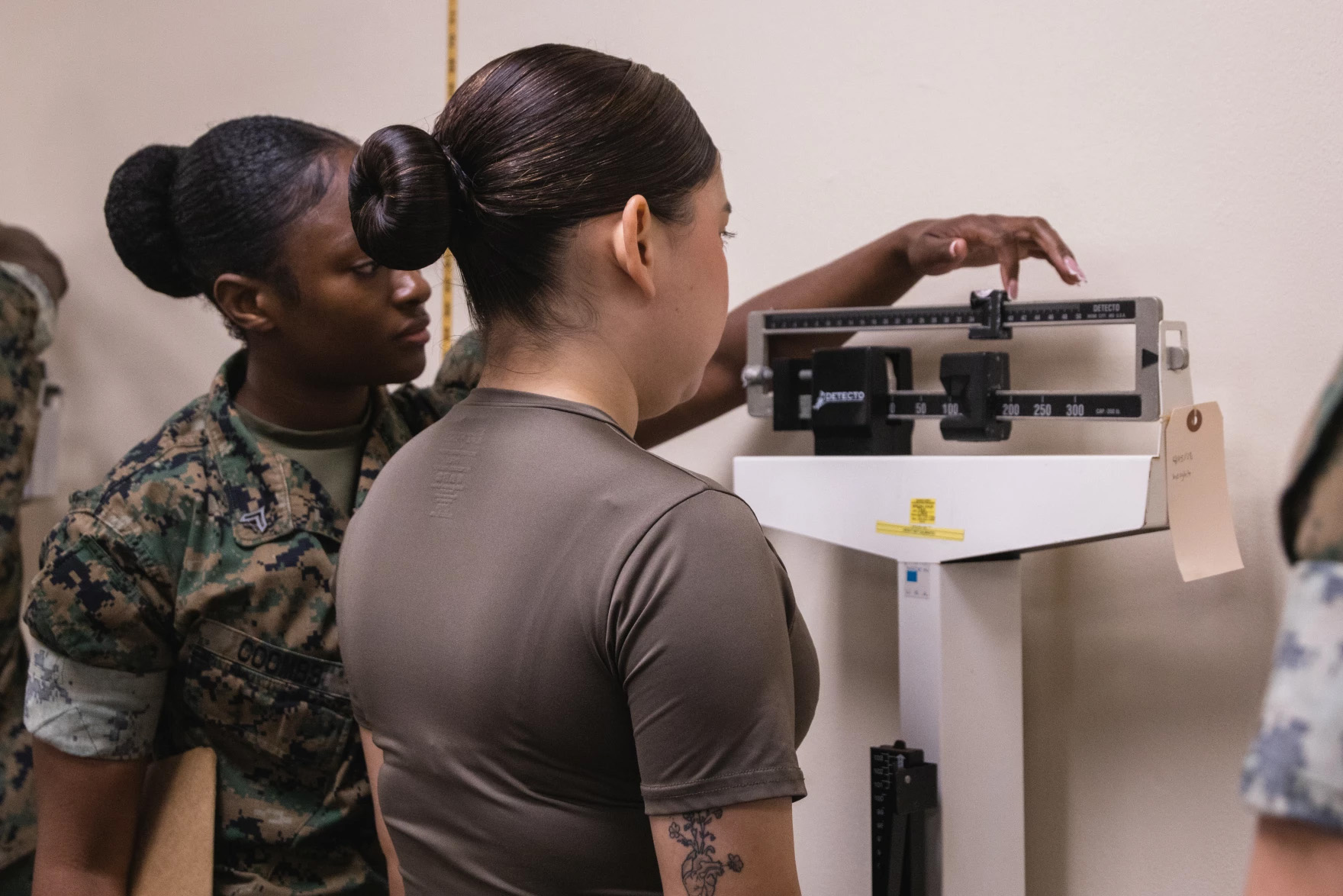
For Sarah Rondinone, a dietitian who served in both the Navy and Army, Hegseth’s strong rhetoric raises concerns. She agrees troops need to be functionally fit, but worries that scolding and shaming them will worsen a longstanding issue in the military: fad dieting and disordered eating.
“It’s known that when height and weight [measurement] comes around, everybody doesn’t eat for three days,” she said. “The culture surrounding it is just not what it should be.”
A 2023 Defense Department study found that eating disorders in the military are growing at a substantial rate. That includes conditions such as anorexia nervosa, bulimia nervosa, and binge eating disorder.
Rondinone has also seen service members engage in other forms of disordered eating that don’t meet the criteria for a medical diagnosis – such as subsisting on chicken broth for days before a measurement. Other troops apply hemorrhoid cream and wrap their waists in plastic wrap to sweat out water weight.
“People will consume laxatives to completely get everything out of their system. Then, oppositely, I have seen people with anorexia nervosa put rocks in their uniform to make weight, because the weight standards go both ways,” she said.
Rondinone now works with SEA WAVES, a nonprofit organization focused on military eating disorder support and mental health. She says Hegseth’s message ignores a range of medical and personal factors that can put service members outside weight standards, such as medications, surgery, or postpartum recovery. She also points out that the standards often rely largely on body mass index, a measure developed in the 19th century that does not account for muscle, genetics, or individual health history.
“You have people that compete in body builder competitions who have 6 percent body fat that are failing these standards because they’re overweight technically,” she said. “But body mass and body composition are not the same for everybody.”
Some experts point to tools like Bod Pods, which use air displacement to measure body fat and lean mass, as more accurate alternatives, though the military has not widely adopted them. Others say fitness and body composition standards should be aligned with a service member’s specific job.
“The military does need to have standards,” said Leah Stiles, founder and CEO of SEA WAVES. “But we need to be concerned with how we’re meeting and reaching those standards. It shouldn’t just be pass or fail, green check mark or red X.”
She said that binary mindset, along with limited prevention and support programs for eating disorders, can push service members toward unhealthy behaviors, which in turn hurt readiness. For instance, she said troops who restrict their calorie intake and increase exercise can reduce their bodies’ available energy.
“The consequences that come from getting into the state of low energy availability are things like brain fog, delayed decision making, delayed recovery after injury, and the list goes on,” she said. “Those aren’t the people that we want beside us on the battlefield or in tense military operations.”