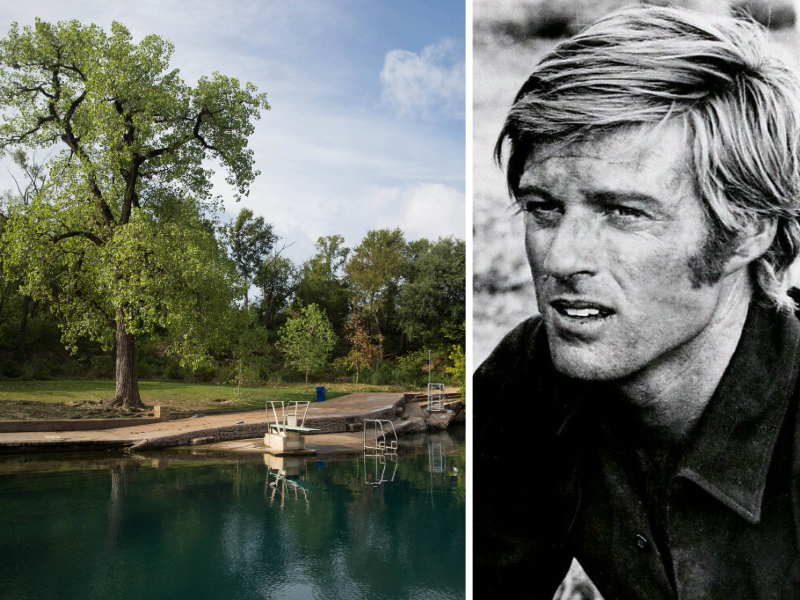
News of Robert Redford’s death on Tuesday broke the hearts of fans worldwide.
Redford won his only Academy Award for his directing, but was also known for his iconic roles, including in “All the President’s Men” and “Butch Cassidy and the Sundance Kid.” Redford used that latter name when he created the Sundance Film Festival, where he championed independent cinema.
Texas filmmakers, including Robert Rodriguez, have shared their memories of him. Rodriguez called Redford “the superstar of his youth” and said being awarded at Sundance was the greatest honor he’ll ever have.
Redford was a Californian by birth and later started his festival and made his home in Utah, but Central Texas was very important to him.
Austin-based filmmaker Laura Dunn learned this when she interviewed Redford for her 2007 documentary “The Unforeseen.” Listen to the interview above or read the transcript below.
This transcript has been edited lightly for clarity:
Texas Standard: Where were you in your filmmaking career when you met Bob, and what impact did that have on you?
Laura Dunn: Yeah, I won’t forget that day.
I was nine months pregnant on the due day of the birth of my first child and interviewed Bob at Barton Springs on the cliff overlooking Barton Springs.
So, Terrence Malick had asked me to do a documentary about Barton Springs when I was fresh out of grad school. I went to film school here at UT. And he [Malick] invited Bob to be a part of that process, since he knew his personal connection to Barton Springs and just the natural world of Central Texas.
It took a couple of years to get Bob to Austin to do that interview. And, of course, it corresponded with – my child was born the next day. But I remember that interview for a lot of reasons. And I was thinking about it driving over here this morning. He talked a lot about how he thought it was so important to have more mothers involved in the environmental movement.
So yeah, I interviewed him at Barton Springs. He was very knowledgeable about hydrogeology, about politics, about environmental policy. And what struck me early on was he was adamant about representing different points of view. He didn’t want to just preach to the choir. He wanted to look at the complexities.
So he had a very astute mind and paid a lot of close attention to detail in his environmental work. I’m sure many people could tell you a lot more than I could, but that struck me right away.
People might be surprised that Robert Redford had this connection to Austin, to Barton Springs. What did he tell you about that?
Yes, so his mom’s family is all from the San Marcos area.
And so while he lived in Los Angeles during the year, his grandfather owned a house that’s still there on Scenic Drive. We actually went over it to it that day. And it’s a beautiful stone house right there on Lake Austin.
And so he spent his childhood summers here. He learned to swim in Barton Springs. And he says in the interview in our film that this is where he really learned to love the natural world, in contrast to the eroding landscape of Los Angeles with smog and traffic… That he would come here and be immersed in the natural world and the Texas Hill Country and the creatures and the trees and the light and the water.
So it had a huge impact on him and his childhood experiences.
You went on to continue to work with Bob. Can you tell me about his support over the years?
When we finished “The Unforeseen,” I just want to tell you this quick story for Old Austinites. Because it had its theatrical opening at Alamo South Lamar and that was in 2008. And for those of you who remember the South Lamar before it was renovated, it was the old Highball and this was before you could buy tickets online.
So Bob came in and did a press conference with us there and Tim League [the owner of Alamo Drafthouse] was there and we filmed a press conference. Lee Daniel was the cinematographer, a wonderful Austin cinematographer.
So we were all there, we did the press conference. And then that evening, I think, Bob had a huge impact on this because there was a line around the block for people to buy tickets to the show. So we thank Bob for that.
And Tim League ended up doing a triple lock. He bumped two theatrical movies – big, big box office movies – and ran “The Unforeseen” on three screens that night. And it was packed and sold out. And they ended up running at the Alamo, I believe like 10 weeks of running theatrical. So it was a time in Austin where people really came out and cared and there was that kind of community.
So that day, he also wanted to meet with me and he just asked me what I want to do next. And he really loved “The Unforeseen,” which was encouraging. And I told him I was rereading Wendell Berry’s “The Unsettling of America,” and I thought we needed to do something about the industrialization of agriculture. That book had a huge impact on him in the 1970s, so that we were off and running.
So he and Terry Malick executive produced that film, which is a feature film about Wendell Berry, called “Look & See: A Portrait of Wendell Berry.” And then my third feature, sort of in the series about the eclipse of nature by culture is called “All Illusions Must Be Broken.” And we just finished that one a couple of years ago and Bob also signed on to EP that.
So I’ve seen him at festivals in New York, MoMA, at Sundance… He’s come to Austin several times and I would see him.
So it was just, you know, he was kind like that. He was generous. It’s not anything I deserved, but he stayed in touch and was always responsive and supportive and encouraging of my work. So, you now, I’m very, very grateful for that.
» GET MORE NEWS FROM AROUND THE STATE: Sign up for Texas Standard’s weekly newsletters
That’s something that I’ve seen reflected in the comments from other filmmakers. I think, from an outside perspective, it’s obvious he was a champion of independent film through his work founding Sundance, but it seems like he took an even more personal interest in helping filmmakers and sharing his connections and what he knew. Do you think that’s true?
Oh, absolutely.
I mean, you know, someone with that amount of fame and, for lack of a better word, power, he didn’t come across that way. He was very grounded. He didn’t like all the attention and he was focused on people, relationships, the issues he cared about. He was a very grounded and kind and generous person from my experience.
And yes, very passionate about independent voices. He didn’t really want to get too caught up in Hollywood, he didn’t like big corporate sort of donor- a big corporate presence at Sundance. He appreciated the small communities, the truly independent filmmakers, the boots on the ground, environmental activists. Those were his values, for sure.
Is there another memory you’d share or something that we didn’t get to that you want to make sure people know about Robert Redford?
There is a funny story that I think is worth telling.
So I had finished the Wendell Berry film, I had submitted it to Sundance, Sundance rejected it. And Janet Pierson [who used to run SXSW Film] loved the film and was really excited about it, which is such an encouragement and I’m very grateful to her for that. So she programmed it and it was going to premiere at South by Southwest.
And it was about a week before South by Southwest and I remember I was at home – I have seven kids, so I’m a mom full-time, and I kind of make films on the side. So I was at home making cookies – literally, with an apron on – and my phone rings, and it’s “unknown.” And I know usually when it’s unknown, it’s someone I should answer.
And it was Bob, and he just said, “‘Laura, this is Bob Redford, and I just want to tell you, you know, I’ve watched ‘Look & See,’ and think it’s an amazing film.'” I don’t remember exactly what he said. I was sort of in shock – very surprised for this call. And he just said how powerful it was and he wanted it to play at Sundance and why hadn’t I submitted it to Sundance?
And I said, well, I did, but it was rejected and he was upset about that. He said, “I want it to play, and I’ve talked to John Cooper [the festival director at the time]. John Cooper and I have talked about this.” So he said, “I think they made a mistake and we want to play it at Sundance.”
So I said “well, it’s opening at South by Southwest next week. Like, what do I do?”
And he said, “well, go ahead and play that. But after that, you know, I want to bring it back to Sundance.”
So Janet Pierson, of course, thought that was wonderful. So it premiered here in Austin. And then we kind of held it back and then it re-premiered at Sundance that following January. And that’s just the kind of person Bob was. He didn’t sort of follow the rules and the protocol. He had passion, he had values, and he would sort of cut through the tape and tell you like it was.
So I love that story because it kind of shows the inner workings of these festivals and how subjective the programming is. And as a filmmaker, don’t get discouraged. Just do the work you believe in and trust that you’ll find your audience.
And I think that’s kind of the message I want younger filmmakers to know. Like, it’s very subjective. It’s about relationships, about who connects to your art and who doesn’t. But also that you know sometimes the rules can be broken.
So you never know. You never know. Just do your work and have faith it’ll find its audience.
Bob was a huge champion of those kinds of independent voices.
If you found the reporting above valuable, please consider making a donation to support it here. Your gift helps pay for everything you find on texasstandard.org and KUT.org. Thanks for donating today.