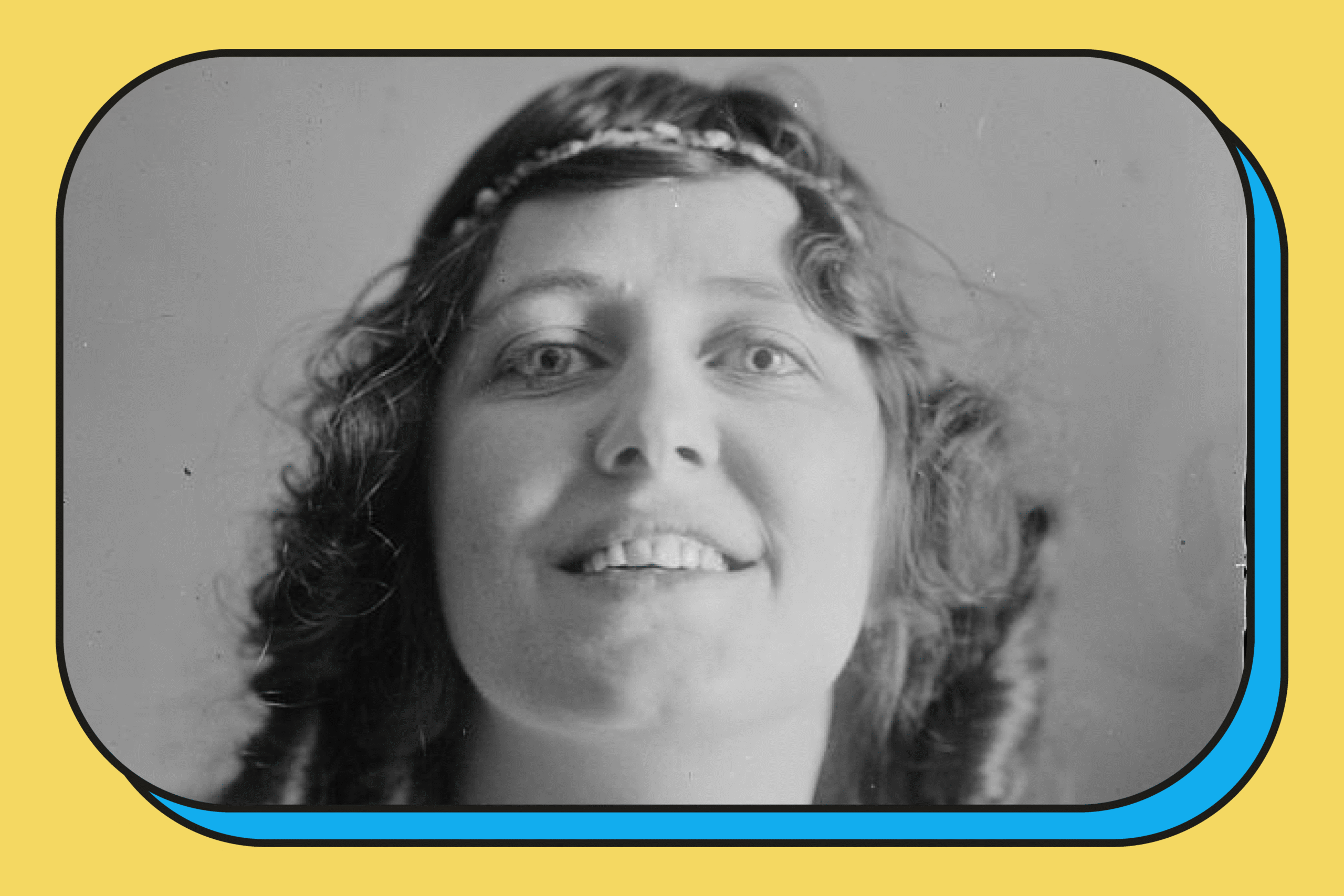
On Feb. 17, 1916, classical pianist Wynne Belle Pyle made her American concert debut in New York City.
The New York stage was a long way from rural Fannin County where Pyle was born in 1881, and she didn’t take a straight path to get there, either.
As a talented young artist in nineteenth century Texas, the first steps on her journey were fairly straightforward. She enrolled at the North Texas College of Music in Denton for her initial classical training. She impressed her piano teacher there, Harold von Mickwitz, and he urged her to move to Europe for further education. So she left Texas – first for Vienna, then for Paris, then Berlin.
For years, she performed across Germany, Austria, England, and France – a soloist with twenty different symphony orchestras. Then, in 1916, with Europe embroiled in WWI, Pyle returned home for her initial stateside concerts.
Her appearance in New York came first in February, followed a few months later by Chicago. As she continued to perform more in her native United States, Pyle settled in New York for much of the rest of her professional career.
She didn’t really break into the early recording industry as we think of it, despite record companies’ early preference for prestigious classical fare. But, she did get involved in the often-unheralded precursor to phonograph records with a series of self-playing piano rolls of classical standards.
In her later years, she also taught at the Manhattan School of Music, founded by her husband and Parisian mentor Harold Bauer. In that role, Pyle trained new generations of pianists – echoes of Fannin County and Denton, Berlin and Paris, Chicago and Manhattan, coursing through the keys.
Sources
Emmett M. Ford in Laurie E. Jasinski, Gary Hartman, Casey Monahan, and Ann T. Smith, eds. The Handbook of Texas Music. Second Edition. Denton, TX: Texas State Historical Association, 2012.