Here are the stories on Texas Standard for Friday, Dec. 12, 2025:
Why Texas looks to the stars from Fort Davis
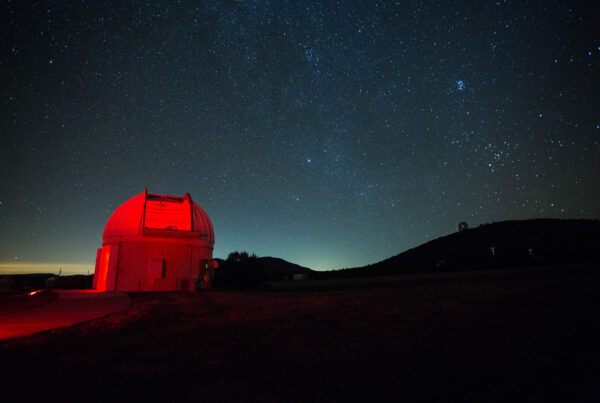
Fort Davis was named the site of the McDonald Observatory generations ago for its unmatched dark skies. The observatory has helped position the University of Texas as a leader in astronomical research while welcoming the public into the science of the cosmos.
Taft Armandroff, UT Austin professor and director of McDonald Observatory, and Rachel Fuechsl, the observatory’s public program manager, join Texas Standard today.
How Texas is fighting to keep its skies dark
Light pollution now blocks views of the Milky Way for most Americans, posing challenges for astronomy and ecosystems alike. The McDonald Observatory’s Dark Skies Initiative works with cities, lawmakers and residents to reduce unnecessary light and preserve night skies across the state.
Stephen Hummel, senior outreach coordinator for the Dark Skies Initiative, explains how the effort works and why it matters:
Making the universe accessible through StarDate
For decades, the daily radio program StarDate has helped listeners understand what’s happening in the night sky without requiring a science degree. From meteor showers to lunar phases, the show aims to make astronomy approachable and relevant.
Billy Henry, host of StarDate produced by the McDonald Observatory, talks about bringing space science down to Earth.
Homeschool day at the McDonald Observatory: ‘Kids ask the best questions’
The observatory isn’t just about research. It’s also about education – and that was on display yesterday when a group of families from around West Texas drove in for its second-ever homeschool day.
The Texas Standard’s Sean Saldana joined for a day of activities and learning.
Searching for dark energy in West Texas skies
At the McDonald Observatory, researchers are leading one of humanity’s first major efforts to study dark energy – the mysterious force driving the universe’s accelerating expansion. Using the Hobby-Eberly Telescope, scientists are mapping millions of galaxies to better understand how the cosmos evolved.
Karl Gebhardt, chair of the astronomy department at UT Austin, explains what dark energy is and why it matters:
What it takes to run a remote observatory
The McDonald Observatory’s isolation is essential for research, but it also creates logistical challenges for the people who work there. From power and water to food and housing, much of daily life must be sustained on-site.
Teznie Pugh, the observatory’s superintendent, details how the facility keeps running far from the nearest city: