Chiggers, dung beetles and more: Our favorite bug stories of the past decade

We’re celebrating Texas Standard’s 10th birthday with a year of Top 10 lists.

By Laura RiceJuly 23, 2025 11:03 am, , ,

Texas Standard is 10, and we’ve been celebrating all year. One way is by highlighting our favorite stories with top 10 lists. This month, we’re looking back on our favorite segments about insects.

Our go-to expert is Wizzie Brown, an insect specialist with the Texas A&M AgriLife Extension Service. I first realized how special Wizzie was when I was describing what I thought was a mutant fly in my bathroom and she interrupted me to tell me I had cockroaches.

What I’d spotted was an ensign wasp. Ensign wasps lay their eggs in cockroach eggs – and their babies then eat the developing cockroaches.

Gross? Yes. But I was hooked. So when Texas Standard was looking for regular segments, I volunteered Wizzie. Since 2015, she’s highlighted everything from Acrobat Ants to Web Worms. I’ve been fascinated by them all – but these are my 10 favorites.

10. An insect expert’s top 7 bugs to look for around Texas

No. 10 is also the most recent. The idea from my colleague Raul Alonzo was this: Birders have lists of lifer birds they want to see. Do insect lovers do the same?

A close-up photo of a yellow and black winged insect with a scorpion-like tail feeding on a smaller insect on a green leaf.

By Richard Bartz, Munich aka Makro Freak image:MFB.jpg - Own work, CC BY-SA 2.5, https://commons.wikimedia.org/w/index.php?curid=6859399

A Panorpid scorpionfly feeding on a dead insect. Don't worry, that tail can't sting.

9. Everything you need to know about chiggers

File this next one in “news all Texans can use.” One of the first official segments we recorded with Wizzie was about chiggers.

“They are not on you, they are not burrowing into your body … they will climb up your body when you go into an infested area,” Brown said. “They find a tight place to feed, and that’s usually around your socks, behind your knees, around your waistband, armpits, that sort of thing. Usually you will brush them off your body or wash them off your body within few hours.

“Your body is breaking down the feeding tube that they leave behind. And that’s what causes the red, itchy welt.”

As producer/reporter Shelly Brisbin points out, this story continues to get numbers – probably because Texans continue to get bit by them!

8. What antlions and ‘Star Wars’ have in common

They say truth is stranger than fiction – and the more I learn about different varieties of science – the more I think that’s true. Take, for instance, the antlion.

“The Pit of Carkoon in ‘Star Wars,’ on Tatooine, outside Jabba the Hutt’s palace … is very similar to an antlion pit,” Brown said.

“You’re going to have this little globular body. Then you’re going to have their head that has these huge sickle-shaped mandibles. Once they fully bury themselves, only their mouth parts are really sticking out. And they will have their mouth parts wide open. So as ground-dwelling insects are walking across the land, looking for food or mates, they will fall into this pit.”

» GET MORE NEWS FROM AROUND THE STATE: Sign up for Texas Standard’s weekly newsletters

7. Red coats, yogurt and lipstick: The insect behind the red hue found in some products you use

We’ve done segments with Wizzie on eating insects. Some people and whole cultures do this on purpose – and yes, all of us do it inadvertently. But it was a particular segment on the red dye used from the cochineal scale insect that continues to haunt one of our staff vegetarians.

“Look for mentions of carminic acid, crimson lake, natural red 4, or E120 in ingredient lists to see if the hue stems from cochineal scale insects,” Brown said. “So it could be anything from yogurts that are tinted pink to lipsticks of some sort, depending on what brands and what they’re utilizing.”

Zyance, CC BY-SA 2.5, via Wikimedia Commons

Cochineal found on a cactus.

6. Like a soft-serve ice cream machine, spiders dispense several different types of silk

Spiders are not insects, of course; they’re arachnids. But as Wizzie explains, they fall under small and “creepy crawly” – so she has to know about them anyway. Did you know there are up to seven types of spider silk?

“It’s almost kind of like if you have one of those ice cream machines, so you’ve got your vanilla handle and you’ve got your chocolate handle, but then you have the one that you can put them together. So it’s kind of similar to that in that they have the different nozzles, but you can also spin stuff together as well,” Brown said.

5. If you hate spiders, you should love mud daubers. Here’s why.

If even hearing about spiders gave you the heebie jeebies – don’t worry. This next one murders them by the dozens. It’s the mud dauber.

After she’s built her nest, the mother mud dauber will find a spider and sting it – paralyzing it – and will take it back to the nest.

“They cram [the spider] into the back of that brood cell. And once that’s placed at the very base of that, they lay an egg on it and they go out and they find more spiders,” Brown says.

After that first spider, the other spiders the mud dauber catches and brings back to her nest – up to 25 per brood cell – won’t have eggs in them. They’ll just be there for nourishment for when the babies hatch.

4. Again, don’t panic. These huge hammerhead worms are weird – but they’ve been in Texas for decades

We’re more than halfway through our list now, and we’re going to highlight another non-insect. This one occasionally freaks out everyone on the internet after a lot of rain. But Wizzie has the explanation. It’s just a land planarian!

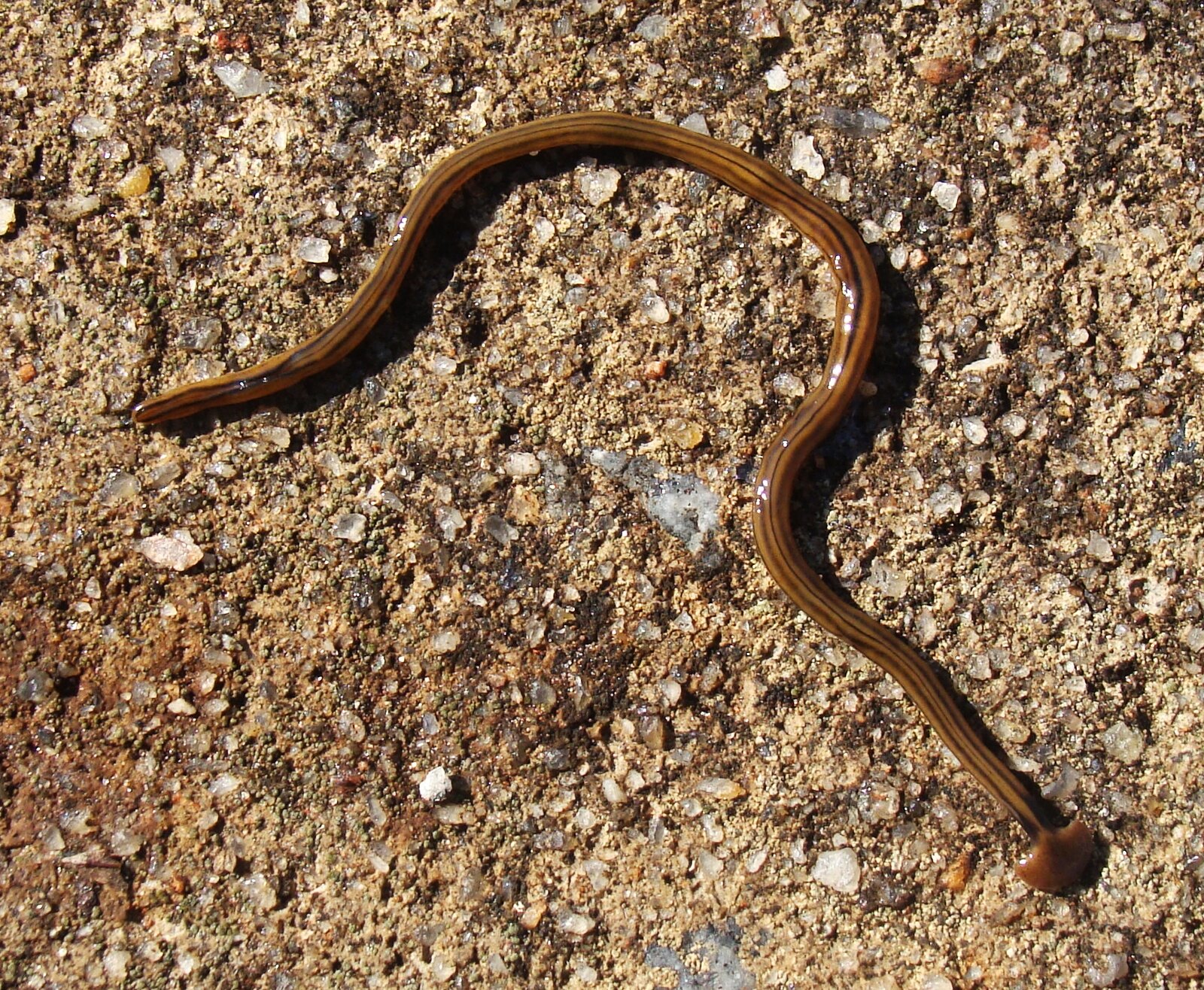
“Sometimes people see them and they have no idea what they are. It’s a flatworm – a long, symmetrical-looking worm. They can either have a tapered head region or, I guess, end region, because it’s not necessarily a head. Or sometimes they’ll have kind of a hammer shape at the end,” she said.

“But I’ve seen them anywhere from like an inch to almost 6 or 7 inches in length. Usually the ones that people panic over are the ones that are very large, because they have no idea what it is and what it’s doing.”

flickr.com/martinlabar (CC BY-NC 2.0)

Photographer Martin LaBar described this land planarian on his driveway as about 6 inches long.

3. It takes a village to get rid of fire ants

At No. 3 on our list – it had to be another top Texas pest – fire ants. We talked to Wizzie about how to actually get rid of them, to everyone’s benefit!

“If you and your neighbors, or everybody on your block, or even better, everybody in your entire neighborhood, all bait for fire ants at the same time, then it’s going to take much longer for those fire ants to come back into that area and really establish themselves,” she said.

2. Ever wonder about the ‘spit’ you see on plants? Blame the spittlebug.

I love the insect segments that make me look closer at my world. What’s that webby stuff on my trees right now? Or what could that be eating my plant? Or who hocked a loogie on that grass over there? It might have been a spittlebug.

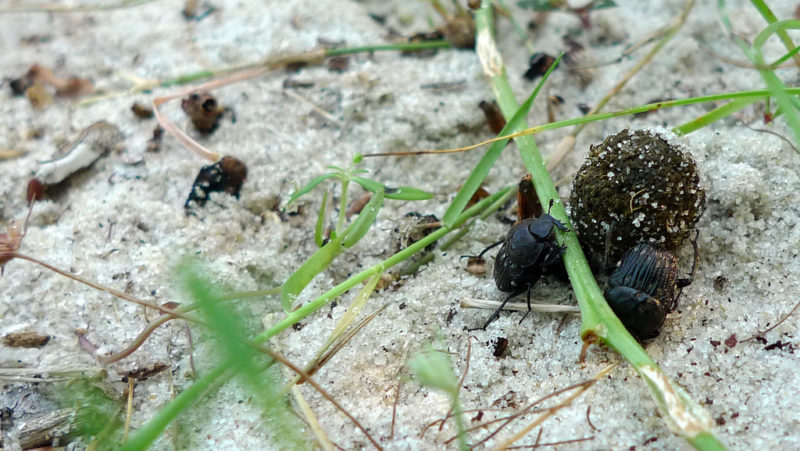
1. For the dung beetle, the perfect home is a pile of poo

And No. 1 could only be one of Wizzie’s favorite insects – the dung beetle! We’ve actually done a couple of great dung beetle segments over the years, but I especially love this part of our 2017 conversation when she reveals just what a big fan of dung beetles she is.

“I was in a museum last year and they actually had a mummified scarab beetle that was adorable. I actually had to take a picture of it, because I was like ‘it’s so cute!’

“Because of course, you know, they have a mummy of a person, and then you have a dung beetle that’s mummified. And who wouldn’t want to take a picture of that?”

Indi Samarajiva/Flickr Creative Commons

One of the best parts of our segments with Wizzie Brown is that she wants to answer YOUR questions about insects. See one you don’t recognize? Or not sure about their behavior or how to get rid of them? Ask!

You can find our full Top 10 list at Texas Standard’s birthday page – along with our other 10th birthday top tens. You can also leave us a happy birthday message, try our coloring sheet, and learn about one of our upcoming special events.

If you found the reporting above valuable, please consider making a donation to support it here. Your gift helps pay for everything you find on texasstandard.org and KUT.org. Thanks for donating today.