Long before TikTok and YouTube made it possible for all of us to share video on the internet, Austinites with something to say could find a home on public access television. Viewers could tune in to shows ranging from music and politics, to relationship advice and cooking in drag – with bananas.
Production values varied, but Austin Community Television showcased a wide array of local characters and gave viewers a window into the city’s eccentricities, along with issues like AIDS and even a march down Congress Avenue by the KKK.
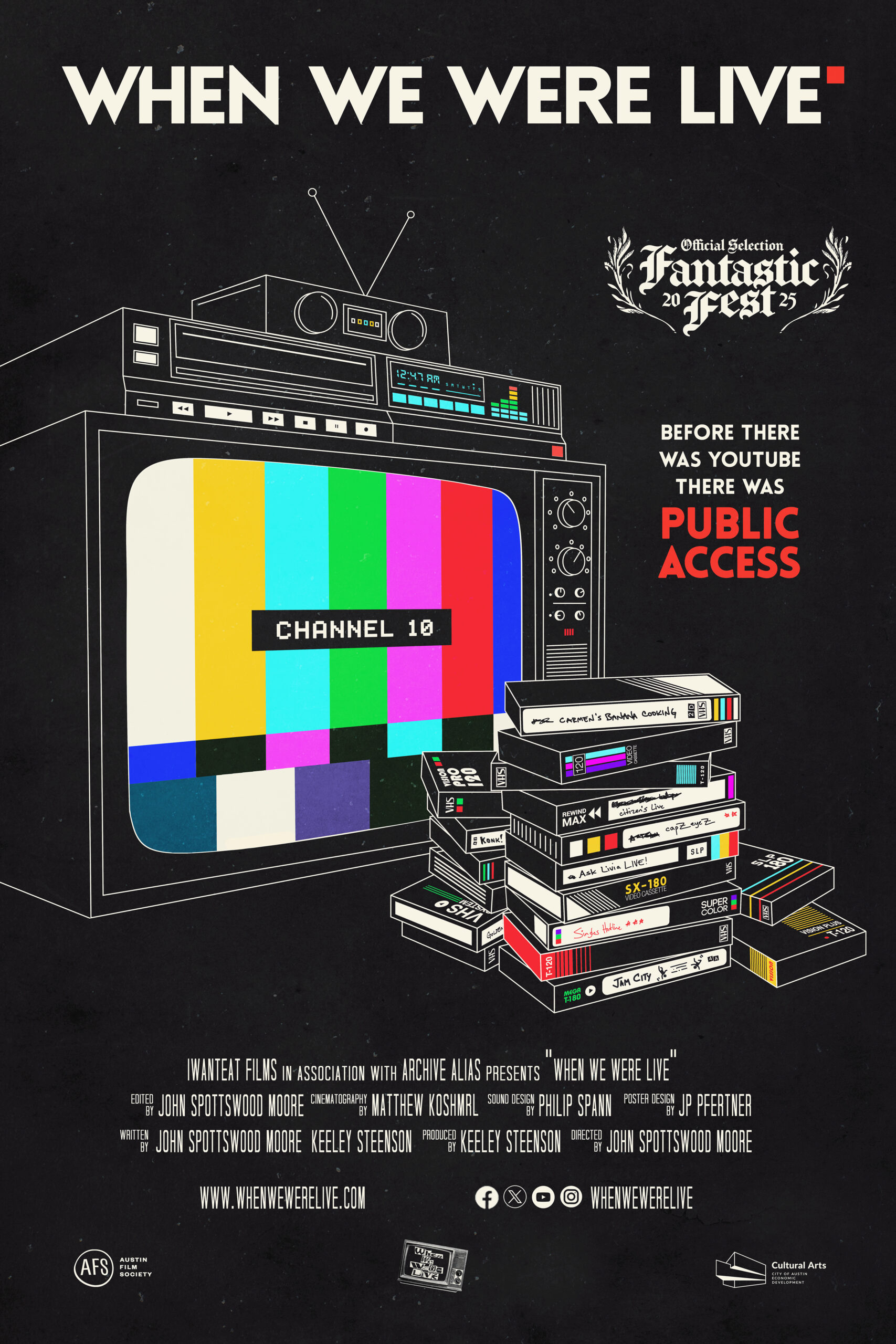
John Spottswood Moore directed the new film, “When We Were Live.” It features rare archival footage and interviews with some of the people who made the ACTV scene so eclectic.
Moore says public access in Austin began with a group of students in 1973. Listen to the interview above or read the transcript below.
This transcript has been edited lightly for clarity:
 Texas Standard: Well, tell us something about the history of public access TV in Austin. It began, I guess, in the 1970s?
John Moore: Actually, I believe the first broadcast would have been around April of 1973. I’m sure that there’s somebody out there who’s ready to correct me on that on the exact day.
But it’s really amazing. It was a group of UT students – actually, which is very ironic, sitting here doing this interview right across the street from where it all began.
And Anita Binda – who was actually subbing for somebody for a semester, who was off on like a Fulbright Scholarship, I believe – and she was teaching a normal RTF class and signal distribution. And some of the students kind of got wind of this very little-known law that had been passed just a few years earlier saying that if you had a major market cable company or cable subscription model in your town, then what Congress basically said was that in exchange for them tearing up your streets and laying down all this cable, they were required to give you airtime to air your own programming. But nobody really took advantage of it that much at the time.
So they kind of said, “well, wait a minute. Maybe we should.” So they got their stuff together. They kind of bargained with the cable company, that was owned by LBJ at the time, called Capital Cable. And they basically were told, “yes, we’ll give you some airtime. But we can’t play your tapes in our facilities. But if you want to go live, you can drive to the top of Mount Larson on a bunch of unpaved roads, and you can sit in the dirt, and you plug your little consumer cameras into one of the broadcast towers up there, and you can go live.”
And so that kind of birthed the beginning of ACTV. Channel 10 is now considered the longest-running access channel in the country.
Your film captures a bit of the vibe of Channel 10. Can you give us a sense of what that was? I mean, obviously you gotta see it to really believe it, but describe it for me.
Well, the thing about our movie was, we knew from the start that this was such a big topic that we didn’t want to do like a soup-to-nuts Ken Burns-style film, because it would literally be like a Ken Burns “Civil War.” It would be like a box set you have to get.
And so what we kind of said was, well, why don’t we kind start in media res around the 1980s when it’s been around for about a decade and we’re just gonna kind of throw you into that world after it’s been kind of established a little bit where it has this insane public access television where anyone – I mean, wealthy, unhoused, doesn’t matter – could walk in, pay a small fee, take a couple of classes, and here you go. We’re giving you state-of-the-art equipment, even though it’s well-used, and you can go out and make a show about basically anything you want.
And also, when you get into the later ’80s, our facilities are open 24 hours. So you can drop in at 2 a.m. and either do a show or dance around while somebody has a band. And it’s just this thing that keeps going. It’s almost like this magical camera being passed from person to person to person to a person. Doesn’t matter what part of town you’re in.
So it didn’t stay in the patch of dirt forever. Obviously there were facilities, there were cameras, things got a little bit more… I want to put quotes around “professional” because it sounds like “amateur” is exactly what it was always still about, right? It was really whoever wanted to be a part of this.
The thing that was so amazing about this, and this is all kind of subtext for the film, because again we kind of throw you into the middle of like this town that is just alive with making television, that is wild and crazy and eclectic and alive…
Some of the backstory is that around the early 1980s, the contract for cable in Austin kind of came up so bidders could get it again. And so it was very competitive to control the cable in Austin. And so one of the things that became Austin CableVision – what they did was they saw that we already had this very healthy kind of public access program. And they said, “well, to sweeten the deal, we’re going to give you basically the best public access facilities in the country.”
So they let them use the CableVision facilities, use this equipment that was just leaps and bounds above what a lot of people in the country had. And because of that, even though yes, it was still amateur, some of the stuff that some of these people were doing would rival network television, if you were to see it. It was amazing, the facilities that they had for the time.
» GET MORE NEWS FROM AROUND THE STATE: Sign up for Texas Standard’s weekly newsletters
Well, let’s talk about some of these characters. Obviously, you couldn’t feature every producer, every type of show on ACTV. You chose some very particular shows. Could you tell us about Livia Live?
Oh my goodness, the second you say “Livia Live,” I promise you there are countless Austinites who just their ears perked up when they heard about that.
So Livia, again, to bring it back to UT, was getting her Ph.D. in geophysics. Of course, no small task, right? And she, in basically one night she was watching TV with her friend. She was a night owl like all these Ph.D. students are. And came across a call-in show with the great Dean Langston, who was kind of the king of call-in shows.
And basically the thing is that a lot of people would do after-hours at ACTV would be sometimes not even really having a plan. They would just go in and put a phone number up and people would just start calling in. And when I say people, I mean like half the town.
My good friend Keith Kretzilis, who had a show called “Conk,” his quote was, you know, “I couldn’t hang up fast enough” it’s kind of what it was. It was just constantly lighting up. And over the course of this, of like watching the show, just fell in love with this concept. So I could go on TV and just give advice or have people call in and people are actually gonna wait and some people won’t even get online.
And so the show was called “Singles Hotline,” where you call in and it’s kind of like an OKCupid for today. You call in, and they would write down, you know, your vital statistics, what do you do, what do you look like, what part of town are you coming from.
And so she decided to call in and she was so entertaining that Dean, the host of the show, invited her to be a live guest. And from that, she just fell in love with it.
And her show ended up being “Ask Livia LIVE!,” which was a show that was all about dating and oftentimes sex advice, people talking about more romantic things. And because it was on late night access, they could swear, they could talk about a lot of issues that even Dr. Ruth couldn’t talk about.
And she would dress the studio to be kind of like a boudoir, and she’d wear kind of an Elvira-esque type outfit. It’s amazing because she would toe the line between like dealing with guys that were calling in as prank callers, but then women that would call in and say, “I just found out I was pregnant.” Or “I’m being harassed by my boss at work.”
And so there was this really interesting dichotomy between being funny and giving out very critical advice.