‘Great treasures for all of us’: After a career preserving Latino stories, Voces director to retire

Dr. Maggie Rivas-Rodriguez’s path saw her take part in carving spaces for Latinos in the journalism world to founding a nationally-recognized oral history center. Now she’s set to pass the torch.

By Raul AlonzoDecember 10, 2025 10:00 am, , ,

Longtime listeners of Texas Standard may be familiar with the stories from the Voces Oral History Center based at the University of Texas.

Since its founding in 1999, the center has gathered over 1,800 oral history interviews and over 2,500 photographs – finding and filling in the gaps when it comes to sharing the story of the Latino experience in the U.S. and preserving the record for future generations.

And all these years, Voces has been led by its founder, Dr. Maggie Rivas-Rodriguez. But that’s about to change.

Next year, Rivas-Rodriguez will be stepping down from Voces ahead of her retirement, which means what for the future of this important program and the trailblazing professor and journalist who launched it?

Rivas-Rodriguez joined Texas Standard for a wide-ranging look back on Voces, her career and the what’s in store for the future. Listen to the interview above or read the transcript below.

This transcript has been edited lightly for clarity:

Texas Standard: Congratulations on this huge change. I think a lot of people who’ve been following the rise of Voces and, of course, listening to the stories that we’ve had the opportunity to share on the Texas Standard wonder what now for Voces? What what what what are you what’s gonna be happening?

Maggie Rivas-Rodriguez: The great news is that we have somebody who’s gonna be stepping in to be the next director. He’s someone who’s a historian by training. And he’s from Las Cruces, New Mexico, which is a stone’s throw away from El Paso, of course. So he’s almost a Texan but not quite.

His name is C.J. Alvarez and when I first proposed the idea to him, he was over the moon. He was so excited about doing it.

Now C.J. has been steeped in Voces methodology for many years. He came to our summer institute we do every year for academics here in Austin. And he’d done some interviews with us in Hebbronville a couple of summers ago. So he was very familiar with what to do and he loved what we we do.

And so when I brought it up to him, he was super excited and immediately said yes, where can he sign up?
Lorianne Willett / Texas Standard

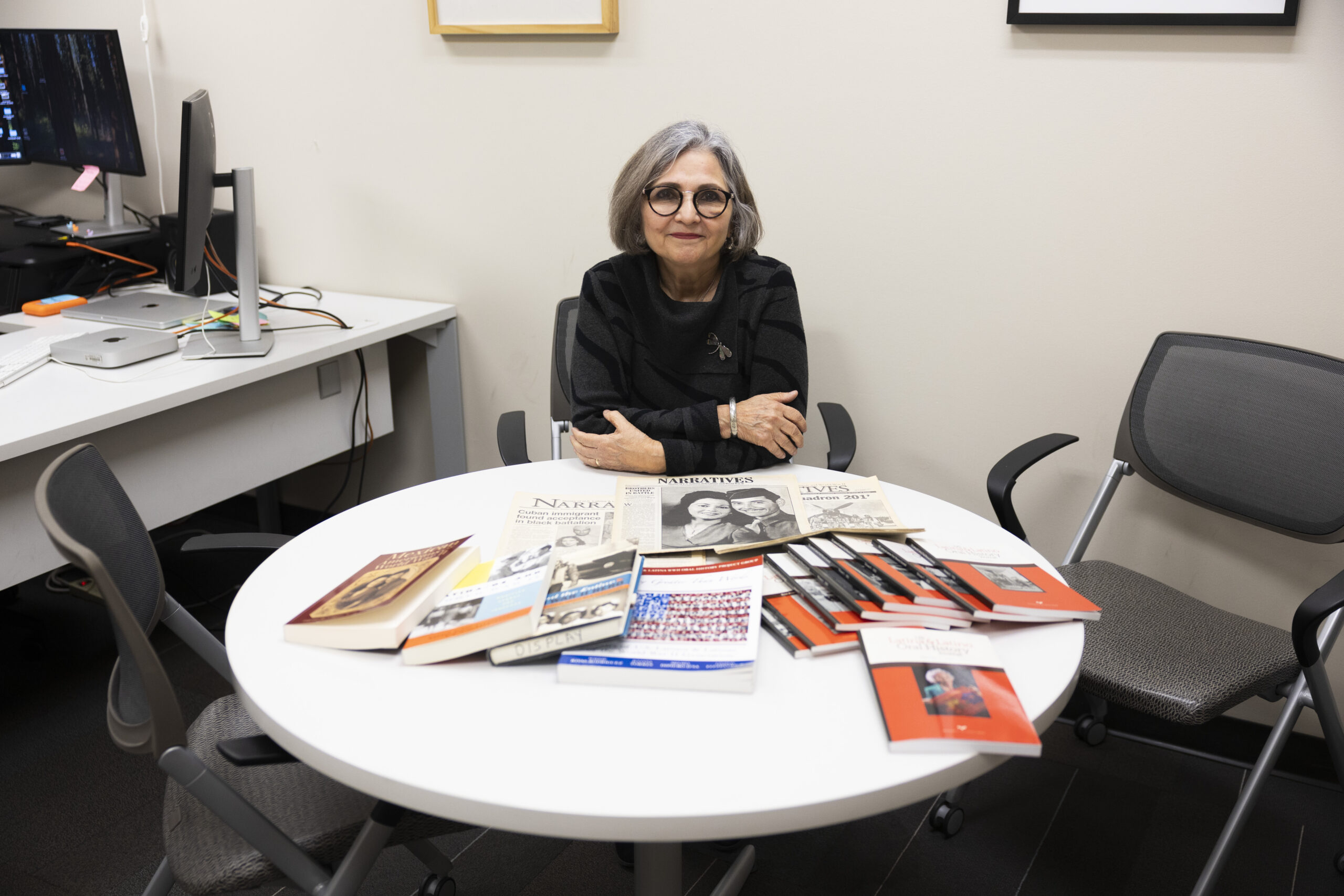
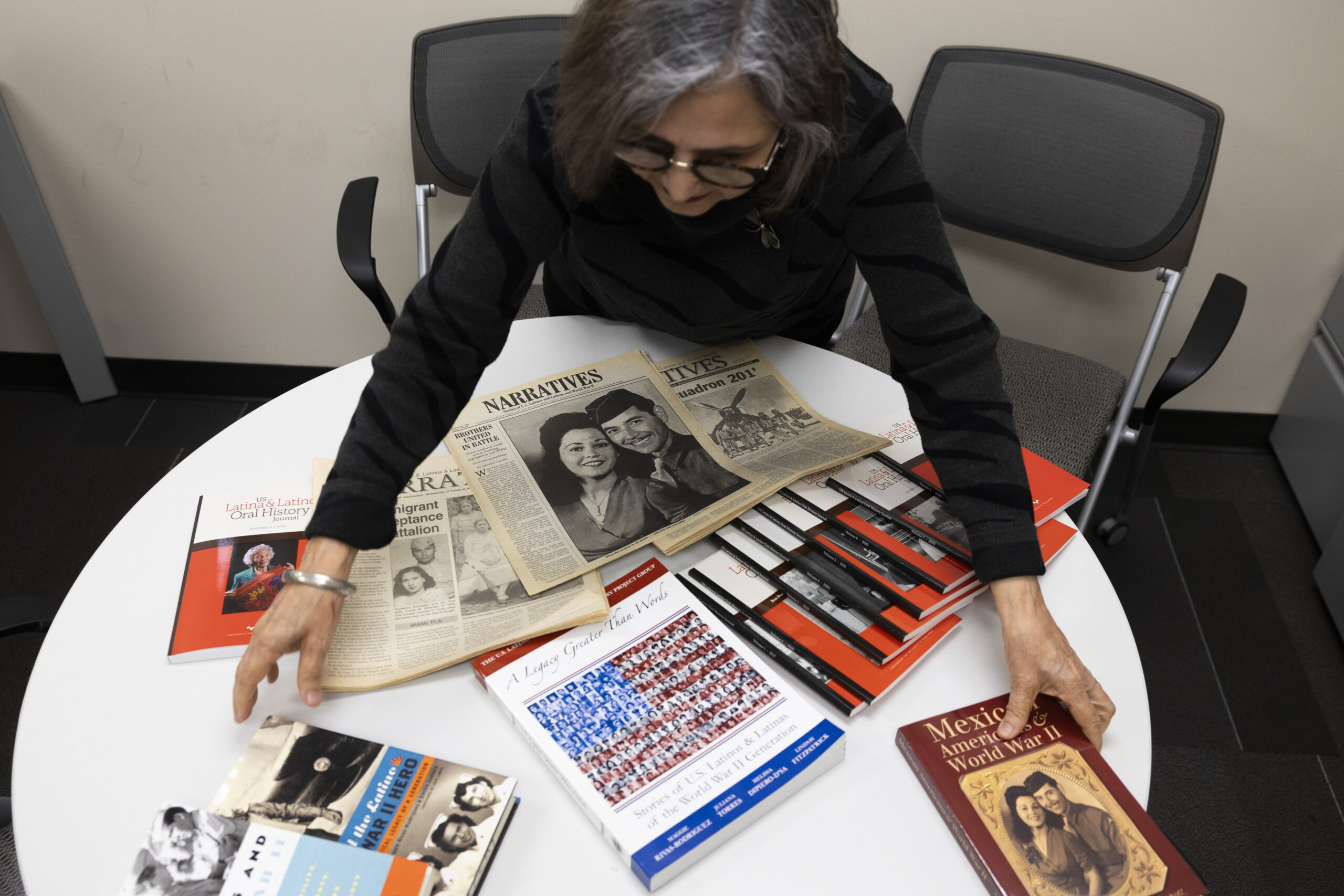
Dr. Maggie Rivas-Rodriguez, director of the Voces Oral History Center, organizes various literature detailing some of the work the center has done over the decades.

Professor, take us back a little bit. We mentioned that you started this program, what was it now? More than 25 years ago I guess. What did you propose initially? What did you see was missing that this program could provide?

I had been a newspaper reporter before I became a professor. So I had done a magazine piece in 1992 for the Dallas Morning News Sunday magazine. And it was about Mexican Americans of the World War II generation and their contributions to civil rights.

And when I was doing the interviews, I was realizing every single one of these people that I interviewed could be the subject of a book. They had so much.

And so I knew about oral history. I had read a bunch of Studs Terkel, wwho’s one of my favorite oral historians. And I thought, well, we should do an oral history of the World War II generation of Latinos – not just Mexican Americans, but more broadly Puerto Ricans, Cuban Americans, because they have similar, but very unique, experiences as well.

So it started in 1992 really, the idea. And then in 1993 I proposed it to a couple of professors and they were both enthusiastic about it. But it didn’t get off the ground for lots of different reasons.

Dr. Rivas-Rodriguez’s early inspiration for Voces came from her projects chronicling Latinos of the World War II generation. Lorianne Willett / Texas Standard

And then in 1998, I came here to teach at UT Austin and I was asked to teach a class. It could be about any subject I wanted, but it had to produce a newspaper. So I knew how to do production for newspapers and I said, “can it be about the World War II generation of Mexican Americans?” And they said, “whatever you want.” So that was it.

And so that’s why we originally started off with having a newspaper. And this is important because at the very, very beginning when we were doing our interviews, we were also taking pictures and we were scanning their archival photographs. And so we talked the Austin American-Statesman into producing the first one and then the San Antonio Express-News to doing the second one and then they alternated for a few years.

And so that was really the beginning of it. My students were all doing interviews. We started off wanting to do just audio and a friend of mine named Hector Galán, who’s a documentary film producer, said, “don’t do audio, do video,” because if we do a documentary, it can be my like my field research.

So we started off doing video because of Hector and I fell in love with video and it was so important that we start off at a time when oral history really was not doing a lot of video work. We started off doing video and I’m so glad we did because we still have those video interviews with people, including my parents who were both of this generation that are great treasures for all of us.

» GET MORE NEWS FROM AROUND THE STATE: Sign up for Texas Standard’s weekly newsletters

It’s interesting that you come from the world of journalism initially, and I think that you have an appreciation for something that perhaps some of our listeners might not completely, and that is when you do these interviews, there’s so much that winds up on the cutting-room floor once it’s condensed into a story that’s fit for print, as they say.

And there are gems, jewels, there’s nuance and texture that if it were just left to an article or an occasional piece or what have you, it wouldn’t do the full story justice.

So a big part of what Voces, seems to me, contributes is having a much more full and rich story that’s preserved. It’s the preservation aspect of it and having the complete story as well, it seems to me.

That’s such a great point, because it is one of my frustrations. Probably in your career you’ve done the same thing where you’ve interviewed somebody and what ends up on the air is just a small piece of what they said.

Yeah. It’s so frustrating.

It is frustrating. But it is true that the real gold is that full interview. And one of my frustrations is that when people look at our website, vocescenter.org, if they look at our website, they see the stories that have come out of those interviews… Some people think that that is the oral history project. And it’s not. It is a journalistic interpretation of the interview.

So to see the entire interview, you either have to go to the repository, which is the Nettie Lee Benson Latin American Collection on campus, or we are trying to put as many interviews as we can on YouTube.

So when you go to YouTube, you can look up a collection like “World War II Collection” and you can see some interviews of people that we interviewed 25, 26 years ago at the very beginning. And most of these people are no longer with us. But that is the beauty of having that, that those interviews can be interpreted and understood in different ways by different people depending on your perspective.

I wanna dig a little bit deeper into your early years as a reporter, which obviously shaped a lot of your appreciation for this narrative approach that Voces has developed.

I understand that well before Voces was initially conceived, you saw a need for more Latino representation in the industry at large. You were, I gather, among the committee that founded the National Association of Hispanic Journalists. Do I have that right?

That is correct.

Tell us a little bit about what you were hoping to accomplish there.

Well, you know, I was a student here at U T and I graduated from UT in 1976. And even in the seventies we were looking at the newspapers and the Daily Texas and a lot of us did work at the Daily Texan, but the number of stories that we found in the Daily Texan or in the Austin newspaper, San Antonio newspapers, was really… There were very few that were about the Latino experience.

So what we didn’t know was we didn’t realize that the Kerner Commission report had come out and they had looked at the same issues of the news media was largely told through the perspective of people that were not part of these, quote-unquote, “minority communities.” So our stories kept on getting lost. And so we were very aware of that. We, as students, were very aware of that.

And we did a conference here in 1975 that brought in people from all over the country to look at some of the issues facing Latinos in the news media and what it meant to be part of the news media and try to get those stories told in the news media. So it really goes back to my college days.

Well, flash forward, I ended up going to the Boston Globe and I was working at the Boston Globe from 1979 to 1982. And at the Boston Globe I was the first Hispanic they ever hired. I had a lot of Black friends there and we would meet and we would talk about how can we get more perspective into the newspaper, how can we champion our stories.

So we tried to do as much as we could, but the entire thing was because we didn’t have a lot of editors who could say, “well, that’s a great story idea” and we didn’t have enough reporters saying “that story needs to be told and it needs to be placed in a prominent part of the newspaper, not buried.”

Lorianne Willett / Texas Standard

Rivas-Rodriguez flips through newspapers at the Voces Oral History Center. She started her career as a journalist, working for such outlets as the Boston Globe – eventually joining the committee that founded the National Association of Hispanic Journalists.

So when I was at the Boston Globe, I got an invitation to be part of committee to plan a conference of Hispanic journalists. And that took place in 1982 in San Diego. So we planned this thing for – I don’t remember if it was a year or whatever – but I was part of that committee. And I made sure, at that point, to reach out to as many Hispanic journalists in the New England region as I possibly could.

And so that was kind of the beginning of my involvement in what ended up being the National Association of Hispanic Journalists. But in San Diego, at that conference in 1982, there were something like 700 people at this conference. I had never seen so many Hispanic journalists in one place.

And we had some of the same problems that sometimes we’d have what we thought was a really important story idea and it would get shot down. Or we had a really important story and it got buried. And just by being able to talk about these issues and try to come up with solutions, that was so important to all of us.

And so from that came, well, why don’t we have a National Association of Hispanic Journalists? There was a National Association of Black Journalists and they had been very successful.

So I was on the committee that started to meet all over the country trying to get people excited about the idea of a National Association of Hispanic Journalists. I still have a letter that I received from a reporter in San Antonio. His name was Frank Trejo. I have another friend named Frank Trejo who’s from El Paso, but this this was a reporter in San Antonio who wrote me a letter and he said, “I received your letter about this conference happening and over the years there’s been five attempts to create National Associations of Hispanic Journalists and they’ve all failed. Good luck to you.”

Not the most encouraging sort of letter to receive at that time. 

No, it’s not. It’s not. But you know, that was his experience and he couldn’t hope for something that  would be important. And so it really is.

NAHJ became a very important part of my life. I worked very hard, you know, as always. I’ve been volunteering in different ways for a very long time. But through NAHJ, that is kind of important because we were doing a conference in 1988 in Dallas and the big national NAHJ conference, and we said, Well we want to do something different here that they haven’t done before.

So I don’t remember whose idea it was. It may have been mine, but I really don’t recall. We should have a newspaper. Now, I’m a reporter. By this time I’m working at the Dallas Morning News as a business reporter. And I don’t know how to produce a newspaper. And this is 1982. This is when desktop publishing was just getting off the ground.

So anyway, we ended up having a daily newspaper that was put together out of an abandoned restaurant at the Hyatt Hotel in in downtown Dallas. And we had college kids come in and then we had professional reporters and editors, NAHJ members, working as their editors and coaching them.

And it was a huge hit. People were just so thrilled that we had accomplished two things. We had trained the next generation of journalists and at the highest standards that we were capable of. But also we had let people at the conference know what was going on at this conference.

So it really accomplished those two goals and that’s why I knew anything about newspaper publishing, because I used to do this a lot for NAHJ.

Books sit on a table at the Voces Oral History Center, based at the University of Texas at Austin. Lorianne Willett / Texas Standard

You know, I’m realizing that this is taking on the dimensions of a Voces interview in a sense, because you’re sharing this and, you know, one thought stimulates another, stimulates another.

As you were speaking, I was thinking, gosh, do you have any idea how many interviews make up the Voces archives now?

Yeah, we have a really, as we say, robust database that some people hate, but I absolutely adore.

This database… It is somewhere just north of 1,800. But we put this database together and it gives us information about who did the interview, where they did the interview, what format. Was it a hi8? Was it a digital interview? Was it just audio? We do have some that were just audio that were donated to us.

So we have a really, really huge database that gives us that information.

Well now here’s the question that all journalists hate to get and that is, do you have a favorite or one that sticks out out of all those interviews that you’ve done?

You’re right, we all hate that question, but we all ask it anyway, don’t we?

But I’ll tell you, one of the ones that does stick out to me is, when we first started, I used to go around just doing informational meetings with people. So I was in El Paso and I was doing an informational meeting at the El Paso Times and afterwards this older man comes up and I’m talking to other people and he was like standing in the background waiting to talk to me, I could tell.

And so finally he comes up and he’s so intent on talking to me. It’s all in Spanish and he tells me, “I want to be interviewed.” And I didn’t have any equipment with me. I really was there on vacation just to do this – just as a side I did this informational thing.

His name was Nicanor Aguilar. I said, “Mr. Aguilar, I’m gonna come back at Christmas with my family to celebrate Christmas. I will bring equipment and we’ll interview you then.” So I came in and my brother, who lived in El Paso, we did the interview – he handled the camera and I did the interview.

And Mr. Aguilar told the most remarkable story about growing up in West Texas in a very racist, little town in West Texas where Mexican American children were not allowed to go to high school. They could go as far as the eighth grade and after that there was nothing for them.

But he had a younger sister named Maria, who was super, super smart, and the whole family went and advocated – and her teachers advocated – so that this girl could go to high school. And that’s what it took.

So years later, he goes back to this little town and he goes to the bank, and there’s a Mexican American bank clerk, and he says, “How did you get your job?” And he says, “Well, I graduated from high school and then I went to college over here,” and he says, “No, that’s not how you got your job.” He says, “How you got your job is that a lot of people like me advocated and championed and protested so people like you could enjoy those opportunities that you enjoy.”

And he was right. And I say this all the time. I talk about the World War II generation. Had it not been for the sacrifices and the efforts of that generation, of men and women, people like me would never be able to dream of the opportunities we’ve been able to enjoy. It’s just the truth.

So Mr. Aguilar ended up sending me afterwards, he sent me a money order for $20. And he attaches a letter, and in this letter he says in Spanish, “I’m not a man of money. I pick up cans to pay my rent. But what you’re doing is really important.” So for this man – didn’t have a bank account, had to send a money order – to cash in so many cans so that he could send me a money order for $20, it meant the world to me.

And I think it says something about the people that get interviewed by Voces are people that really understand what we’re trying to do. And they understand that this is important, not just for the individuals being interviewed, but for the larger Latino people – and not only just for the larger Latino people, but really for the country to be able to understand and reflect more about what makes our country our country, what makes our state our state, what makes our communities who we are.

And he understood it. He understood it beautifully.

Lorianne Willett / Texas Standard

"Over and over again we get letters from people who will tell us the news that someone has passed on and they say he was so proud that he was part of this project," Rivas-Rodriguez said. "And we've had people tell us 'you made us feel important.'

I see why that would stand out to you. You know, it makes me think that quite often we focus on the product, the outcome, whatever it is that we get from, say, a sit-down interview with someone or with a subject that we may be interviewing – whether you’re a journalist or a documentarian or what have you.

But what really struck me in your recounting of that story was how important it was to him to have someone to share that story with. For all that it meant in terms of documenting his experience, what it meant to him as a human being was deeply profound and something we perhaps may overlook from time to time.

David, you’re gonna make me cry. Because over and over again we get letters from people who will tell us the news that someone has passed on and they say he was so proud that he was part of this project. And we’ve had people tell us “you made us feel important.”

Like why would it take an interview, a sit-down interview on video to make you feel important? But it is true that until that experience gets acknowledged and affirmed in some way, people just don’t know.

Well, you’ll be stepping down and retiring from the academy this coming year. I understand that’s not necessarily the end of the road when it comes to your involvement in this project, thankfully.

What is next for you? Have you given it a whole lot of thought?

I’ll always be involved with Voces in some way.

I love doing the radio stories. I work with two interns. It takes us months and months to put put together the Hispanic Heritage stories. I love putting together the stories for Memorial Day and Veterans Day. And I love doing the Summer Institute, so I’ll always do those as long as I’m able.

But other than that, I’m just trying to finish everything on my plate right now. I’ve got so many unfinished projects and I don’t want to leave anybody to have to clean up after me or to finish what I started.

If you found the reporting above valuable, please consider making a donation to support it here. Your gift helps pay for everything you find on texasstandard.org and KUT.org. Thanks for donating today.